

AI Brand Visibility: Who’s Telling Your Brand’s Story?
AI brand visibility is how often, how accurately, and in what context your brand appears in answers from AI-powered search…
-
binomedia
- September 11, 2026


Before dawn on Friday, 24 July 2026, a mob in Bali beat a man to death. He is identified only by the initials KD, from Buleleng regency, and the attack took place in Banjar Dinas Juwuk Legi, a hamlet in Batunya village, Baturiti district, Tabanan regency. Police say he’d been caught stealing a fighting chicken that belonged to a local resident. A video soon spread on social media showing KD’s youngest child crying as his body was brought home.
What makes this case worth a closer look isn’t the tragedy alone. A clear mainstream media vs social media narrative gap opened up around it, and the story itself kept shifting for days after the killing. The case has since become part of a wider pattern, too: international outlets, including The Jakarta Post, linked it to a string of recent vigilante killings in Indonesia and renewed calls for stronger law enforcement.
This article compares two sets of monitoring data for 24-29 July 2026. Newstensity covers mainstream news coverage. Socindex covers social media conversation. The goal is simple: understand why two public spaces told the same story so differently. For anyone who tracks public opinion or manages communications, this is a concrete lesson. Relying on one kind of monitoring data alone can leave you with a skewed picture of how people see an issue.
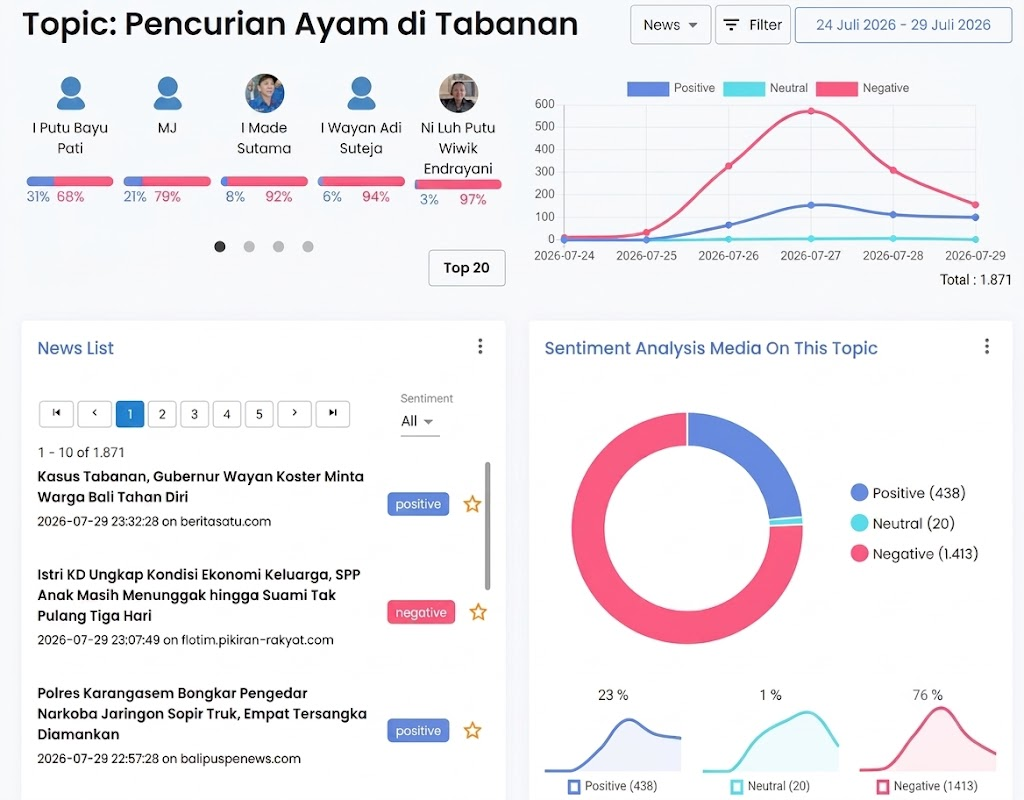
By volume, social media talk dwarfed mainstream news coverage. Newstensity recorded 1,871 articles between 24 and 29 July, with sentiment running 77% negative, 22% positive, and 1% neutral.
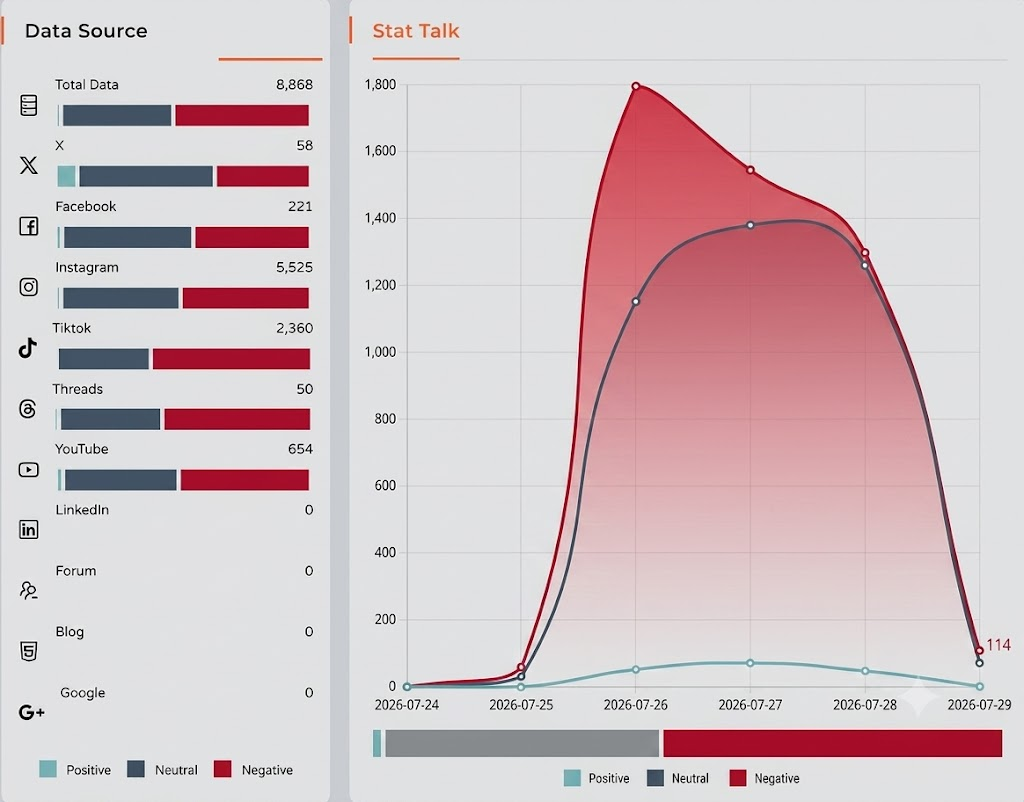
Socindex captured a louder, messier picture. Across all monitored channels for the same period, total conversation reached 8,868 data points. Instagram led with 5,525. TikTok followed with 2,360.
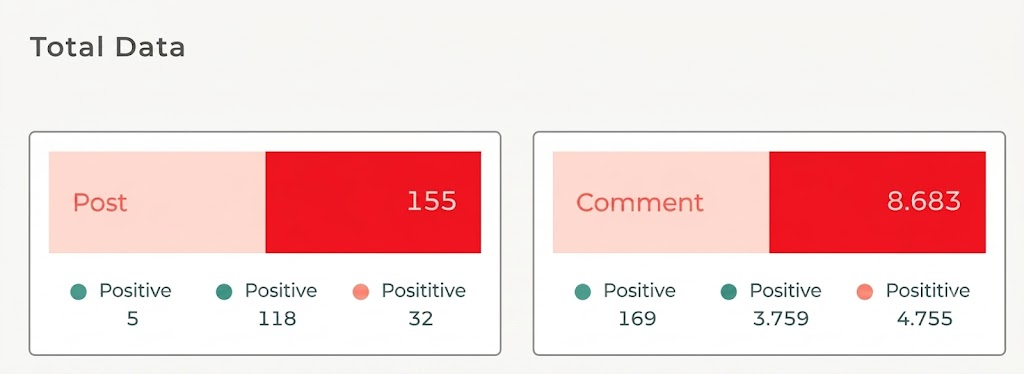
Of 155 posts tracked, most were neutral: 118 of them. The pattern flips hard at the comment level, where 4,755 of 8,683 comments carried negative sentiment. That single number already beats the entire volume of mainstream articles for the period.
The pattern is a familiar one: social media is where people do most of their talking, while mainstream news stays closer to plain fact reporting. But a large volume doesn’t mean one point of view. Underneath it sat at least three competing narratives, easier to see once we lay out how the story shifted, day by day.
In the first two days after the killing, both mainstream news and social media leaned on human terms. News coverage reported that KD’s wife said he stole out of urgent need: the family owed IDR 2.7 million in school fees for their two children. That framing put economic pressure at the center, without excusing what KD did.
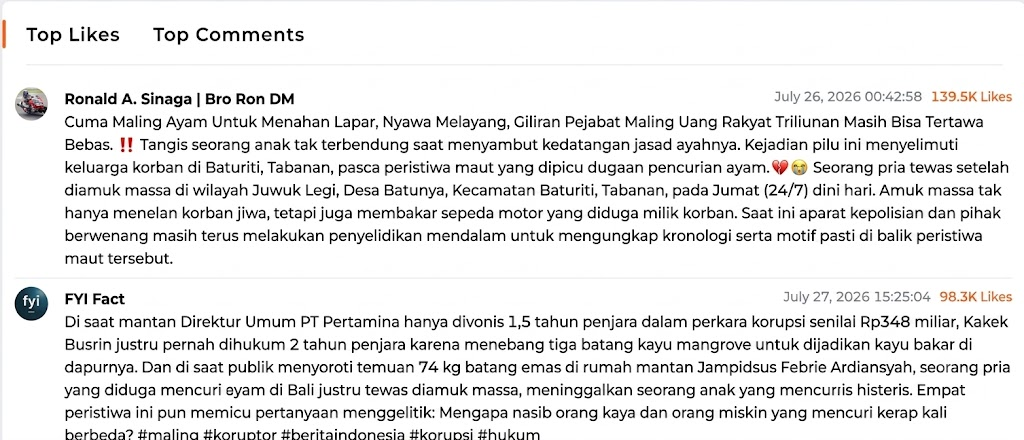
On social media, that sympathy grew into something sharper: structural criticism. One post with more than 139,000 likes compared KD’s fate to corrupt officials who face huge charges yet stay free. Another viral post, with nearly 100,000 likes, went further. It contrasted a light sentence for a former state-owned enterprise director in a mangrove-deforestation case with what happened to KD. Posts like these turned his death into a symbol of class inequality in Indonesian law enforcement, not just a local crime story.
This tracks with a familiar social media pattern. Once a local event reads as proof of a bigger problem, users tend to pull it into wider, more emotional comparisons. Mainstream news worked from a different logic. Coverage stayed close to facts that reporters could verify directly with family and police. That’s part of why it rarely made the same symbolic leap in the early days.
The turning point came on 26 July. Tabanan Police Chief AKBP I Putu Bayu Pati held a press conference. He announced that KD was in fact a recidivist, tied to a 2018 clove-theft case. The motorcycle KD had been riding, later burned by the mob, turned out to be stolen property too, taken from Kabupaten Bangli in 2019. Police also confirmed KD carried a sharp weapon, a slingshot, and small stones at the time, details later backed up by national media outlets citing official Tabanan Police statements from the same period.
Opinion on social media split in several directions once police confirmed KD’s past record. Some questioned how quickly they’d offered sympathy at first, while others insisted a criminal record still doesn’t justify a killing by mob. A third group pushed back hard against dragging KD’s children into the larger argument at all.
Mainstream news, for its part, kept its focus on the legal process. Coverage stressed that the case against the five mob-attack suspects was moving forward, regardless of the victim’s record. Kukuh Dwi Kurniawan, a criminal law lecturer at Universitas Muhammadiyah Malang who is widely quoted across Indonesian media, weighed in too. He said vigilante violence still counts as serious assault under Article 351 Paragraph 3 of Indonesia’s Criminal Code, no matter the victim’s history. He added that even bystanders who watched without stepping in could face legal exposure.
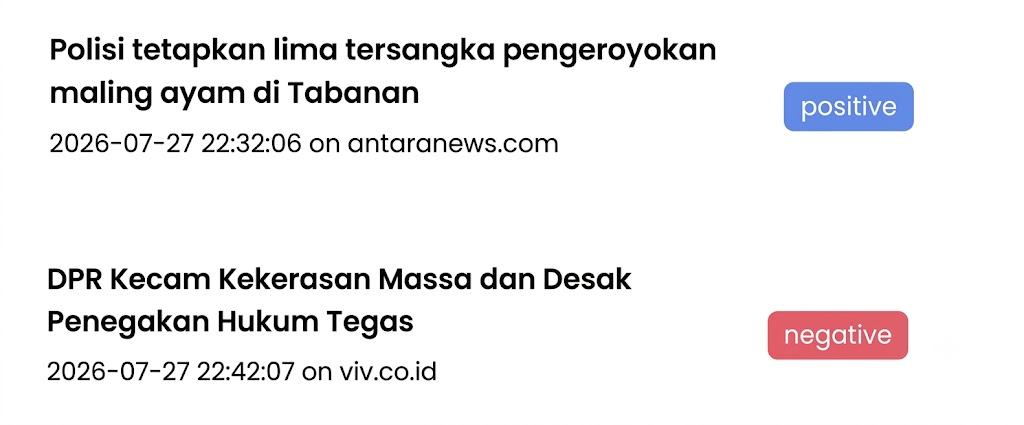
The contrast points to something important. The same new fact split opinion apart in one public space. In the other, it simply reinforced a framing that had already taken hold. Social media treated the new fact as fuel for debate. Mainstream news treated it as confirmation that the legal process was on track.
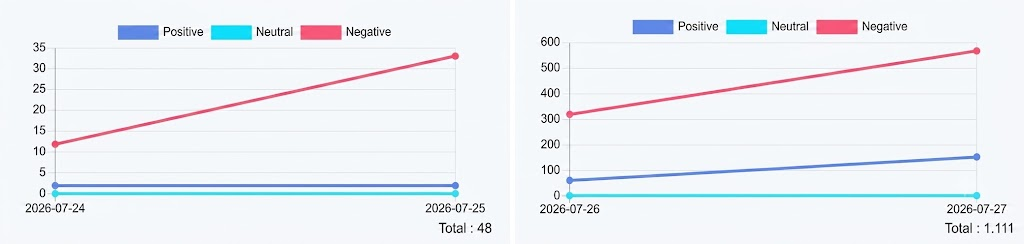
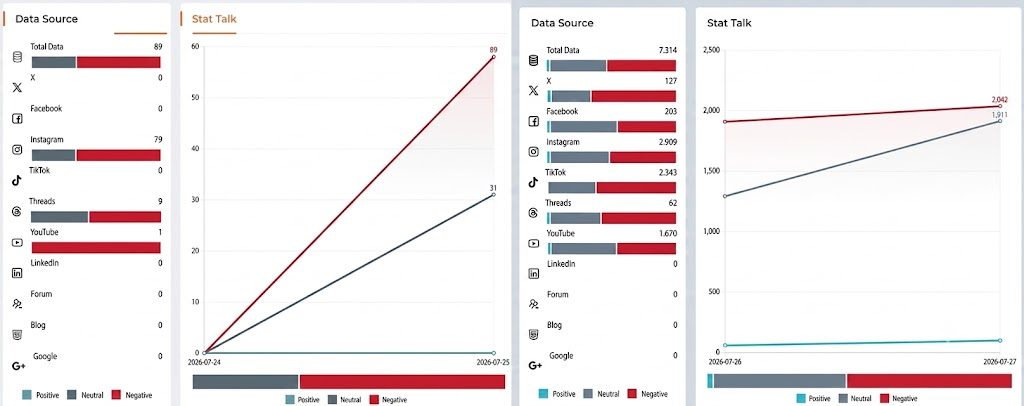
Comment-level monitoring in Socindex shows at least three narrative threads running in parallel. This was never one unified voice. All three surfaced almost as soon as KD’s past record came out, and they collided directly in the same comment sections.
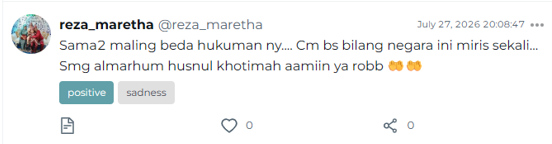
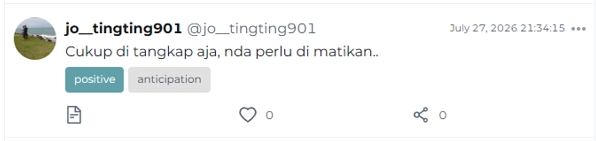
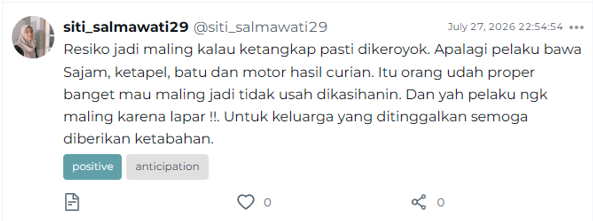
These three narratives barely show up in mainstream coverage in the same proportion. Mainstream news stayed cautious throughout the monitoring period. It held to a procedural, legal framing from start to finish, and it tends to tell one coherent story. Social media ran three stories side by side instead, sometimes colliding in the same comment thread.
A single sentiment number doesn’t explain what’s really happening in people’s heads. The 4,755 negative comments out of 8,683 can trace back to three entirely different reasons. Each one needs a different response. Calming anger about class inequality takes a different approach than pushing back on a narrative that normalizes violence.
The framing gap between mainstream news and social media here isn’t just a difference in tone. Three things about it matter for anyone who manages public communication or opinion research.
Rumors about KD’s past surfaced on social media a full day before police confirmed it officially. That’s a reminder: social media can act as an early-warning channel for facts that aren’t verified yet. Treat that channel with care.
In this case, the rumor turned out to be true, but no one could confirm it until police made it official. The risk cuts both ways: in another case, that same kind of early signal could turn out wrong, and spreading unverified information can make a tense situation worse, not better. For comms and newsroom teams, the takeaway is simple: let social media monitoring trigger fast verification against official sources, rather than standing alone as the basis for a public statement.
The strong sympathy of the early phase wasn’t permanent. Once police confirmed it, part of the public’s support for KD eroded. Even so, the class-inequality critique held on as its own issue, separate from KD’s personal record.
That shift matters. A strategy built on day-one sentiment can be badly wrong by day three or four, especially in a story still unfolding. A team that stops watching once the first wave of sympathy fades risks missing the exact moment opinion moves fastest.
Mainstream news gives a more verifiable picture of the facts and the legal process. Social media shows how the public reads those facts and ties them to bigger issues, like class inequality here. Lean on just one source and you risk an incomplete picture of how people understand an issue.
Combining both, rather than picking one, is what gives the full map. Newstensity brings factual certainty: what happened, who said what, how the legal process is moving. Socindex shows how the public makes sense of it, competing narratives and all. The two layers complement each other. Neither replaces the other.
This chicken-theft killing in Tabanan shows how one local event can grow into a symbol of a much larger issue. It also shows how the narrative around it keeps moving as new facts land. The case sits inside a troubling wider pattern, too: Indonesian media reported at least one more suspected-thief killing within 24 hours of this one.
Mainstream news and social media, in this case, weren’t interchangeable. They were two complementary layers. One secured the facts. The other showed how the public actually made sense of them. For any organization that wants the full picture, combining Newstensity and Socindex is built for exactly that.

AI brand visibility is how often, how accurately, and in what context your brand appears in answers from AI-powered search…

binomedia

The DTSEN social assistance decile controversy in 2026 is not merely about inaccurate data. Media monitoring and digital conversation analysis…
binomedia

Indonesia’s gross domestic product (GDP) grew by 5.29 percent in the second quarter of 2026. This figure exceeded the median…
binomedia

Artificial intelligence (AI) is transforming education faster than most education systems can respond. Machines can now search for information, summarize…
binomedia

One Event, Two Market Moves On Monday, August 10, 2026, Indonesia’s rupiah closed 0.79% higher at IDR 17,755 per US…
binomedia

On Thursday, July 30, 2026, Indonesian President Prabowo Subianto announced a “cleanest city” competition. The top five cities would win…
binomedia

Gen Z is increasingly tuning out advertisements that look overly polished and perfect. Instead, they tend to trust recommendations from…
binomedia

On June 10, 2026, Indomie brought back its Goreng Cabe Ijo flavor after the product had been difficult to find…
binomedia

Companies today use AI to read customer data, monitor public conversations, measure reputation, map issues, and support strategic decision-making. In…
binomedia

Amid economic uncertainty, one phenomenon has been widely discussed on social media and has attracted the attention of many financial…
binomedia