

Downgrade Lifestyle: Indonesia’s Real Economic Signal
What Is “Downgrade Lifestyle” and Why Is It Trending on Threads? Since early September 2026, the term “downgrade lifestyle” has…
-
binomedia
- October 9, 2026


On Wednesday, October 28, 2026, students and civil society groups held the #IndonesiaSadar protest at Bundaran HI, the Hotel Indonesia roundabout in central Jakarta. The organizers were the University of Indonesia student executive board (BEM UI) and a coalition called Komite Selamatkan Daulat Rakyat (SADAR). The protest fell on Youth Pledge Day, which marks the day in 1928 when young Indonesians pledged to be one nation. To track the October 28 protest media coverage, Newstensity recorded 1,623 news articles between October 27 and 29, 2026. Of these, 68 percent were positive in tone, 30 percent negative, and 2 percent neutral.
Framing is how the media chooses which words, angles, and parts of an event to put in front of readers. An aggregate sentiment score only shows the big picture, and at first glance, 68 percent positive looks reassuring. The more revealing pattern appears when you sort the coverage by publication time. Before dawn, outlets wrote tertib (orderly) as a hope, and by evening they wrote ricuh (chaos) as a report. In between, the protest’s main demand got buried in protest-day coverage.
Of the 1,623 stories, Newstensity marked 1,105 as positive, 484 as negative, and 34 as neutral. The daily chart peaks on October 28, with nearly 850 positive stories and about 400 negative ones. A day earlier, there were only about 250 positive stories and fewer than 100 negative ones.
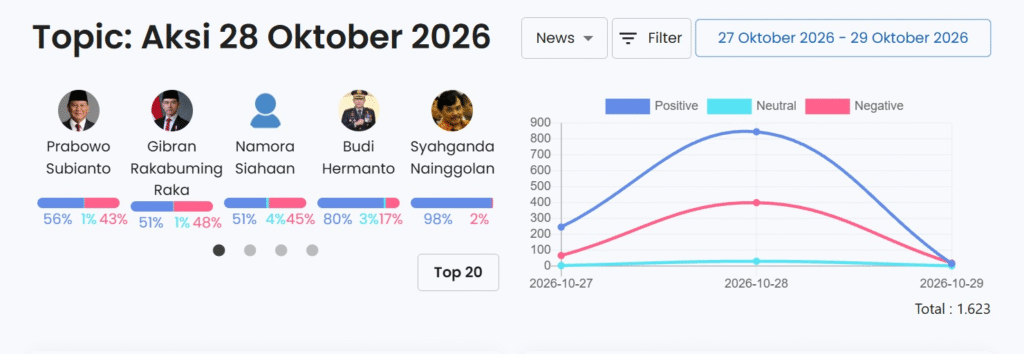
Two often-named figures drew split coverage. Stories that named President Prabowo Subianto were 56 percent positive and 43 percent negative. Stories on Vice President Gibran Rakabuming Raka split almost evenly: 51 percent positive, 48 percent negative.
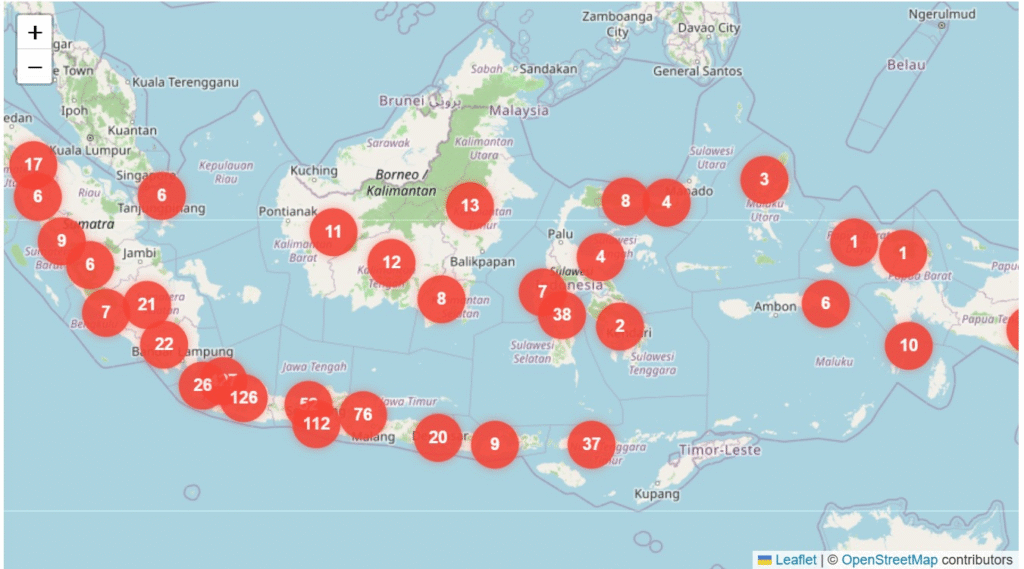
The coverage spread from Java to Sumatra, Kalimantan, Sulawesi, Nusa Tenggara, and Papua. The heaviest concentration came from Jakarta and the rest of Java.
Newstensity gives every story a sentiment label. A positive label does not mean an outlet backed the protest or its demands. It reflects the tone of the headline and body, such as calls for calm, promises of security, or reports of a smooth protest. Negative labels tend to go with stories about clashes, damage, and arrests. So sentiment figures work best as a map of tone, not of a newsroom’s politics.
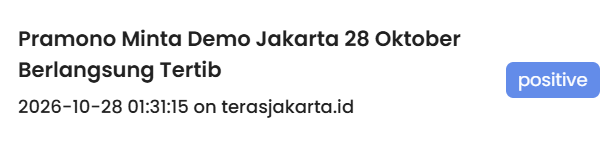
The shift in tone is easiest to see when articles are sorted by time of posting. Before the protest began, the word tertib came from officials and groups. At 01:31 WIB, terasjakarta.id posted a story on Jakarta’s governor under the headline “Pramono Asks for Orderly Protest on October 28.” Jakarta Governor Pramono Anung said he hoped the rally would stay orderly, cause no damage to public property, and not turn into anarchy.

Labor unions joined in. At 05:02 WIB, jpnn.com published an appeal from the labor confederation KSPI urging students and workers joining the protest to keep things peaceful. Another confederation, KSPSI, also said it hoped the protest would stay orderly, and “kspsi” appears several times in this topic’s word cloud. At this stage, the sources quoted talked about what they hoped would happen. Stories carried appeals and wishes, so “orderly” was still a hope rather than a fact.
By Evening: “Chaos” as a Report
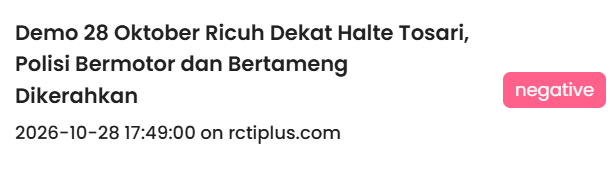
As evening approached, headlines turned into field reports of clashes around Bundaran HI. In Newstensity, the earliest report of unrest came from RCTI+ at 17:49 WIB. A crowd trying to join students in front of the UOB building was blocked by a police barricade near the Tosari bus stop. The two sides then threw bottles and road barriers at each other.
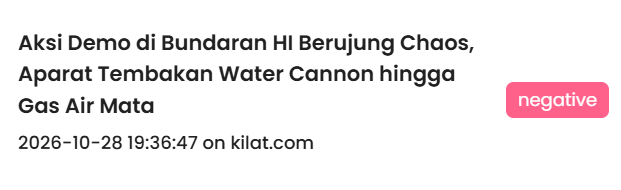
The next report mentioned tear gas. At 19:36 WIB, kilat.com reported water cannon and tear gas at Bundaran HI. Its headline read “Protest at Bundaran HI Ends in Chaos, Officers Fire Water Cannon and Tear Gas.” According to kilat.com, the clash broke out around 18:20 WIB, and the crowd began dispersing from 19:45 WIB.
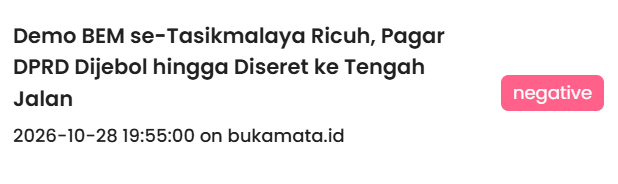
Similar reports came in from other cities. At 19:55 WIB, bukamata.id reported a chaotic student protest in Tasikmalaya, West Java. Protesters tore down the fence of the regional legislature (DPRD) and dragged it into the street.
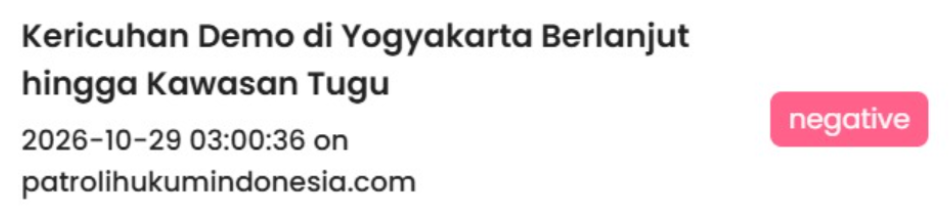
In Yogyakarta, patrolihukumindonesia.com published several articles at once around 03:00 WIB on October 29. One headline read “Clashes in Yogyakarta Protest Continue to the Tugu Area.” Another read “From Peaceful Protest to Clashes: A Chain of Unrest in Malioboro.” At 04:11 WIB, kepri.genpi.co reported that an unidentified crowd appeared and the protest on Malioboro, the city’s main street, turned chaotic. Outlets publishing from evening into the early hours mostly reported on the unrest.
Access also shaped the evening’s story. Suara.com reported that police at one point kept journalists from covering the protest. Jakarta’s regional police (Polda Metro Jaya) later apologized and promised a review.
The shift in tone followed events on the ground. But each newsroom’s choice of words decided how sharp that shift looked. When the crowd left Bundaran HI, Sinar Harapan headlined it “October 28 Protest Orderly, Crowd Leaves Bundaran HI Toward Evening.”
Other outlets chose different angles. Aktual.com said the protest “ended in chaos.” Disway ran “Bundaran HI Protest Turns Chaotic!” CNN Indonesia built its headline around traffic reopening on Sudirman and Thamrin, Jakarta’s main avenues. These outlets used three frames: orderly, chaos, and traffic.
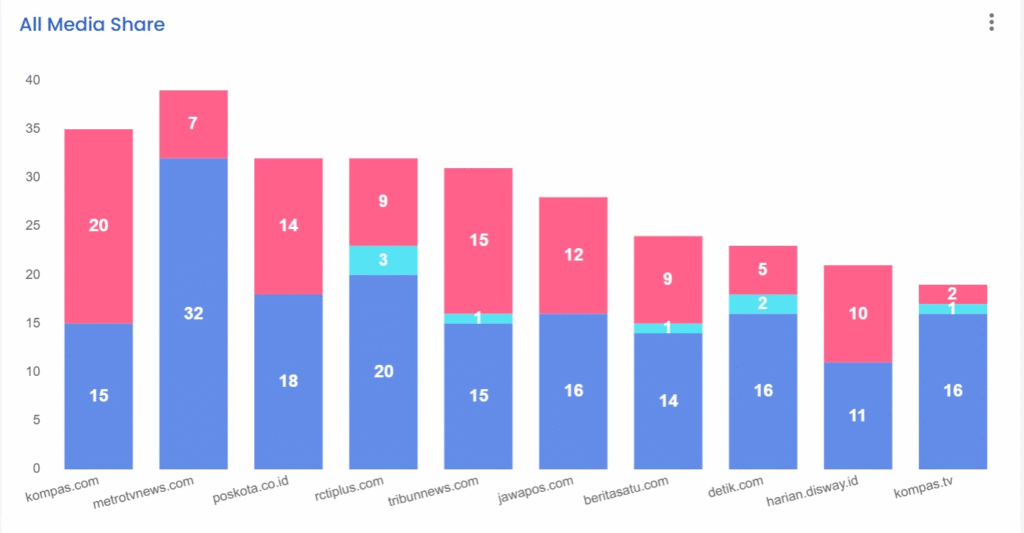
Counted by outlet, Newstensity’s All Media Share data shows the same split, with outlets pulling in opposite directions. Of 39 stories from Metrotvnews.com, the news site of broadcaster Metro TV, 32 were positive, about 82 percent. Of 35 stories from Kompas.com, one of the country’s biggest news sites, 20 were negative, about 57 percent. Of the ten outlets with the most stories, only Kompas.com ran more negative than positive ones. Tribunnews.com split evenly at 15 to 15, while Poskota.co.id (18 positive, 14 negative) and Harian Disway (11 positive, 10 negative) were nearly balanced.
The gap even shows up within a single media group. Kompas.tv, the television arm of the same group, had 16 positive stories out of 19, about 84 percent, the opposite of Kompas.com. Readers who follow only one outlet could come away with different pictures of this protest. Metrotvnews readers saw mostly positive coverage, while Kompas.com readers saw more negative coverage.
Beyond tone, word choice decides which issues stay visible. The Newstensity word cloud shows which words came up most: aksi (action), demonstrasi (demonstration), mahasiswa (students), pemuda (youth), tuntutan (demands), massa (crowd), bundaran (roundabout), and sumpah (pledge). These words describe the event itself.
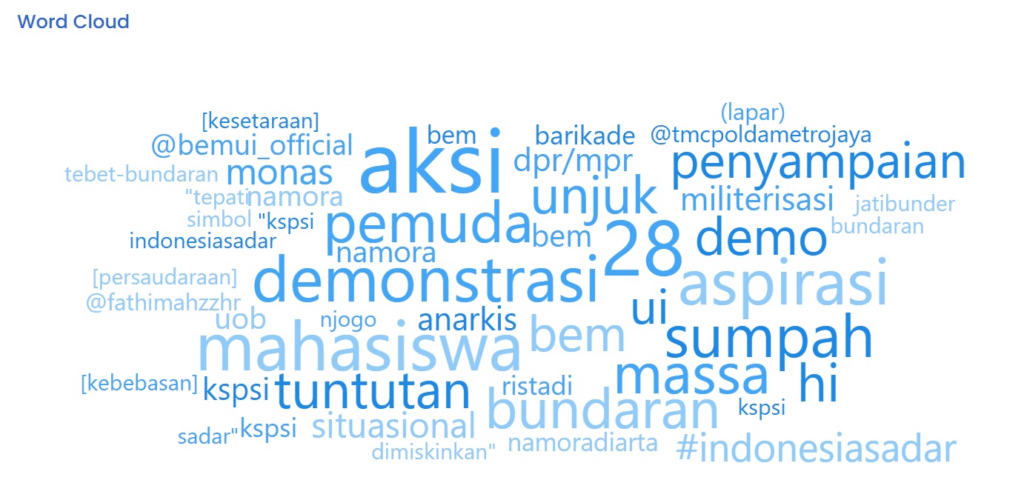
Meanwhile karhutla, short for forest and land fires, does not appear in the word cloud at all. That issue was the core of the protest’s first demand. The term did appear in headlines summarizing the demands before the protest, such as a Kompas article on October 27. It never came up often enough to enter the word cloud.
The absence stands out against the backdrop. In the weeks before the protest, Indonesia struggled to contain forest and peatland fires in Sumatra, Kalimantan, and Papua. The Jakarta Post reported that the toxic haze had spread to Singapore and Malaysia.
Other demands were more visible. The word militerisasi (militarization), from the fifth demand, appears in the word cloud. An Arrahmah.id headline said BEM UI was pressing Prabowo and Gibran on their promise of 19 million jobs, close to the third demand. Yet the organizers had put the fires first.
According to Akurat and Disway, the October 28 protest made five demands:
The substance of these demands lost the spotlight to the drama of the protest. Several outlets focused on celebrities who joined the march, as reported by Suara.com and Pikiran Rakyat. A video of a foaming packaged tea drink also became a story of its own. Crowd size, clashes, and ceremonial symbols like Youth Pledge Day make easier headlines than policy demands.
This case holds three lessons for anyone who monitors issues or manages reputation. First, break your daily sentiment summary down by publication time. A daily figure can hide a shift in tone from morning to night, and that shift tells you when to prepare a statement or clarification.
Second, compare sentiment by outlet. A single major outlet with a negative tone can outweigh dozens of small neutral ones, especially once others pick up its stories. Third, check whether your core message made it into the coverage. The organizers of this protest brought five demands, yet their first demand did not appear in the word cloud. Any organization can face the same problem at a press conference, a product launch, or a crisis response.
What Is “Downgrade Lifestyle” and Why Is It Trending on Threads? Since early September 2026, the term “downgrade lifestyle” has…

binomedia

You can no longer tell AI astroturfing from genuine public opinion by reading the text. Generative AI writes as fluently…
binomedia

Who controls money in the blockchain era? When Bitcoin launched in 2008, the answer sounded simple: no single party, because…
binomedia

The debate over whether AI development should slow down is no longer theoretical. In September 2026, the CEOs of the…
binomedia

AI brand visibility is how often, how accurately, and in what context your brand appears in answers from AI-powered search…
binomedia

The DTSEN social assistance decile controversy in 2026 is not merely about inaccurate data. Media monitoring and digital conversation analysis…
binomedia
Indonesia’s gross domestic product (GDP) grew by 5.29 percent in the second quarter of 2026. This figure exceeded the median…
binomedia

Artificial intelligence (AI) is transforming education faster than most education systems can respond. Machines can now search for information, summarize…
binomedia

One Event, Two Market Moves On Monday, August 10, 2026, Indonesia’s rupiah closed 0.79% higher at IDR 17,755 per US…
binomedia

On Thursday, July 30, 2026, Indonesian President Prabowo Subianto announced a “cleanest city” competition. The top five cities would win…
binomedia