

Downgrade Lifestyle: Indonesia’s Real Economic Signal
What Is “Downgrade Lifestyle” and Why Is It Trending on Threads? Since early September 2026, the term “downgrade lifestyle” has…
-
binomedia
- October 9, 2026


The DTSEN social assistance decile controversy in 2026 is not merely about inaccurate data. Media monitoring and digital conversation analysis reveal a deeper narrative battle: mass media framing that highlights cases of injustice directly confronts the technical clarification strategy carried out by BPS and the Ministry of Social Affairs.
The result is that public trust in government data deteriorated faster than institutional responses could keep up, as reflected in waves of citizen complaints on social media followed by official government responses. This article examines the dynamics from a media intelligence perspective.
The issue surrounding the determination of DTSEN deciles had actually triggered public concern and discussion since mid-2026. However, the controversy reached its peak and gained a concrete example when the Timbul case emerged in August 2026.
Timbul, a 49-year-old motorcycle pedicab driver from Kulon Progo, Yogyakarta, was suddenly classified into DTSEN decile 9, despite having a net income of approximately Rp50,000 per day. Previously, he had been categorized in decile 1. The change in status threatened his youngest child’s access to the Indonesia Smart College Card (KIP-K) after being accepted at Yogyakarta State University. The house where he lived was inherited from his parents and had not yet been divided among his six siblings. To pay tuition fees, Timbul and his child had to combine their savings from daily allowances.
The Timbul case went viral because it became concrete evidence of how an abstract statistical decision within a system could directly affect citizens’ basic rights. After BPS Yogyakarta Province and BPS Kulon Progo Regency conducted a direct inspection of Timbul’s home, they found that the recorded data did not reflect his latest circumstances. With assistance from BPS officers, Timbul completed an update form through Cek DTSEN, and his status changed to decile 3. The Head of BPS confirmed that this process also supported the registration of Timbul’s child for KIP-K assistance.
One individual case became a national trigger because Timbul was not the only affected citizen. Ombudsman offices in various regions received similar complaints. According to Radar Jogja’s report, hundreds of residents in Kulon Progo also protested due to mismatched decile data that threatened their access to social assistance. This pattern shows that Timbul was not an anomaly, but rather a symptom of a systemic problem that had previously been hidden behind the database.
Monitoring by Newstensity on reports regarding the DTSEN decile controversy shows a consistent framing pattern: mass media tends to produce negative sentiment-driven narratives by highlighting specific cases with a strong sense of injustice. Dominant headlines such as “DPR Gives BPS Two Weeks Ultimatum to Fix Decile Data” colored the public discourse. This type of framing is effective because it uses a narrative logic that is easy for the public to understand: poor citizens being “forced to become rich” by a system.
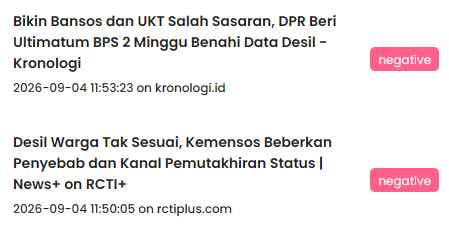
This framing works because it follows a narrative logic that is easy for the public to understand: poor citizens being “forced to become wealthy” by the system. Readers do not need to understand the Proxy Means Test mechanism or the concept of relative ranking to feel anger. A single news headline that appears contradictory to people’s daily realities can be enough to shape public perception.
Reports explaining the technical mechanism behind DTSEN do exist, but they receive a smaller portion of media attention. Media outlets generally place BPS’s clarification as a response section within their reports rather than presenting it as the main perspective. As a result, negative narratives spread widely before clarification could reach the public. False tables linking decile levels with specific income amounts also circulated on social media. The Ministry of Communication and Digital Affairs (Komdigi) has declared these claims as misinformation, but corrections of this kind rarely spread as widely as the initial content.
This pattern reflects a classic dynamic in crisis communication: emotionally engaging personal stories always move faster than technical explanations based on data. According to studies on government crisis communication in the digital era, communities are more likely to accept policies when they feel heard and involved. The decile controversy shows that BPS has not yet reached this stage: its communication remains one-way and technical, while the public needs dialogue.
BPS and the Ministry of Social Affairs (Kemensos) pursued two response tracks. First, definitional clarification: both agencies emphasized that “a decile is not a certificate of wealth or poverty” but a relative socioeconomic position. The head of BPS RI explained that deciles show how one household ranks compared to others based on multiple socioeconomic characteristics.
Second, operational response. BPS published an official FAQ about DTSEN, opened self-service data update channels through the Cek Bansos portal, and expanded field verification efforts. The government allocated additional budget for data correction.
Both tracks were reactive. BPS statements surfaced only after negative narratives had filled public discourse for weeks. DTSEN Version 3 covers 290.13 million individual records and 95.98 million family records. That scale makes instant data fixes a logistical challenge. But the public does not grade response speed by system complexity. People grade it by what happens at the village office, the hospital desk, or the university admissions counter.
Socindex tracked social media from August 13 through September 4, 2026, and captured a sharp spike in public talk. TikTok led with 187,029 data points. Instagram followed at 127,509. X (formerly Twitter) trailed at 4,674. Short-form video platforms drove the spread, confirming that the decile dispute traveled through visual personal stories rather than text-based policy debate.
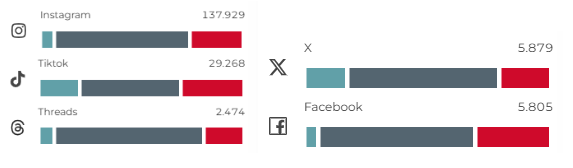
Overall sentiment leaned neutral to negative, mixing confusion, anxiety, and criticism over decile accuracy. Online talk spilled past basic aid into education. Users flagged the impact of decile shifts on Jakarta Smart Card (KJP) funds and KIP-K scholarships. That spillover matters because a single data policy decision disrupted multiple parts of citizens’ daily lives.
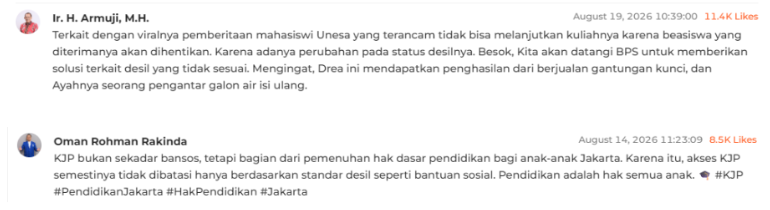
The wave of online complaints pushed regional officials to intervene publicly. Elected representatives and local executives responded to constituent grievances about lost access to assistance caused by decile reclassification. In Jakarta and other regions, legislators argued that basic education rights such as KJP and KIP-K should not be rigidly gated by decile thresholds. Deciles designed to target assistance were instead blocking access to education the state had already guaranteed.
When local officials respond to individual cases through social media, they simultaneously position themselves as defenders of ordinary citizens against central government policy. This dynamic transforms a data accuracy dispute into a local political arena where decile numbers are read as evidence of either official concern or official neglect.
The gap between statistical language and lived experience sits at the center of this communication failure. BPS employs a Proxy Means Test using dozens of variables to calculate decile positions. Citizens, meanwhile, measure the impact of a decile change by what disappears from their lives: subsidized energy, a child’s scholarship, access to health insurance. When the algorithm assigns a high decile to a low-income household, resistance is inevitable.
Legislators in Indonesia’s national parliament (DPR RI) called the method outdated. Static markers like housing quality, they argued, no longer capture who is truly vulnerable in an era of gig work and informal jobs. Their pressure produced a concrete result. DPR RI gave BPS an ultimatum to resolve decile data appeals within 10 to 14 days.
The government’s call for citizens to proactively check and update their own data through online portals signaled openness. But it also exposed a contradiction: the government was asking citizens to correct data that should have been the state’s responsibility to maintain. For residents in remote areas or those unfamiliar with digital portals, this self-service mechanism added burden rather than relief.
Research on PMT accuracy backs up these concerns. A study in The Journal of Development Studies tested how non-random errors affect PMT models (Premand & Schnitzer, 2020). The errors cut predictive accuracy by 5 to 27 percent and raised targeting mistakes by 10 to 34 percent when poverty was measured in absolute terms. The ILO’s working paper “Exclusion by Design” found that most PMTs in developing countries explain only about half of the variation in household spending. The method produces inclusion and exclusion errors by design. Indonesia’s DTSEN controversy fits squarely within these known limits.
Political communication analysts have noted that technical explanations about “data synchronization” are often dismissed as bureaucratic formality when media and social media have already filled the public space with narratives of disappointment. A late clarification gets received as justification, not explanation.
The DTSEN decile crisis offers a clear lesson for anyone working in public communication. Data quality is not measured by methodological precision alone. It is also measured by how transparently and accessibly every data change is communicated to the people it affects.
This failure follows a recurring pattern in how governments talk about policy: the habit of reducing human welfare to numbers on a screen. The logic of systems often forgets that behind every variable shift in a database sits a person whose access to basic rights hangs in the balance. No statistic fully captures the social and economic complexity of a population. When data updates are rolled out in dry, technical language with no social awareness, the government sidelines the human reality behind its own numbers.
Two worlds need alignment. Inside the system, data lives as databases, algorithms, quarterly updates, and budget lines. In the public sphere, data lives as citizen perceptions, news coverage, digital conversations, and daily experience. When these two worlds run disconnected, a number change in a database becomes a trust crisis in the public arena.
In the digital era, a single case posted on social media can draw a public official’s response within hours and grow into a national crisis within days. BPS can no longer rely on technical statements as its only tool. Media monitoring through Newstensity and digital conversation tracking through Socindex should serve as core infrastructure for public bodies, not extras switched on after a crisis has already broken.
Getting input data right inside the system remains the primary technical task. But making sure citizens understand why their decile status shifted, and providing responsive grievance channels, carries equal weight in maintaining the legitimacy of public policy. Without both running in balance, even accurate numbers will be judged as wrong by a public that has already lost trust.
For PR and communications teams, the DTSEN decile crisis is a live case study. Good data without the right narrative is as exposed as bad data. Public bodies that want to keep trust must build the capacity to read media dynamics and digital talk as a daily practice, not a fire drill after the crisis has already erupted.

What Is “Downgrade Lifestyle” and Why Is It Trending on Threads? Since early September 2026, the term “downgrade lifestyle” has…

binomedia

You can no longer tell AI astroturfing from genuine public opinion by reading the text. Generative AI writes as fluently…
binomedia

Who controls money in the blockchain era? When Bitcoin launched in 2008, the answer sounded simple: no single party, because…
binomedia

The debate over whether AI development should slow down is no longer theoretical. In September 2026, the CEOs of the…
binomedia

AI brand visibility is how often, how accurately, and in what context your brand appears in answers from AI-powered search…
binomedia

Indonesia’s gross domestic product (GDP) grew by 5.29 percent in the second quarter of 2026. This figure exceeded the median…
binomedia

Artificial intelligence (AI) is transforming education faster than most education systems can respond. Machines can now search for information, summarize…
binomedia

One Event, Two Market Moves On Monday, August 10, 2026, Indonesia’s rupiah closed 0.79% higher at IDR 17,755 per US…
binomedia

On Thursday, July 30, 2026, Indonesian President Prabowo Subianto announced a “cleanest city” competition. The top five cities would win…
binomedia

Before dawn on Friday, 24 July 2026, a mob in Bali beat a man to death. He is identified only…
binomedia