

Downgrade Lifestyle: Indonesia’s Real Economic Signal
What Is “Downgrade Lifestyle” and Why Is It Trending on Threads? Since early September 2026, the term “downgrade lifestyle” has…
-
binomedia
- October 9, 2026

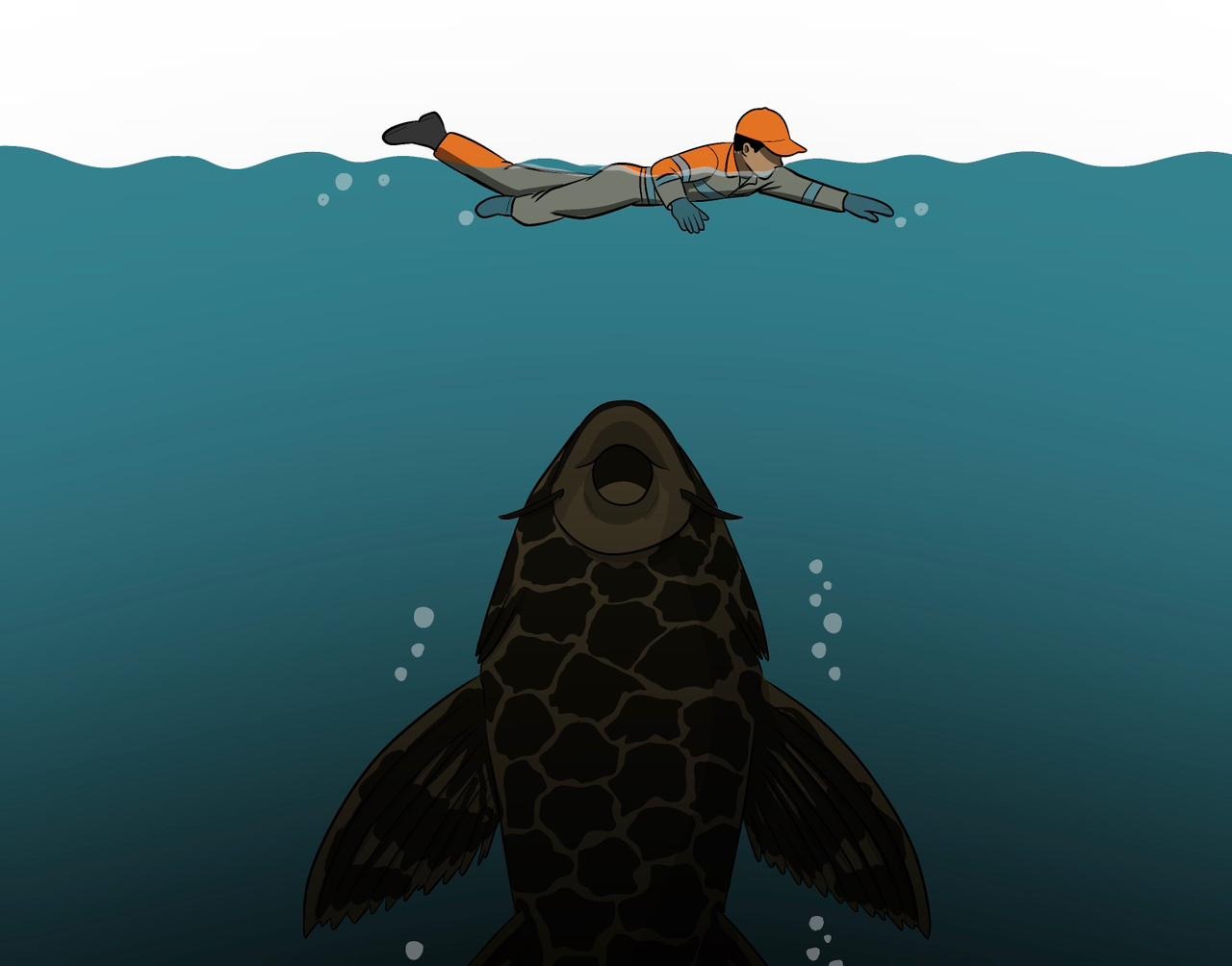
Growing public attention toward environmental issues has placed the Jakarta Provincial Government’s action to clear suckermouth catfish from several rivers in the capital under the spotlight. The move came as the fish population was considered increasingly massive.
The suckermouth catfish, or Pterygoplichthys pardalis, is a fish species with strong morphological adaptation abilities, allowing it to survive in various freshwater environments. Its presence in Indonesian waters can create ecological impacts, especially when the species becomes invasive and competes with local species for habitat.
Jakarta Governor Pramono Anung stated that the population of suckermouth catfish in Jakarta’s waters is estimated to have exceeded 60%. This indicates the dominance of the species, which could pose a serious threat to aquatic ecosystems. The fish has a high ability to adapt to different environments and can prey on the eggs of other fish, making it difficult for local endemic fish to survive. In addition, suckermouth catfish are considered unsafe for consumption because of the potential presence of high pollutant residues.
This issue had previously drawn attention from environmental activist Arief Kamarudin, who expressed concern over the booming population of suckermouth catfish in the capital. According to Arief, the rapidly growing population of this invasive fish can disrupt the balance of river ecosystems. Besides reproducing quickly and threatening the stability of local fish populations, the species can also damage riverbeds due to its digging behavior.
The Jakarta Provincial Government responded by capturing suckermouth catfish simultaneously across five city areas as an effort to curb the population surge. This step became part of the government’s quick response and initiative to follow up on public and environmental activists’ concerns regarding the increase in invasive fish populations. Pramono confirmed that this control effort would be carried out continuously.
One of the social media posts with the highest audience response on this issue came from the TikTok account @radioelshinta. The post showed a suckermouth catfish control operation through simultaneous mass capture across five administrative cities in Jakarta, producing a total catch of 6.98 tons on Friday, April 17, 2026. The captured suckermouth catfish contained high heavy metal residues, so they were confirmed not to be consumed and were later buried in a controlled manner.
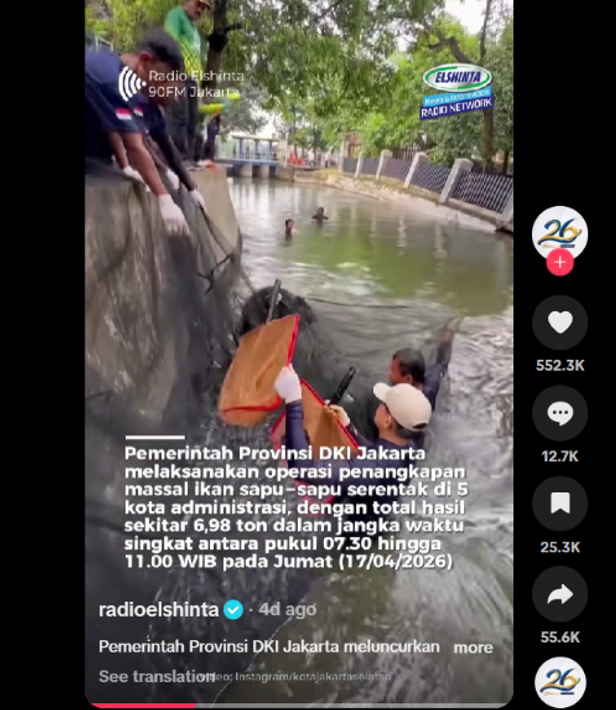
The Jakarta Provincial Government’s action received wide public responses, ranging from support for the government’s move to criticism of the method, which some considered controversial.
Based on monitoring results using the Socindex dashboard across various social media channels, including Twitter/X, Facebook, Instagram, YouTube, Threads, and TikTok, the issue of the Jakarta Provincial Government’s suckermouth catfish culling operation across five administrative city areas generated a total of 43,447 conversations.
The monitoring was conducted from April 14 to April 21, 2026, using related keywords: “Pemusnahan Ikan Sapu-sapu,” “Pengendalian Ikan Sapu-sapu,” “Polemik Ikan Sapu-sapu,” “MUI Pemprov DKI Jakarta,” “Majelis Ulama Indonesia Pemprov DKI,” “MUI Pemerintah Provinsi DKI,” and “MUI Kritik DKI Jakarta.”

Netizens expressed various responses to the Jakarta Provincial Government’s effort to control the suckermouth catfish population. Most users supported the program and viewed the government’s action as a quick response to an urgent environmental issue.

On the other hand, some netizens reacted negatively by criticizing and questioning the effectiveness of culling suckermouth catfish for the environment in the long term. Some comments questioned why the fish were immediately culled instead of being utilized first. Others argued that the government should pay more attention to other, more crucial issues and considered this effort not urgent.
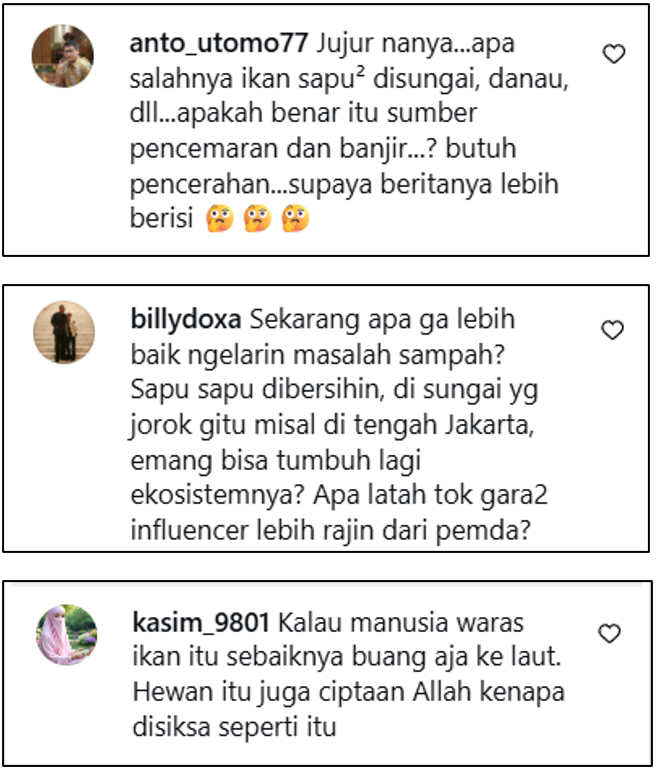
The diverse reactions from netizens are understandable because this issue is not only related to the technical method of controlling an invasive species, but also to animal welfare ethics and environmental impacts. The debate shows that the method used became a central point of public attention.
Some netizens considered the measure effective, while others questioned the potential ecological risks after the fish were buried. Public response did not focus only on government policy, but also on how the policy was implemented in the context of environmental responsibility after the program was carried out.
Beyond the public debate over the method of controlling the suckermouth catfish population through burial, the Indonesian Ulema Council, or MUI, also criticized the method, especially from the perspective of ethics and animal welfare. This was because some fish were allegedly buried while still alive.
MUI stated that the practice violated two main principles in Islam: rahmatan lil ‘alamin, or mercy for all creation, and the principle of animal welfare.
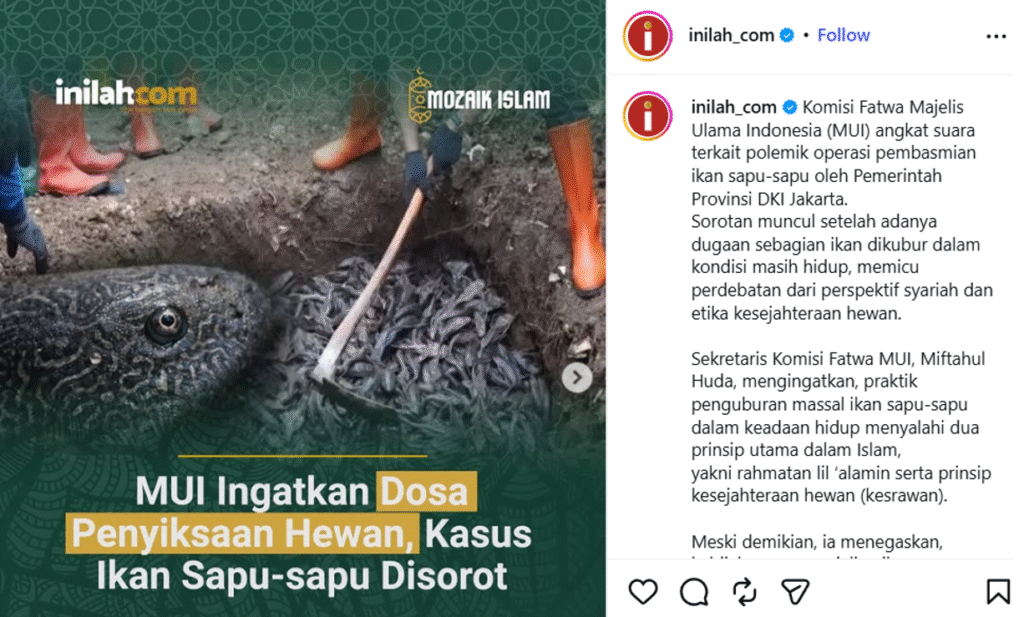
Even so, MUI considered the population control policy appropriate because of the characteristics of suckermouth catfish, which have the potential to threaten local endemic fish populations in Jakarta’s rivers.
MUI’s response expanded the debate. What initially focused on ecological impact and the effectiveness of the method developed into a broader discussion about ethics and moral responsibility toward living creatures. Environmental policy needs to be continuously evaluated, including how such programs are implemented.
The Governor of Jakarta responded positively to MUI’s criticism. He stated that the government would evaluate the method of burying suckermouth catfish while still alive and ensure that experts would be involved in adjusting the procedure.
Referring to MUI’s recommendation, the South Jakarta City Government, following instructions, ensured that captured suckermouth catfish were already dead before burial. This was done to avoid violations of animal welfare ethics.
The government plays a major role in environmental control. The Jakarta Provincial Government’s operation to cull suckermouth catfish, which were considered disruptive to the balance of aquatic ecosystems in Jakarta, received support from netizens. The action was seen as an effort to protect the survival of local species threatened by the dominance of invasive fish.
However, the move also triggered public discussion about the culling method used, including its effectiveness and potential long-term environmental impact. Population control is necessary, but it must be carried out through a safe, appropriate, and science-based approach.
Although the policy gained broad public support, environmental management still requires comprehensive and careful ecological consideration. This controversy shows the public’s growing concern for environmental issues, while also emphasizing that government policies are never free from public scrutiny on social media.

What Is “Downgrade Lifestyle” and Why Is It Trending on Threads? Since early September 2026, the term “downgrade lifestyle” has…

binomedia

You can no longer tell AI astroturfing from genuine public opinion by reading the text. Generative AI writes as fluently…
binomedia

Who controls money in the blockchain era? When Bitcoin launched in 2008, the answer sounded simple: no single party, because…
binomedia

The debate over whether AI development should slow down is no longer theoretical. In September 2026, the CEOs of the…
binomedia

AI brand visibility is how often, how accurately, and in what context your brand appears in answers from AI-powered search…
binomedia

The DTSEN social assistance decile controversy in 2026 is not merely about inaccurate data. Media monitoring and digital conversation analysis…
binomedia

Indonesia’s gross domestic product (GDP) grew by 5.29 percent in the second quarter of 2026. This figure exceeded the median…
binomedia

Artificial intelligence (AI) is transforming education faster than most education systems can respond. Machines can now search for information, summarize…
binomedia

One Event, Two Market Moves On Monday, August 10, 2026, Indonesia’s rupiah closed 0.79% higher at IDR 17,755 per US…
binomedia

On Thursday, July 30, 2026, Indonesian President Prabowo Subianto announced a “cleanest city” competition. The top five cities would win…
binomedia