

Downgrade Lifestyle: Indonesia’s Real Economic Signal
What Is “Downgrade Lifestyle” and Why Is It Trending on Threads? Since early September 2026, the term “downgrade lifestyle” has…
-
binomedia
- October 9, 2026

Who would have thought a simple joke could explode into a full-blown social-media drama?
Everything began with a viral post comparing the face of RM BTS to senior TV host Indy Barends. For some, the comparison was harmless humor — but for hardcore BTS fans, the ARMY, it was an insult to their idol.
And just like that, a tiny spark on social media turned into a wildfire that dragged a local skincare brand, Somethinc, into the chaos.

Somethinc’s admin casually replied “UDAAAH BANG…” under a tweet by influencer Gilang Bhaskara, who had posted the Indy Barends meme that was trending at the time.
But the digital world is merciless — context rarely survives, and nuance often gets erased.
ARMY interpreted Somethinc’s reply as the brand supporting the joke that mocked RM. Within hours, Somethinc’s accounts were flooded with angry comments. The anger didn’t stop on X (Twitter): it poured into Shopee live shopping rooms, TikTok Live, and even targeted hosts and staff who had nothing to do with the comment.
Many netizens felt this had crossed the line — no longer “defending an idol,” but bullying regular workers who were simply doing their jobs.
This phenomenon illustrates something deeper: how thin the line is between admiration and fanaticism. Affection for an idol can grow so intensely that fans feel entitled to control how others speak, joke, or react about them. One wrong word — even accidental — and boom — the internet becomes an arena of digital gladiators.
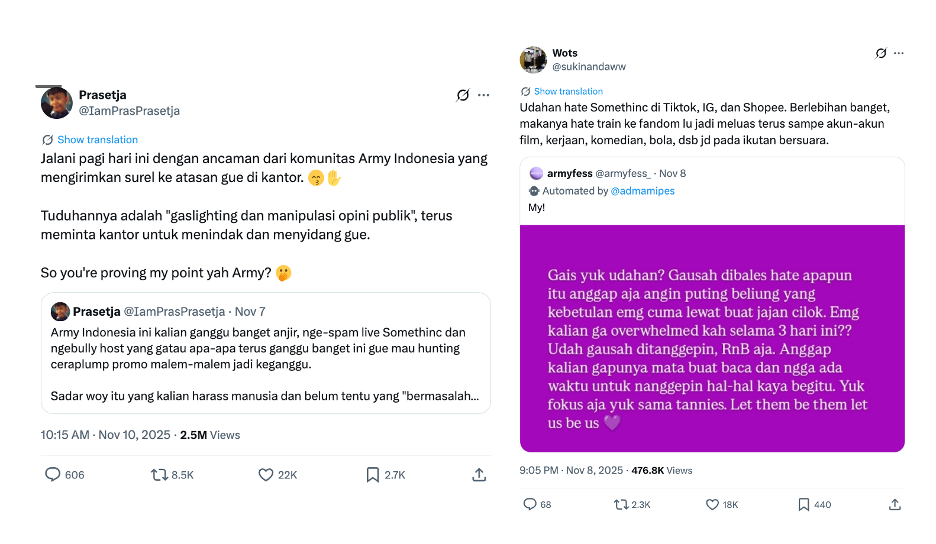
The situation escalated when influencer Prasetja (@IamPrasPrasetja), known for his bluntness and 12.4K followers, posted a strong defense of Somethinc and its employees.
He wrote:
“I stand with @Somethinc4u for doing business like this. Kalau kalian followersku ada ARMY Indonesia yang anti dan masih mendukung gerakan harassment, bullying, dan tindakan misoginis kpd host Somethinc, tolong unfollow aku. I don’t care about y’all community and BTS.”
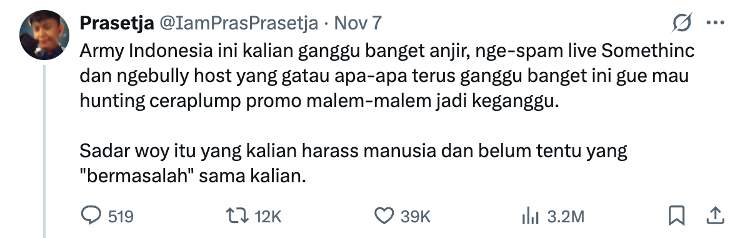
Prasetja, who works at PT Trisula Ungu Indonesia — a social-psychology and research organization — soon became the next target. His thread, intended to defend victims of harassment, instead fueled ARMY’s anger. They attacked him personally, accusing him of belittling the fandom.

He argued that the inability to distinguish criticism from insult — and retaliating with personal attacks — reflected weak psychological mindedness, the capacity to understand one’s own thoughts and behaviors.
He added that ARMY projected negative emotions onto others and noted that Somethinc’s admin never insulted RM, yet became the subject of massive hate.
The drama escalated further.
ARMY no longer focused solely on Somethinc — they shifted their anger to Prasetja and his workplace. Many demanded PT Trisula Ungu Indonesia take action, even calling for boycotts, mass reports, and corporate sanctions.
For some ARMY members, this was “holding a public figure accountable.”
But for many others, the response resembled toxic overreaction, a coordinated harassment wave disguised as moral righteousness.
This shows how fandoms, when mobilized collectively, can shift from solidarity to social pressure — even intimidation.
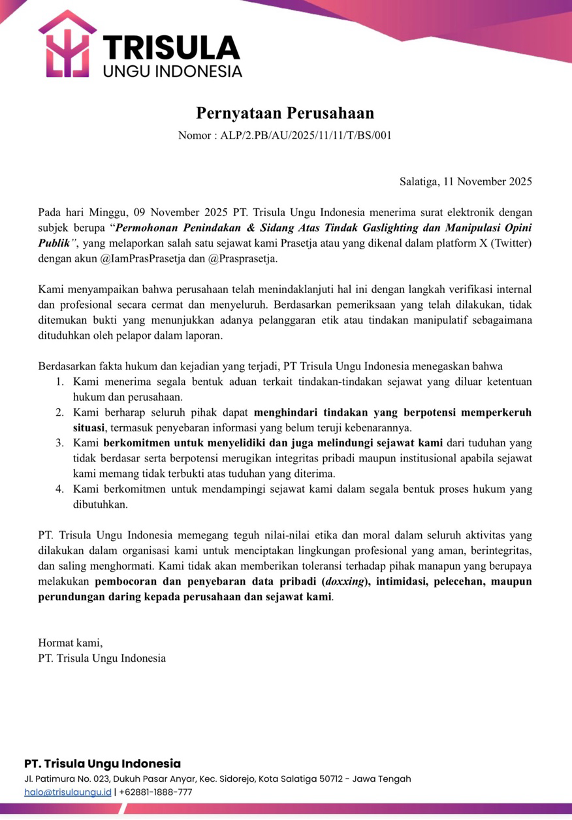
The company released an official statement after receiving numerous complaints. They clarified that:
In short, the company publicly defended its employee — a move that earned widespread support from neutral netizens.
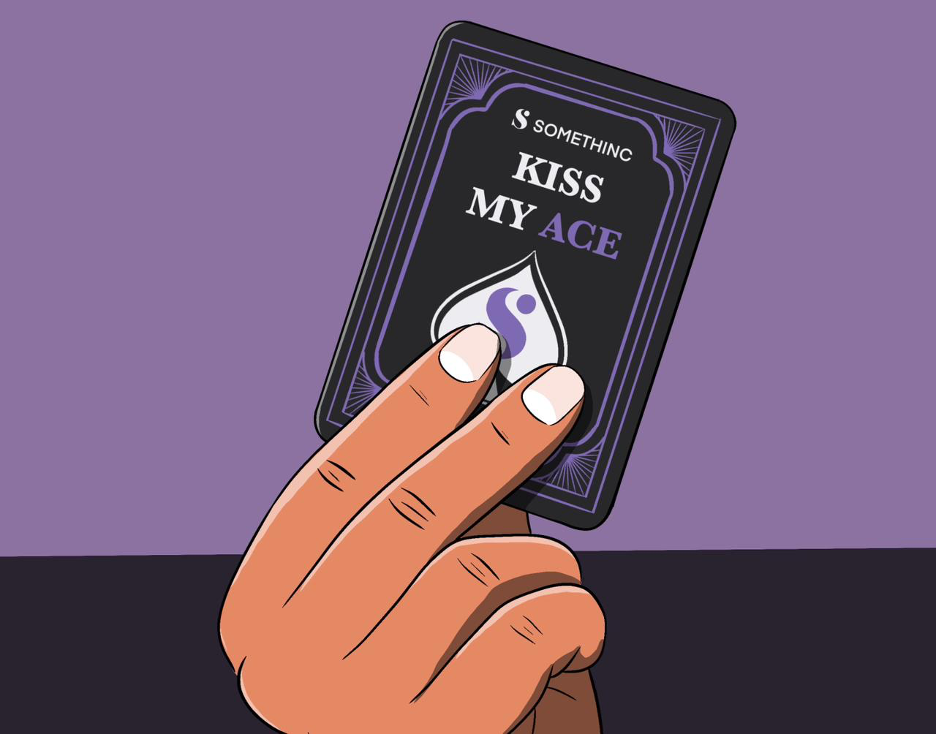
Amid the uproar, Somethinc quietly launched its new lip collection, “Kiss My Ace.”
The lineup included lip balms and lip tints in bold purple shades, paired with the playful tagline “Ace your lip game.”
A bold name, bold colors, bold attitude — aligning perfectly with their young, digital-native audience.
But the timing raised eyebrows: launching during a reputation crisis made some interpret it as strategic damage control, while others saw it as coincidence.
Still, the release symbolized Somethinc’s attempt to shift public focus from drama to product innovation.
This entire case is a reminder:
Admiring idols is natural — they inspire, motivate, and bring joy.
But when admiration morphs into a force that attacks, bullies, or harms others, something has gone wrong.
Toxic fandom transforms affection into ego — a competition over who “loves the idol the most.”
Ironically, in trying to protect their idol, fans often end up damaging the idol’s image in the eyes of the public.
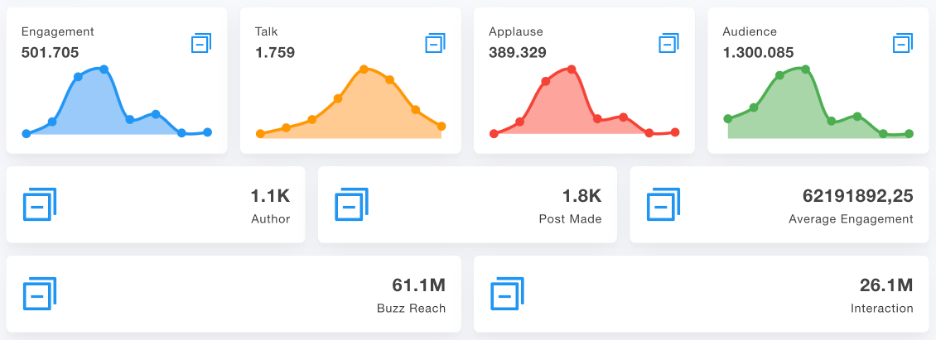
Using Socindex, big-data analysis of keywords “ARMY,” “Somethinc,” “BTS” during 5–12 November 2025 revealed:
This wasn’t just fandom noise — it became a national-scale viral event spreading far beyond BTS fans.

The engagement spike showed how a minor issue can snowball into a massive online spectacle within hours. The peak came when ARMY consolidated narratives, created threads, shared “evidence,” and called for boycotts of Somethinc and Prasetja’s employer.

Sentiment analysis revealed:
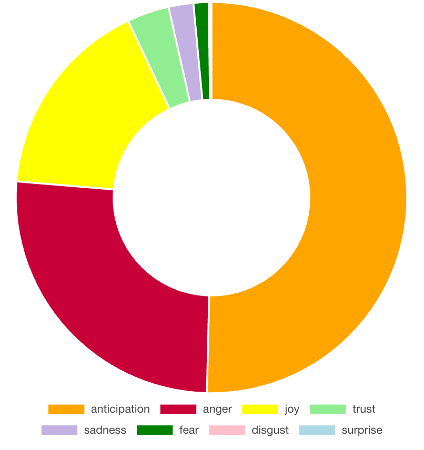
Emotional mapping showed mainly anger and heightened anticipation as users waited for corporate responses.
Despite the chaos on social media, online news coverage remained relatively low.
Newstensity recorded 86 articles (5–12 November), with negative and positive news appearing almost evenly.

Traditional media tend to filter social-media drama as “perception-based conflict,” covering it only when it becomes socially or institutionally relevant.
This explains why X looked like it was “on fire,” while the media landscape stayed comparatively calm.
The ARMY–Somethinc episode reveals the complex duality of fandom culture:
Fandom becomes toxic when the impulse to protect an idol transforms into a crusade to attack others.
The real question is not how much we love our idols — but how we ensure our admiration doesn’t harm people who did nothing wrong.
Because in the end, the loudest voices in defense of an idol can also be the ones that damage that idol’s image the most.
What Is “Downgrade Lifestyle” and Why Is It Trending on Threads? Since early September 2026, the term “downgrade lifestyle” has…

binomedia

You can no longer tell AI astroturfing from genuine public opinion by reading the text. Generative AI writes as fluently…
binomedia
Who controls money in the blockchain era? When Bitcoin launched in 2008, the answer sounded simple: no single party, because…
binomedia

The debate over whether AI development should slow down is no longer theoretical. In September 2026, the CEOs of the…
binomedia
AI brand visibility is how often, how accurately, and in what context your brand appears in answers from AI-powered search…
binomedia
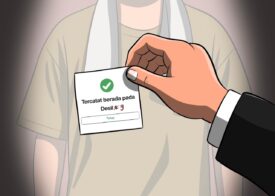
The DTSEN social assistance decile controversy in 2026 is not merely about inaccurate data. Media monitoring and digital conversation analysis…
binomedia
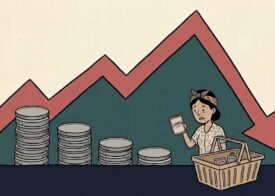
Indonesia’s gross domestic product (GDP) grew by 5.29 percent in the second quarter of 2026. This figure exceeded the median…
binomedia
Artificial intelligence (AI) is transforming education faster than most education systems can respond. Machines can now search for information, summarize…
binomedia
One Event, Two Market Moves On Monday, August 10, 2026, Indonesia’s rupiah closed 0.79% higher at IDR 17,755 per US…
binomedia
On Thursday, July 30, 2026, Indonesian President Prabowo Subianto announced a “cleanest city” competition. The top five cities would win…
binomedia