

AI Brand Visibility: Who’s Telling Your Brand’s Story?
AI brand visibility is how often, how accurately, and in what context your brand appears in answers from AI-powered search…
-
binomedia
- September 11, 2026


Over the past month, Indonesia’s political elites, economists, and the general public were stirred by a statement from Finance Minister Purbaya Yudhi Sadewa, who revived discussion on the long-delayed rupiah redenomination plan. At a time when Indonesia’s economy is undergoing policy changes and the rupiah’s exchange rate remains unstable, the proposal prompted a wide range of reactions—both supportive (pro) and opposing (contra).
Supporters view rupiah redenomination as a step that could strengthen the currency against foreign denominations, help maintain purchasing power, and support modernization of Indonesia’s payment systems. Meanwhile, public confusion between “redenomination” and “sanering” (currency devaluation or value-cutting) triggered negative sentiment and distrust toward the proposal.
Binokular Media Utama, through Newstensity as its media monitoring platform, presents data-driven insights on the pro–contra dynamics surrounding rupiah redenomination from both mass media and social media perspectives.
Over the monitoring period of more than one month (1 October–24 November 2025), there were 4,695 articles across online, print, and broadcast media discussing rupiah redenomination. Online media contributed the largest share with 4,326 articles.
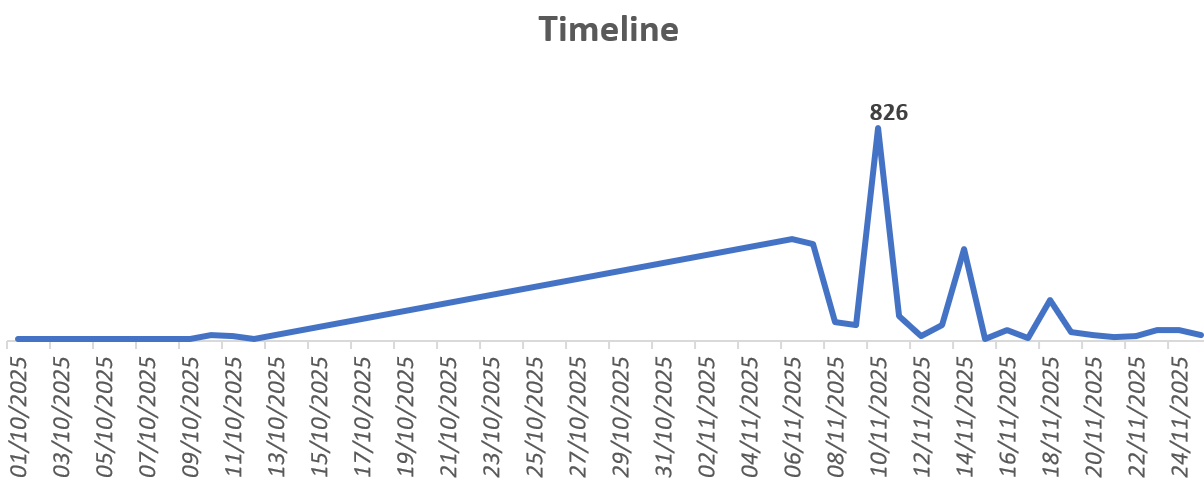
The highest spike occurred on 10 November 2025, with 826 articles published in a single day.
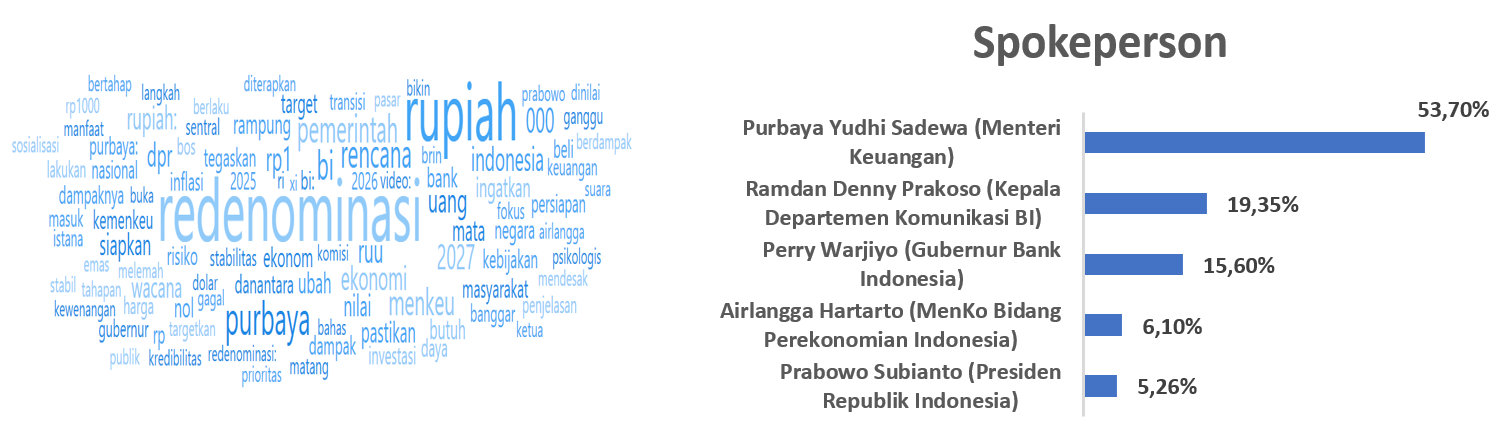
The most sought-after figure in the redenomination discourse was none other than Finance Minister Purbaya Yudhi Sadewa, appearing in nearly 54% of all articles (equivalent to 2,237 articles).

The redenomination issue involves three key institutions:
The illustration shows thick connecting lines between the Ministry of Finance and Bank Indonesia, indicating a strong and frequent linkage across almost all articles. Likewise, Purbaya Yudhi Sadewa and BI Governor Perry Warjiyo consistently appeared as central figures across media narratives.
A majority of media articles expressed positive sentiment toward rupiah redenomination—63% of total coverage.
Much of this support came from Commission XI of the DPR RI, which advised the government to prepare an academic draft, absorb public aspirations, and positioned redenomination as a step to enhance Indonesia’s financial credibility. BI also reassured that redenomination would not reduce public purchasing power.

However, sentiment on social media told a different story.
Across 542 conversations on platforms such as Twitter, Facebook, YouTube, Instagram, and TikTok, 40% reflected negative sentiment.
Public concerns included:
YouTube was the most active platform with 8,911 discussions captured.
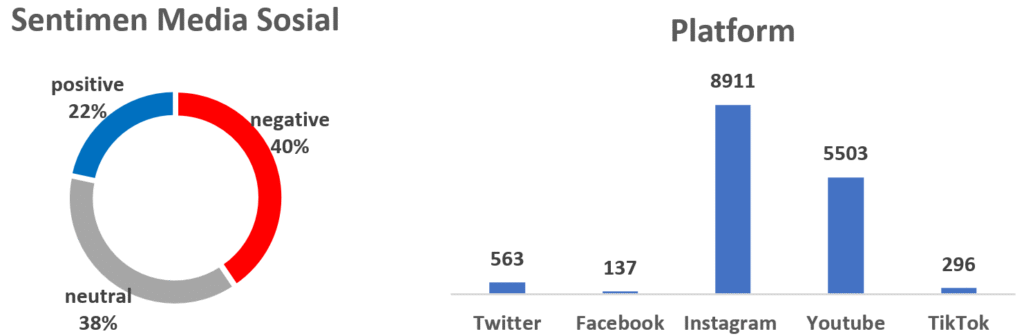
The disparity between media and social platforms is natural. Social media allows unfiltered expression—support, criticism, or sarcasm—while mass media must follow journalistic ethics and structured narrative guidelines.
Neutral sentiment appeared in both domains, mostly arguing that redenomination would not significantly impact the economy and trusting that the government would act prudently after comprehensive study.
The resurfacing of the rupiah redenomination plan took many by surprise. Bank Indonesia firmly stated that redenomination would not occur anytime soon and would require at least six years of preparation—indicating BI has yet to prepare any concrete steps.
This contrasts with the Ministry of Finance, which included redenomination in its 2025–2029 Strategic Plan, targeting completion of the redenomination draft bill (RUU) by 2027.
These differing views from Indonesia’s two leading economic institutions created a split in public opinion—between those who support the plan and those who oppose it. The divergence is reflected both in mass media articles and public expressions on social platforms.
Every perspective carries its own reasoning, but the data highlights the importance of choosing the right timing for redenomination. Public anxiety cannot be ignored. Government intentions must be socialized clearly and wisely. Deeper studies are needed to avoid future risks.
Policymakers may also learn from countries that have implemented currency redenomination—such as Germany, China, and Zimbabwe. The ultimate hope is that whatever policy is taken, it will enhance public welfare and strengthen Indonesia’s financial credibility in the global arena.

AI brand visibility is how often, how accurately, and in what context your brand appears in answers from AI-powered search…

binomedia

The DTSEN social assistance decile controversy in 2026 is not merely about inaccurate data. Media monitoring and digital conversation analysis…
binomedia

Indonesia’s gross domestic product (GDP) grew by 5.29 percent in the second quarter of 2026. This figure exceeded the median…
binomedia

Artificial intelligence (AI) is transforming education faster than most education systems can respond. Machines can now search for information, summarize…
binomedia

One Event, Two Market Moves On Monday, August 10, 2026, Indonesia’s rupiah closed 0.79% higher at IDR 17,755 per US…
binomedia

On Thursday, July 30, 2026, Indonesian President Prabowo Subianto announced a “cleanest city” competition. The top five cities would win…
binomedia

Before dawn on Friday, 24 July 2026, a mob in Bali beat a man to death. He is identified only…
binomedia

Gen Z is increasingly tuning out advertisements that look overly polished and perfect. Instead, they tend to trust recommendations from…
binomedia

On June 10, 2026, Indomie brought back its Goreng Cabe Ijo flavor after the product had been difficult to find…
binomedia

Companies today use AI to read customer data, monitor public conversations, measure reputation, map issues, and support strategic decision-making. In…
binomedia