Michael Kusuma Head Of Investor Relations Sampoerna Agro
“Binokular makes it easier for us to obtain up-to-date information and news. Its monitoring reports are comprehensive and customizable, and features like news archive searching are very useful. The range of services allows personnel with high mobility to access the website, newsletters, and SMS alerts.”
Arif Haryanto Corporate Communication Department, PT Angkasa Pura I (Persero)
“Binokular is a smart solution! Monitoring media spread across 13 regions in central to eastern Indonesia, where Angkasa Pura I airports are located, becomes easy and fast with Binokular. The accuracy and relevance of the captured news are commendable. Binokular’s comprehensive and user-friendly web service makes news documentation searches easier. Binokular also helps us respond quickly to any negative news with its SMS alert service. Kudos to all these innovations, Binokular!”
Miranti Hadisusilo Corporate Secretary & Legal Director, PT Matahari Department Store Tbk
“Binokular has been incredibly helpful for our media monitoring, covering news related to our company, industry, and competitors. Up-to-date information is essential for market analysis, allowing us to respond quickly when necessary.”
Eko Harmonsyah Director of Strategic Planning and Public Relations, Bank Indonesia
“Media monitoring has become easier with Binokular. The necessary information can be searched quickly and accurately using its search engine. The interface is also quite user-friendly. But most importantly, the responsive and proactive service from the Binokular team is extremely helpful.”)
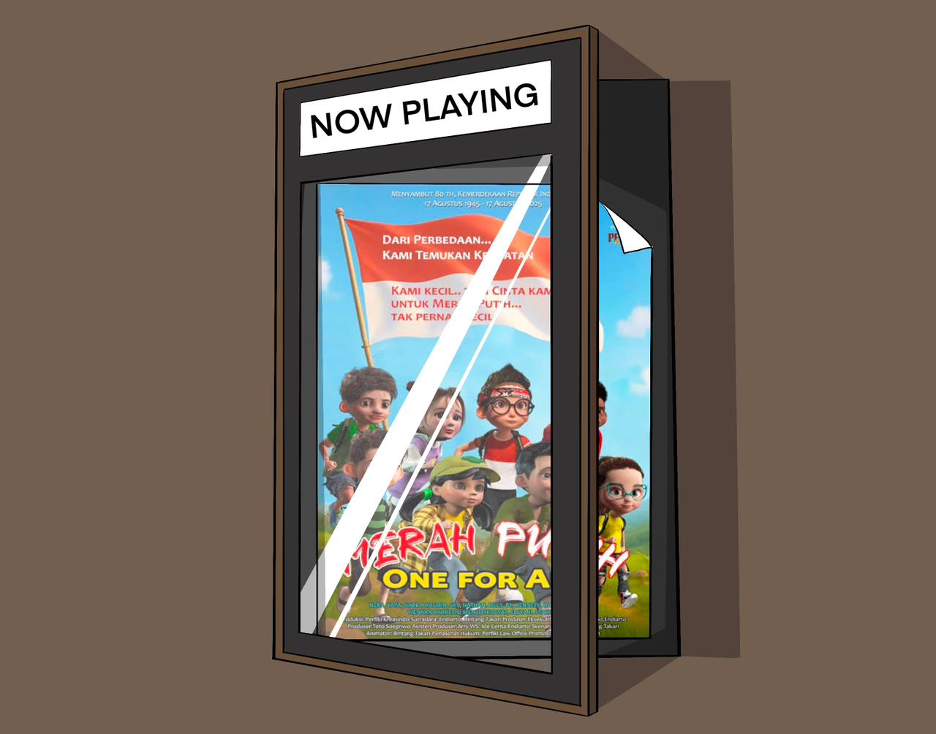
The animated film Merah Putih: One for All was launched in August 2025, timed to coincide with Indonesia’s 80th Independence Day celebrations, with hopes that perfect timing would draw large audiences. Instead, the title went viral for the wrong reasons: a flood of sharp public criticism.
A trailer released in early August was quickly inundated with heated comments on social media, especially X/Twitter. Some users highlighted animation technique and financing, others criticized the promotional rollout, and still others raised copyright questions. A film promoted as Indonesia’s first nationalism-themed animated feature suddenly became a battleground of public opinion.
Screenshot of the official trailer for Merah Putih: One for All on YouTube
As of Tuesday, Aug. 12, 2025, the trailer had amassed 784,000 views in three days, with 14,000 comments. The discussion intensified into the second week of August as copyright and funding issues around the production entered the spotlight.
A feature film is expected to prove Indonesia can deliver big-vision, feature-length animation. The patriotic theme, the national symbolism suggested by the title, and promotion stressing “pride in local creators” aimed squarely at that sentiment. For many, however, the pride felt premature. Even before release, the work faced a basic question: Does the quality match the ambition?
The “First Indonesian Animated Film” Claim
The initial uproar was fueled by promotional language implying this was the “first Indonesian animated film”. Netizens immediately refuted this, pointing to earlier Indonesian features such as Battle of Surabaya (2015) and Nussa (2019). At this point, debate widened from quality to accuracy and respect for pioneers.
Screenshot of a post on X citing Battle of Surabaya as Indonesia’s first animated feature (Source: X account @rgoestama)
Alleged Use of Third-Party Assets Without Credit or Compensation
“If there are similarities, that’s fine. Initially, our IT and animation team did not intend that. They gave it their all,” Endiarto stated.
His remarks did not directly answer whether the designs in the film were taken from an overseas animation platform.
Further allegations followed: the original artist of one of the film’s characters, Junaid Miran, was said not to have received proper compensation. The asset is officially sold on Reallusion for US$149 (around Rp 2.4 million). Junaid claimed the production team never contacted him to purchase a license or provide credit as part of the film’s creation. The controversy thus widened from aesthetics and storytelling into ethics and law.
“Quality vs. Rp 6.7 Billion” — Value for Money Questioned
On visuals, critics focused less on “good or bad” and more on consistency of animation quality. Many asked how a project claiming a large budget could yield a result judged “far below expectations.”
Screenshot of a netizen’s post criticizing Merah Putih: One for All (Source: X account @dav1ncy)
Comparisons were drawn to international standards—and at minimum, to locally produced animations that had won wide praise. The perceived quality gap led to a familiar question: did the stated budget truly go into the creative process, or did some portion “park” elsewhere? While there is no legal proof to validate such claims, public perception has already taken shape. For many, lackluster visuals are not merely an artistic issue; they symbolize poor transparency in managing a national-scale creative project.
Asked for clarification, Deputy Minister for the Creative Economy Irene Umar said the ministry did not provide funding or promotional facilitation for the film.
On the other side, producer Toto Soegriwo directly denied any embezzlement claims. In a clarification posted to his personal account on Aug. 11, 2025, he firmly rejected accusations that the production received Rp 6.7 billion in government funds, calling such claims “vile slander.”
Screenshot of Toto Soegriwo’s clarification post (Source: X account @totosoegriwo)
Despite the producer’s explanation, the public still questioned how a film deemed visually weak could so quickly secure a theatrical slot on Aug. 14, 2025. Some suspected the film leapfrogged a queue of 200 other titles via special lobbying.
In short, Merah Putih: One for All has become more than a film. It is now a case study in how a cultural product can be swept into heated public discourse about quality, nationalism, copyright, and expectations of the creative industry. Will the finished work silence its critics—or entrench an already-formed narrative?
Social Media Heats Up
The topic became one of the most widely discussed on news outlets and X (Twitter) in recent days, especially after the trailer’s online release. Its virality owed less to technical achievement or story strength than to a wave of public ridicule over visuals. With a cited production budget of Rp 6.7 billion, netizens asked why the end result felt comparable to early-2000s TV animation. Criticism quickly morphed into mass meme-making, with jokes likening it to a “3-D soap opera from the old days.”
Using social media monitoring tool Socindex and the keywords “film animasi,” “animasi Merah Putih,” “Merah Putih One for All,” for Aug. 4–14, 2025, analysts found roughly 4,477 conversations, reaching 3.3 million people and involving 3,300 individual accounts.
Conversation statistics of Merah Putih: One for All on Social Media X (Source: Socindex)
The conversation around the film kept running wild. Netizens packaged their criticism into creative memes. Some advised viewers to bring “eye drops,” while others made parody movie tickets listing BPJS national health-insurance benefits, ambulances, and specialist doctors. This form of criticism was not only a jab at the film’s quality, but also a protest against alleged budget inefficiencies in the creative industry.
Trend graph of X (Twitter) conversations about Merah Putih: One for All, Aug. 4–14, 2025 (Source: Socindex)
From the trend graph, discussion rose sharply in a short time. Aug. 4–6 remained low—indicating limited exposure—then the first jump on Aug. 7 (~4,500 posts). A bigger increase came Aug. 8 (over 17,000 posts), peaking Aug. 9 at 21,000+ posts when Cinépolis Indonesia released another trailer version with the Aug. 14, 2025 opening date. This period brought public focus to a head: long threads of criticism, memes, and statements by public figures pushed the issue further viral.
One biting, sarcastic comment came from Ridwan Hanif (@ridwanhr), urging people not to be too hard on the film—after all, “making animation with Windows 98 isn’t easy.” Netizens replied with nostalgia memes from Microsoft Paint to Solitaire, as if the movie had time-traveled from early-2000s internet cafés.
@IndoPopBase added spice: noting the Rp 6.7 billion budget—“an amount equal to centuries of meals at a warteg,” some joked. Compared with the final output, the quip “budget as a mountain, result a morsel” took flight.
Capping it off, @temantelinga posted an over-the-top line predicting the film would be the greatest of all time, draped in nationalist language—clearly satire. If this is the best, the post implied, perhaps the bar needs a reset. After the peak, volume tapered on Aug. 10–11, though still high (13–18k posts), showing the topic remained relevant.
Sentiment distribution of tweets about Merah Putih: One for All (Source: Socindex)
Sentiment was officially “noisy positive and negative,” but the “positive” slice included heavy sarcasm—over-the-top “praise” that actually underscored shortcomings. Thus, while quantitative sentiment looked positive, qualitative reading showed much of it was humorous criticism. Negative sentiment surged from Aug. 8, nearly matching positives, then declined after Aug. 11. Most negative posts criticized quality and budget governance directly, without humor.
Account-type breakdown of users participating in the X discussion (human/cyborg/bot) (Source: Socindex)
By user type, human accounts dominated with 2,000+ posts—evidence of organic public interest. Cyborgs (part-manual, part-automated) ranked second at 800 posts, helping accelerate spread with a blend of personal touch and automation. Fully automated bot accounts contributed relatively little (250 posts), suggesting spam/propaganda did not drive the virality.
News-Media Coverage
News timeline for Merah Putih: One for All across mass media (Source: Newstensity)
Using media monitoring tool Newstensity, monitoring captured about 2,206 articles (Aug. 4–14, 2025). Coverage in mass media climbed Aug. 8–9, later than social media, where chatter rose from Aug. 4. The X peak on Aug. 9 came earlier than mass-media highs, indicating that social discourse likely catalyzed wider newsroom interest. Total interactions during monitoring reached 2,206, reflecting high public engagement as coverage expanded.
Sentiment of mass-media coverage: positive, neutral, negative (Source: Newstensity)
Media sentiment showed 1,117 positive articles (51%), 77 neutral (3%), and 1,012 negative (46%). The narrow edge for positives stemmed from success-story angles and official release coverage, while the strong negative slice focused on controversy—budget, copyright, quality, and alleged fund misuse.
Epilogue
Merah Putih: One for All arrived promising to channel nationalism through a homegrown animated feature. The journey to theaters, however, has been defined by the roar of public reaction—from hopeful to harsh. The work has become a symbol in debates over quality, expectation, and how Indonesia presents itself on the creative world stage.
In the end, the film is a bittersweet reminder: nationalism on the big screen cannot rest on the slogan of “love of country” alone. The public longs for work that is original and genuinely pride-worthy. Whether this film can rise from controversy—or sink beneath a tide of memes and doubt—remains to be seen.
Writer: Jenna Nadia Rasbi (Jangkara), Ilustrator: Aan K. Riyadi
When geopolitical tensions surge—such as in a scenario of US–Iran escalation—business risks often appear long before operational disruptions become visible….
The government’s decision to appoint personnel from the Nutrition Fulfillment Service Unit (SPPG) as Government Employees with Work Agreements (PPPK),…