

AI Brand Visibility: Who’s Telling Your Brand’s Story?
AI brand visibility is how often, how accurately, and in what context your brand appears in answers from AI-powered search…
-
binomedia
- September 11, 2026


Over the past few decades, growing awareness of sustainability has reshaped the way companies and investors evaluate business performance. Rising environmental threats, the demand for social welfare, and calls for transparent governance have fostered the ESG framework—Environmental, Social, Governance. Rather than replacing traditional financial statements, ESG complements them by mapping non-financial risks that can affect a firm’s value and reputation.
For investors, ESG opens a new window on long-term opportunity. For corporations, it offers a strategic tool to strengthen branding, comply with global regulations, and attract capital at more competitive rates. This brief explains ESG in plain language, outlines its business functions, and shows how it is applied in the media-monitoring industry.
ESG is a measurement framework for the environmental, social, and governance impacts and risks of an organization—essentially anything that falls outside pure financial data.
Focuses on greenhouse-gas emissions, waste management, resource efficiency, and climate risk. The Task Force on Climate-related Financial Disclosures (TCFD) links climate variables to financial risk, while the Global Reporting Initiative (GRI) supplies the world’s most widely used environmental-reporting standards.
Covers a firm’s relationship with employees (wages, safety), local communities, and end-users. In an era of critical consumers, corporate reputation often hinges on how well a company treats its people, suppliers, and neighbors.
Centers on board structure, oversight mechanisms, business ethics, and shareholder rights. Decision-making transparency, anti-corruption policies, and executive pay all fall under this pillar.
PwC notes that companies integrating all three pillars enjoy a stronger competitive edge with stakeholders.
Early warning system – ESG highlights crises that standard financials may miss. Unethical supply-chain practices, for instance, can trigger consumer boycotts or legal action long before the damage hits the balance sheet.
Opportunity engine – Investing in renewable energy, water efficiency, or community empowerment can unlock new markets and trim operating costs.
Investor signal – Pension funds and global lenders now prioritize high-ESG assets. Companies with strong scores often secure lower borrowing costs and broader access to capital.
PwC’s 2023 Global Investor Survey found that 79 percent of investors view ESG as crucial to decision-making—yet 94 percent suspect corporate sustainability reports contain unsubstantiated claims (green-washing).
In today’s digital landscape, ESG issues move reputations. The torrent of online and social-media content demands not only ethical action but savvy perception management.
Traditional clipping services are no longer enough; firms need deep analysis that gauges ESG impact against global standards such as GRI. Newstensity answers that need by combining AI with real-time media monitoring:
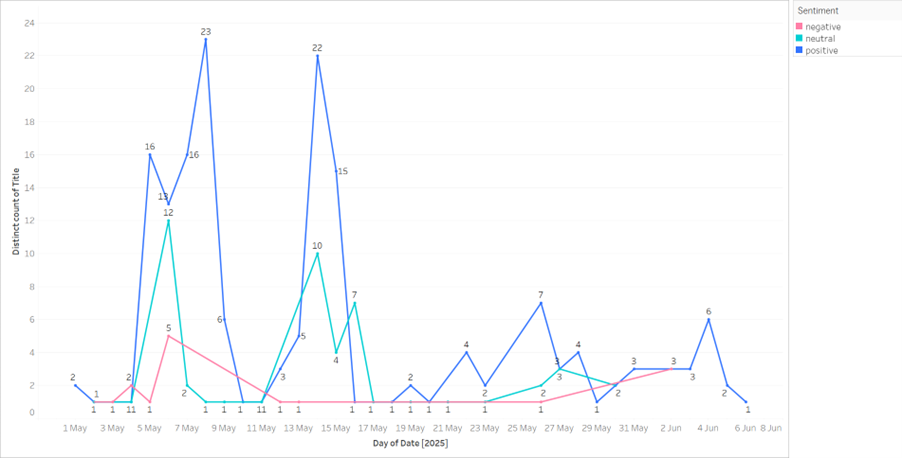
During May Indika generated 134 ESG-related stories with a composite index of 45.02—placing the company in the Safe (BB) zone, though vigilance is still advised. Positive coverage dominated, linking Indika to the national shift toward green business and infrastructure in eastern Indonesia.

A closer look shows the Environmental pillar’s highest-risk issue was resource efficiency and conservation, tied to coverage of subsidiary Interport and its logistics expansion. The risk spike arose not from negative sentiment but from low-credibility sources: 15 of the 19 articles came from unverified regional portals, inflating the index.
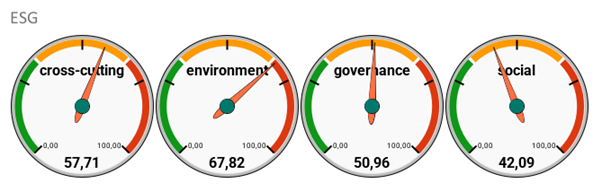
Implication – Indika’s reputation was healthy overall, yet the firm could reinforce its positive narrative by partnering with verified, higher-credibility outlets.
In a world of complex environmental and social challenges, ESG serves as a strategic compass. When businesses and investors grasp its meaning, function, and analytical use—especially through modern media-monitoring platforms—they can align action with public expectation and sustainability goals.
Writer: Fajar Yudha Susilo, Ilustrator: Aan K. Riyadi

AI brand visibility is how often, how accurately, and in what context your brand appears in answers from AI-powered search…

binomedia

The DTSEN social assistance decile controversy in 2026 is not merely about inaccurate data. Media monitoring and digital conversation analysis…
binomedia

Indonesia’s gross domestic product (GDP) grew by 5.29 percent in the second quarter of 2026. This figure exceeded the median…
binomedia

Artificial intelligence (AI) is transforming education faster than most education systems can respond. Machines can now search for information, summarize…
binomedia

One Event, Two Market Moves On Monday, August 10, 2026, Indonesia’s rupiah closed 0.79% higher at IDR 17,755 per US…
binomedia

On Thursday, July 30, 2026, Indonesian President Prabowo Subianto announced a “cleanest city” competition. The top five cities would win…
binomedia

Before dawn on Friday, 24 July 2026, a mob in Bali beat a man to death. He is identified only…
binomedia

Gen Z is increasingly tuning out advertisements that look overly polished and perfect. Instead, they tend to trust recommendations from…
binomedia

On June 10, 2026, Indomie brought back its Goreng Cabe Ijo flavor after the product had been difficult to find…
binomedia

Companies today use AI to read customer data, monitor public conversations, measure reputation, map issues, and support strategic decision-making. In…
binomedia