

Indonesia’s Asset Forfeiture Law and the Trust Gap Online
Indonesia’s House of Representatives passed the Asset Forfeiture Law on 19 November 2026, and the public did not respond with…
-
binomedia
- November 20, 2026

Media monitoring is the process of monitoring, collecting, and analyzing news and conversations about a topic, brand, figure, or issue across various media, whether online, print, television, radio, or social media. The results are used to understand what is being discussed, who is speaking, and the tone.
Media monitoring runs in four stages: determining keywords, collecting data, analyzing, and reporting. Most stages are automatic, but the results are more accurate when someone filters and checks the data. The Kemkomdigi media monitoring guidelines detail a similar flow in five stages: planning, data collection, visualization, analysis, and reporting.
Write the brand name, figure, product, or issue you want to monitor, including the writing variations. Boolean operators help sharpen the results. The keyword “Jakarta Running Festival” AND (COP OR barricade), for example, only captures news containing both elements, while the NOT operator omits words that cause the results to be off-balanced.
The system continuously pulls articles and uploads from many sources, then discards irrelevant results, for example, news that happens to contain the same keywords but discuss something else. Newstensity, for example, covers more than 10,000 online media, 185 print media, and 34 electronic media, namely television and radio channels.
Data are grouped based on news volume, sentiment (positive, neutral, negative), media, figures mentioned, and the results are presented in a dashboard or report for easy reading and follow-up.
What is monitored in the media monitoring?
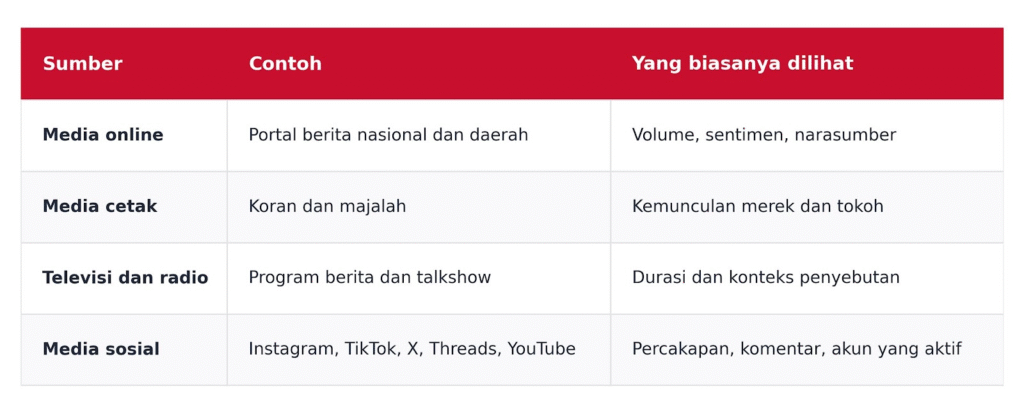
The flow works on four source groups: online media, print media, television and radio, and social media. The Kemkomdigi guidelines include all four within the scope of media monitoring. Each group has something that is usually observed, as shown in the following table.
Media monitoring helps the communication team make decisions based on news data. Its benefits include the following seven things:
Maintaining reputation. Negative news is detected early before it grows larger.
Managing crises. The communication team can prepare responses based on data.
Measuring campaigns. The impact of press releases or PR campaigns is evident from the number and tone of the news.
Monitor competitors. It remains to be seen who is receiving media attention and with what narrative.
Finding opportunities. Rising issues can be used for content or official statements.
Countering disinformation. The incorrect narrative was evident from the start, so clarifications could be prepared more quickly.
Evaluating media relations. News results show which media respond to your activities and press releases.
The last two benefits are listed in the Kemkomdigi guidelines for government public relations. PR agencies and corporate communications teams use the same logic for their needs.
Media monitoring is needed by anyone whose decisions are influenced by what is reported and discussed by the public. Its users include government agencies, companies, PR and communication agencies, political parties, research institutions, and journalists.
Each user’s needs are different. The agency’s public relations read responses to policies, PR agencies reported campaign results to clients, and researchers compared how the media framed an issue. In companies, the users include the investor relations, corporate communication, and corporate secretary departments. Binocular itself has partnered with more than 300 companies.
Media monitoring is an umbrella that monitors news and conversations across all types of media. Social listening narrows the focus to conversations, comments, and reactions of netizens on social media. Both complement each other. From the news, you know what the media is carrying. From social media, you know how netizens react to it. A policy can be reported positively by the media, while conversations on social media tend to be critical. Teams that want to know whether the two are aligned need both types of monitoring. On Binokular, Newstensity monitors news, while Socindex monitors conversations on social media.
A published example is an analysis from Jangkara, a digital research service using Newstensity and Socindex data, about the COP incident at the Jakarta Running Festival 2026, written by Devi Novita Sari and published on November 6, 2026. On October 24, 2026, footage from the race time limit (COP) at kilometer 10.5 circulated on social media. The footage shows participants crowding and trying to break through the barricade after the time limit has passed.
Newstensity recorded 493 articles about the event from October 21 to 23, before the incident, and 984 articles from October 24 to 26. News coverage nearly doubled in the three days since the incident. Socindex recorded 17,903 conversations with the keyword “Jakarta Running Festival” from October 24 to 26, with sentiments of 12,655 neutral, 3,363 negative, and 1,885 positive. This sentiment counts all conversations with those keywords, including those that do not address incidents.
Devi Novita Sari concluded that this incident should not stop at the question of who is at fault. He sees it as evaluation material for organizers and participants. Because the units are different, namely articles and conversations, the two numbers are read side by side. For the organizing communication team, the surge in news indicates when clarifications need to be released, while conversational sentiment helps adjust the tone of the message.
Media monitoring provides an overview of news coverage and conversations. There are three limitations you need to remember before reading the numbers: automatic sentiment can be off-putting, no service reaches all sources, and data is not yet conclusive.
Sentiment can automatically be wrong. Satire, slang, and complicated contexts are often difficult for machines to read, so some results need to be checked by humans. Newstensity sentiment assesses the tone of the headline and news content, so the numbers reflect the tone of the news, not the editorial stance or public opinion. The total number can also mask changes within it. In the analysis of the October 28, 2026 demo, 68% of the 1,623 news reports were positive, but the tone changed throughout the day. In the morning, the media uses the word “orderly” as hope, while at night uses the word “chaotic” as the report. One percentage for three days showed no such change.
There is no service that covers all sources. Some sources can be missed, and strong services in online media may not necessarily include radio or regional media. Ask about media coverage and unmonitored sources before choosing a service.
The data has not yet been conclusive. Volume and sentiment figures only become useful after someone interprets them in the context of the issue. Two teams with the same data can draw different conclusions if the analysis objectives are unclear.
Choose a service whose media coverage suits your needs, whose analysis is accurate, and whose team helps interpret the data. The Kemkomdigi guidelines detail eight criteria for assessing service providers:
Your goals, such as reputation, crisis, or campaign, determine the necessary features. Ask: which features do clients use for similar purposes?
The sources are broad and relevant to the Indonesian context. Ask: how many online, print, television, radio, and social platforms are monitored, and are regional media included?
Data is updated quickly. Ask: how long is the lag from publication until the data appears on the dashboard?
Sentiment analysis and topic classification can be understood. Ask: how is sentiment assessed, and what object is it assessed?
Ask: can you see sample reports or contact clients who have used the service?
Ask: where is the data stored, and who can access it?
The dashboard is easy to read and reports can be downloaded. Ask: what report formats are available, and how often are reports submitted?
The team helped interpret the results. Ask: who assists in data interpretation, and through which channels?
Request a demo or trial on a topic you are familiar with. The results quickly show whether the coverage and analysis of the service are relevant to you.
When comparing media monitoring services, several things to consider are source coverage, how the data is analyzed, archive availability, and the form of analysis support. Binocular offers several service options for these needs, ranging from technology-based monitoring to data processing with human involvement.
Binocular media include online, print, television, and radio media. This coverage is relevant for organizations that need to follow news across various channels. For example, an issue might appear in a regional newspaper before it gets national media attention. Therefore, when comparing providers, check whether sources important to your organization are included in their monitoring.
Binokular provides Newstensity, which uses AI to assist sentiment setting, as well as Bino Premium, which involves humans in maintaining data accuracy. This option is a consideration for teams that require automatic data processing or further examination. When comparing services, ask which parts are processed by machines and which parts are inspected by humans.
The Binocular news article database has been recorded since 2013. Historical archives provide a basis for tracing news developments and comparing issues between periods. The availability of data for certain topics and access to them still need to be confirmed according to the chosen service.
Within the Binocular ecosystem, Newstensity is used for news monitoring, Socindex for social media monitoring, and Jangkara for digital research. Organizations can consider services according to the questions they want answered: how the media reports on an issue, how netizens respond to it, or what the findings mean for communication strategies.
These differences need to be assessed through demos with the same keywords and issues. This way, you can compare the relevance of results, source coverage, and depth of analysis based on organizational needs.
Media monitoring focuses on collecting and monitoring data about what is said and by whom. Media intelligence adds in-depth analysis and strategic recommendations. Cision stated that media monitoring is tactical and reactive, while media intelligence is strategic and proactive. Isentia describes monitoring as the foundation that tracks brand and keyword emergence, while intelligence adds context about what it means for strategy.
No. Researchers, journalists, government agencies, and marketing teams also use it. PR is indeed the most common user, but other needs are just as real. Researchers examine how media frame an issue, journalists trace how the issue unfolds, and marketing teams read market responses to products and campaigns.
Yes, depending on the service. Some services combine news and social media monitoring on a single platform, while others separate them. First, check whether your needs include news, social media, or both, then ask which platforms are being monitored. Newstensity monitors news coverage, while Socindex monitors conversations on social media.
The answer depends on the service and the type of source. The automated system can continuously pull data, and reports are presented daily, weekly, or as needed. Ask how long the gap is between publication and the data appearing on the dashboard. The Ministry of Communication and Technology’s guidelines for monitoring during crises state that initial reports are made within 2 hours, so data gaps have a direct impact. Socindex provides social media monitoring in a single dashboard that can be accessed 24 hours a day.
The range depends on the service and subscription package. Historical data is useful for comparing this year’s campaign with last year’s, identifying seasonal issues, and assessing whether a surge in news coverage is considered normal. Ask about data setbacks, whether old data can be downloaded, and whether the range differs between packages before subscribing. The Newstensity article database, for example, has been recorded since 2013.
For simple needs, Google Alerts can be a starting point. This free service sends emails when there are new results in Google Search for the topic you specify. Because the scope is search results, you don’t get sentiment dashboards, cross-period comparisons, or periodic reports. If needed, consider specialized monitoring services.
The COP incident example earlier demonstrates the practical benefits of media monitoring. In the three days since the incident, the volume of news nearly doubled and 17,903 conversations appeared on social media, allowing organizers to determine when and with what tone to respond. Start with one issue that is most important to your organization. Request a Binocular demo and try it on topics you know.

Indonesia’s House of Representatives passed the Asset Forfeiture Law on 19 November 2026, and the public did not respond with…

binomedia

Indonesia Corruption Watch (ICW) findings regarding influencer service contracts have been widely discussed since November 9, 2026 night. ICW highlighted…
binomedia

Today, you can start building an app by giving an AI instructions in plain language. This approach is called vibe…
binomedia

On Wednesday, October 28, 2026, students and civil society groups held the #IndonesiaSadar protest at Bundaran HI, the Hotel Indonesia…
binomedia

What Is “Downgrade Lifestyle” and Why Is It Trending on Threads? Since early September 2026, the term “downgrade lifestyle” has…
binomedia

You can no longer tell AI astroturfing from genuine public opinion by reading the text. Generative AI writes as fluently…
binomedia

Who controls money in the blockchain era? When Bitcoin launched in 2008, the answer sounded simple: no single party, because…
binomedia

The debate over whether AI development should slow down is no longer theoretical. In September 2026, the CEOs of the…
binomedia

AI brand visibility is how often, how accurately, and in what context your brand appears in answers from AI-powered search…
binomedia

The DTSEN social assistance decile controversy in 2026 is not merely about inaccurate data. Media monitoring and digital conversation analysis…
binomedia