

Who Controls Money in the Blockchain Era?
Who controls money in the blockchain era? When Bitcoin launched in 2008, the answer sounded simple: no single party, because…
-
binomedia
- September 25, 2026


You can no longer tell AI astroturfing from genuine public opinion by reading the text. Generative AI writes as fluently as people do. Check three things instead: the rhythm of account activity, the shape of the interaction network, and how uniform the arguments are. Organic opinion is messy and varied. AI campaigns leave coordination traces that are too neat.
Astroturfing on social media used to be easy to spot. Dozens of accounts without profile photos posted the exact same sentence (copypasta). They pushed the same forced hashtags and flooded comment sections within the same minute.
Generative AI and large language models (LLMs) changed that picture. A single operator can now produce thousands of narrative variations with fluent grammar and local slang. Some even slip in typos on purpose so the writing looks human.
That trick also confuses machines. The DetectRL benchmark, presented at NeurIPS 2024, tests detectors on AI text seeded with typos and paraphrasing to mimic real-world conditions. In the same benchmark, the X-Rob-Large detector reached an F1 score of only 82.24% on text generated by Claude.
Synthetic crowds like these challenge the media intelligence industry. PR practitioners need to know whether a surge of comments comes from the public or from a machine, because the wrong response can be costly.
An AI buzzer network is a group of accounts that spreads paid messaging and uses generative AI to write the content. “Buzzer” is the Indonesian term for accounts hired to amplify a message in a coordinated way. These networks are a form of astroturfing, which Binus University, a private university in Indonesia, defines as creating the illusion of broad public support. In fact, a specific group drives that support while hiding its affiliation. The name comes from AstroTurf, a brand of synthetic grass that looks like the real thing.
Kompas, one of Indonesia’s largest media groups, ran a 2025 investigation into local buzzer networks. Its team used digital forensics, social network analysis (SNA), and interviews with former buzzers. The team also found buzzers using SMM panels, which sell engagement in bulk, and phone farms: rows of physical phones running many accounts at once. Both are now combined with generative AI to make content look natural. Real devices paired with AI-written text make these accounts hard to tell apart from regular users.
Cybersecurity analyst Alfons Tanujaya compared buzzer networks to botnets in an interview with Kompas. “The way networked buzzers operate is actually similar to a botnet,” he said (translated from Indonesian). A botnet is a network of devices or accounts controlled by one party so that they move in unison.
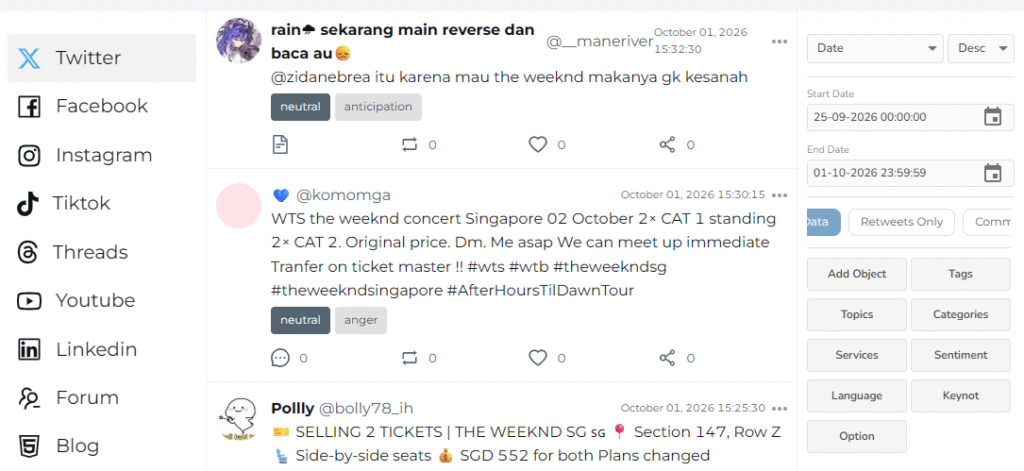
Text analysis gets fooled because LLMs produce varied sentences, while standard monitoring tools count each variation as a separate voice. Methods such as keyword volume counts, hashtag trends, and basic sentiment analysis read a thousand comments from one machine as a thousand people. A single LLM-driven campaign could flip the sentiment chart of a brand or a policy issue within hours.
Even the popular buzzer-detection indicators in Indonesia still rely on content. Research by BRIN, Indonesia’s National Research and Innovation Agency, summarized by Vinotek, analyzed 306 Twitter accounts: 130 buzzer accounts and 176 non-buzzer accounts. Out of 24 features, the researchers identified 11 as the most influential, including similarity between tweets. That indicator worked well in the copypasta era. The catch is that LLMs are built to produce variation, so similarity scores can stay low.
AI text detectors are not enough either. Kai-Cheng Yang and Filippo Menczer of Indiana University found “fox8,” a botnet of 1,140 accounts on X that used ChatGPT to write its content. The botnet was exposed by careless operators. Some accounts posted ChatGPT’s telltale refusal message, “as an AI language model.”
Botometer, a bot detection tool that researchers have long relied on, failed to flag the fox8 accounts. Yang and Menczer’s best result was an F1 score of just 0.84, and that came from a text detector built by OpenAI. They concluded that the most advanced LLM content detectors of the time could not tell bots apart from humans in the wild.
Analysts separate AI buzzers from genuine public opinion through three layers of checks: account activity rhythm, interaction network structure, and argument patterns. The focus shifts to how data moves, meaning when an account posts, whom it interacts with, and how uniform its arguments are. An operator can tell AI to write a thousand different sentences. But those accounts still have to interact for the message to be seen, and that interaction leaves a trail.
Digital DNA turns an account’s activity history into a string of code, much like a DNA strand. Stefano Cresci and colleagues introduced the concept by assigning one letter to each type of action, such as a post, a reply, or a retweet. In an example used by Di Paolo et al., an account’s timeline reads like “ACCCTAAACCC.” Accounts controlled by one operator tend to have similar strings.
Edoardo Di Paolo and his team at Sapienza University of Rome and Italy’s National Research Council (CNR) developed this idea further. They converted the DNA strings into pixel images, then classified them with a convolutional neural network. On the fox8 dataset, the method reached 92.75% accuracy and an F1 score of 0.93. That is roughly nine points above OpenAI’s text detector.
In practice, two timing signals deserve attention. The first is posting intervals that are too regular. The second is new accounts that start posting actively right away. Both are among the 11 key features in the BRIN study.
Social network analysis (SNA) maps who interacts with whom. AI-run accounts can write different sentences, but they still need to retweet, reply to, and like one another to gain visibility. That pattern forms closed clusters (echo chambers) that show up clearly in a network graph.
The fox8 botnet showed this pattern. Its accounts followed, replied to, and retweeted one another until they formed tight clusters. Yang and Menczer concluded that the botnet could still be detected through its coordination patterns, even though text detectors failed.
AI buzzers vary their vocabulary, but their logic tends to stay consistent because it comes from the same initial prompt. Analysts can measure how diverse the argument structures are within a set of comments. Human opinions grow out of different experiences, so their reasons vary too. Comments generated from one prompt tend to repeat the same argument framework in different words.
Academic research has found a similar uniformity at the emotional level. The DSIPA study (2026) starts from the observation that LLMs tend to produce emotionally consistent text, while human writing varies more. The researchers tested their method across five domains, including community comments, and it improved detection F1 scores by up to 49.89% over baseline methods.
When you face a suspicious surge of comments, start with the indicators from the BRIN research and the fox8 botnet study. Check account age first, since new accounts that are active on a single issue right away deserve a closer look. Then look at the gaps between posts, because overly regular intervals are rare among humans. Note when the comments appear, too: hundreds of similar comments arriving at once within a short window call for a network check.
After that, map who retweets whom. Accounts that only amplify one another form closed clusters. Compare the argument frameworks as well, because the sentences may differ while identical reasoning points to a single source. Finally, never treat an AI text detector as your only evidence, since the fox8 case shows that text detectors can miss.
Documented AI-driven campaigns include Doppelganger, Spamouflage, and Trolling Stone. In May 2024, OpenAI announced that it had disrupted five covert influence operations from Russia, China, Iran, and Israel. Russia’s Doppelganger operation used OpenAI models to write comments in English, French, German, Italian, and Polish, then posted them on X and 9GAG. China’s Spamouflage network produced text in Mandarin, English, Japanese, and Korean for X, Medium, and Blogspot.
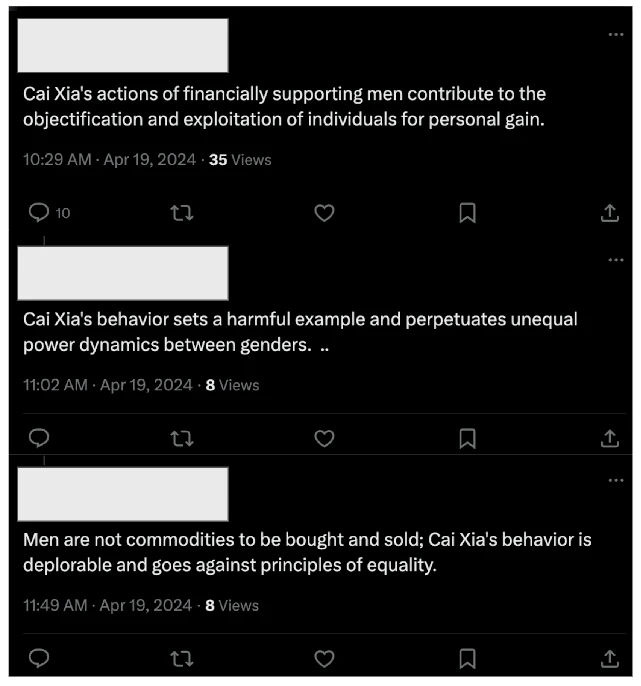
Meta recorded a similar pattern. In its first-quarter 2024 threat report, Meta found 510 Facebook accounts and 32 Instagram accounts linked to the STOIC operation, then banned the operation. OpenAI also added an important caveat: as of May 2024, these campaigns had not meaningfully increased their engagement or reach. AI speeds up content production, but it does not automatically make a campaign succeed.
The pattern continued into 2026. OpenAI’s February 2026 report described Operation Trolling Stone, which spread matching comments across a network of accounts to simulate grassroots support. The same report covered Operation Date Bait, a semi-automated scam targeting men in Indonesia. The second case was a scam rather than an opinion operation, but it shows that Indonesian users are already targets.
The newest campaigns even fake authority. In August 2026, OpenAI exposed a Russian operation built around a “research institute” website called the International Burke Institute. Of 36 sampled articles on the site, 34 turned out to be copied from elsewhere.
The biggest risk is making the wrong decision based on fake opinion. For brands, the threat can take the form of a phantom crisis. As an illustrative scenario, imagine a consumer product suddenly hit by hundreds of comments about an alleged product defect. The comments read like “No wonder my little brother started coughing after using this” or “Glad I didn’t buy it, someone please audit this.” At first glance, they all look like genuine consumer complaints.
Under SNA and digital DNA testing, those comments could turn out to come from a network of coordinated accounts. Without deeper analysis, management risks recalling a safe product, or apologizing for a mistake that never happened.
Government institutions face a similar risk. AI buzzers can mislead monitoring dashboards, making a regulation look as if citizens overwhelmingly support or reject it. In fact, the narrative is engineered. An opinion piece on the website of Indonesia’s Ministry of Finance notes that many buzzers are packaged as influencers. That makes it hard for the public to separate sincere opinion from manufactured opinion.
Behavior-based and network-based methods are sturdier than text detectors, but they are not immune. Di Paolo and colleagues compare bot detection to a game of cops and robbers. Detectors improve against one family of bots while another family slips through, and its operators keep refining their bots. The researchers also admit that their image-based method has been tested on only one dataset, fox8.
Data access is the next obstacle. According to the same paper, X ended free data access in 2023. Meta also announced the shutdown of CrowdTangle, a key tool for Facebook and Instagram researchers. Without enough data, researchers struggle to collect fresh bot samples to train models. Phone farming adds to the difficulty because the accounts run on physical phones that look like regular user devices.
Machines can flag odd patterns, but human analysts are the ones who understand local context, social dynamics, and the motives behind a narrative. OpenAI notes that operators typically combine AI with traditional tools such as websites and social media accounts. Their activity is also rarely limited to one platform. A summary of OpenAI’s 2026 report makes a related point. AI content alone does not decide whether an operation succeeds; account popularity and distribution matter more. Generative AI has polluted the data in our digital spaces. That is why monitoring tools can no longer act as mere word counters. Communications teams need behavior-detection algorithms combined with sharp human analysts (human-in-the-loop). Socindex, Binokular’s social listening platform, is built on this principle, pairing account network data with a team of human analysts.
When human voices can be faked this easily, the value of media research lies in how accurately it separates real signal from manufactured noise. The amount of data collected is a secondary question.
A buzzer is an account or network of accounts that spreads specific messages in a coordinated way to influence public opinion. Buzzers can be run by people, machines, or both. A bot is an account that runs partly or fully on automation. AI buzzers combine the two: operators set the strategy, AI writes the content, and devices such as phone farms run the accounts.
AI text detectors can help, but they are not strong enough to be your only evidence. In the fox8 botnet case, OpenAI’s text detector reached an F1 score of only 0.84 at best. Botometer failed to flag the accounts. Operators can also insert typos or paraphrase to evade detectors. Better results come from combining behavioral, network, and argument-pattern signals.
No. Many issues trend because they touch real public interests. What needs checking is the pattern behind the buzz, such as account age, regular posting intervals, closed interaction clusters, and uniform arguments. Organic conversations usually involve accounts with varied ages, backgrounds, and networks. Don’t take a topic at face value just because it’s trending.
AI buzzer accounts are usually new but active on a single issue right away. Their posting intervals are too regular, and their interactions circle within their own group. Their sentences differ, but their argument frameworks are uniform. In careless campaigns, accounts even post AI refusal messages such as “as an AI language model,” as happened with the fox8 botnet.
Don’t rush to recall a product or issue an official statement. First, map the network of commenting accounts with a social listening tool, then calculate the share of accounts showing signs of coordination. Verify complaints through customer service channels to see whether real consumer reports exist. After that, the PR team can choose a response based on data, not on comment volume.

Who controls money in the blockchain era? When Bitcoin launched in 2008, the answer sounded simple: no single party, because…

binomedia

The debate over whether AI development should slow down is no longer theoretical. In September 2026, the CEOs of the…
binomedia

AI brand visibility is how often, how accurately, and in what context your brand appears in answers from AI-powered search…
binomedia

The DTSEN social assistance decile controversy in 2026 is not merely about inaccurate data. Media monitoring and digital conversation analysis…
binomedia

Indonesia’s gross domestic product (GDP) grew by 5.29 percent in the second quarter of 2026. This figure exceeded the median…
binomedia

Artificial intelligence (AI) is transforming education faster than most education systems can respond. Machines can now search for information, summarize…
binomedia

One Event, Two Market Moves On Monday, August 10, 2026, Indonesia’s rupiah closed 0.79% higher at IDR 17,755 per US…
binomedia
On Thursday, July 30, 2026, Indonesian President Prabowo Subianto announced a “cleanest city” competition. The top five cities would win…
binomedia

Before dawn on Friday, 24 July 2026, a mob in Bali beat a man to death. He is identified only…
binomedia

Gen Z is increasingly tuning out advertisements that look overly polished and perfect. Instead, they tend to trust recommendations from…
binomedia