

How to Tell AI Astroturfing From Genuine Public Opinion
You can no longer tell AI astroturfing from genuine public opinion by reading the text. Generative AI writes as fluently…
-
binomedia
- October 2, 2026

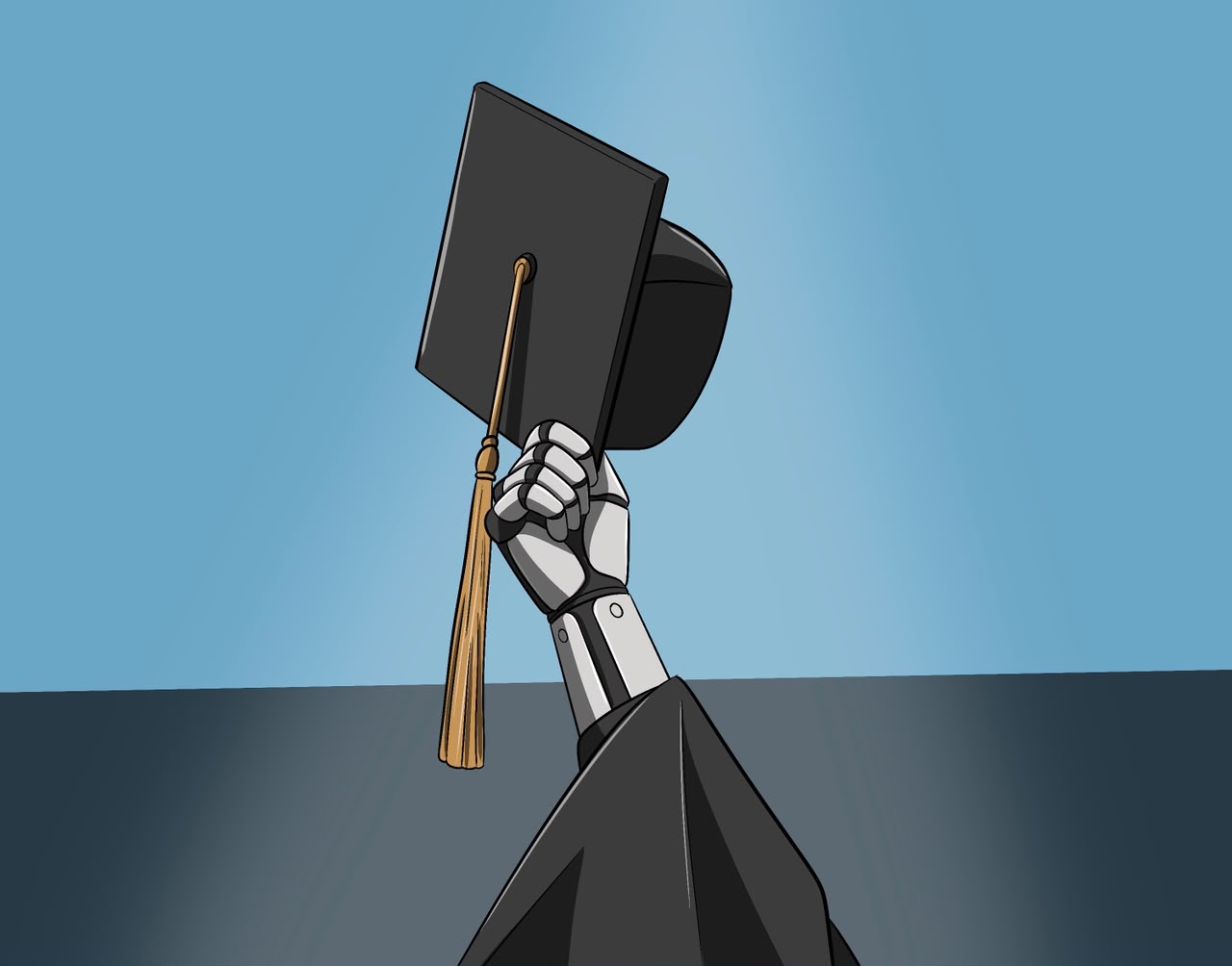
Artificial intelligence (AI) is transforming education faster than most education systems can respond. Machines can now search for information, summarize reading materials, and generate answers within seconds. These changes make learning easier, but they also create risks that are rarely discussed. Students who become accustomed to receiving instant answers from AI may gradually lose the habit of thinking critically and evaluating information independently.
Estonia’s Minister of Education and Research, Kristina Kallas, raised this paradox during a TEDx University of Tartu forum on June 2, 2026. Kallas did not begin by discussing technological sophistication, but instead emphasized that she would be talking about humans, not AI. This perspective matters because much of the discussion surrounding AI in education remains focused on the question, “What can AI do?” Far less attention is given to another important question: “What happens to humans when AI does it for them?”

According to Kallas, AI’s ability to answer questions creates a new problem. The more cognitive tasks humans delegate to machines, the fewer opportunities the human brain has to practice higher-order thinking skills. Research published in the journal Societies by Gerlich (2025) reinforces this concern. Based on 666 respondents across different age groups and backgrounds, the study found a strong negative correlation between the intensity of AI tool use and critical-thinking ability, with people aged 17–25 showing the highest level of vulnerability.
This phenomenon has a name in cognitive science: cognitive offloading. Understanding the concept is essential because it helps explain why AI’s potential impact on human thinking is more than a speculative concern.
Cognitive offloading refers to the human tendency to transfer thinking processes to external tools, a concept formulated by Risko and Gilbert (2016). In principle, cognitive offloading can be adaptive because writing down a shopping list or using a calculator can free up mental capacity for more important tasks. Problems arise when this behavior expands into processes that are supposed to develop cognitive abilities. These include analyzing arguments, evaluating evidence, and developing new ideas.
Kallas uses an analogy from the history of literacy to illustrate the scale of this change. When the printing press was invented, reading evolved from a skill possessed by a limited group of people into an essential ability expected of everyone. A similar shift is taking place today as AI increasingly handles tasks involving memory and summarization. As a result, the skills people need are shifting toward analysis, evaluation, and creation.
Kallas’ framework refers to the revised Bloom’s Taxonomy, which divides cognitive abilities into six levels: remembering, understanding, applying, analyzing, evaluating, and creating. The first three require relatively lower levels of cognitive effort, while the final three demand significantly greater mental effort.
Kallas also distinguishes between two modes of brain activity. The first is largely automatic and includes remembering facts, performing habitual actions, and repeating procedures that have already been mastered. The second requires substantially more energy and involves comparing evidence, questioning assumptions, and constructing new arguments. The human brain naturally tends to favor pathways that require the least amount of energy.
When AI provides shortcuts for tasks at the lower three levels, opportunities to practice the higher three levels can become more limited. However, some education observers caution against interpreting this division too literally as a fact of neuroscience. Bloom’s Taxonomy is better understood as a practical framework for educators designing learning activities. It should not be treated as a biological map of how the human brain works.
A study from the MIT Media Lab provides additional experimental evidence. Researchers divided 54 participants into three groups: those who wrote essays using ChatGPT, those who used Google Search, and those who worked without digital assistance. The group using generative AI demonstrated the lowest level of brain activity and produced the weakest writing results across neural, linguistic, and behavioral measures. The findings underline that the convenience offered by AI may not come without consequences.
However, not every study has reached the same conclusion. Research involving 121 students at Universitas Negeri Semarang (UNNES) found that AI use had a positive effect on critical-thinking skills. The crucial distinction was how AI was used, rather than simply how often it was used. These contrasting findings strengthen the argument that the design and manner of AI use are critical factors in determining its impact.
Estonia has responded to the challenge of cognitive offloading differently from many other countries. Instead of banning AI from classrooms, the Estonian government launched the AI Leap program in September 2025. The program involves around 20,000 students in grades 10 and 11 across all 154 upper-secondary schools in the country, along with approximately 4,900 teachers. First-year investment reached €4 million, jointly funded by the education ministry and private-sector partners.
What distinguishes AI Leap from an ordinary software distribution program is its pedagogical design. Estonia has worked with OpenAI and Anthropic to develop AI tutors based on a Socratic approach. Instead of immediately giving students answers, the learning application responds with a series of questions designed to force students to continue thinking. Students who have tested the application reportedly described it as “annoying” because it keeps asking questions instead of simply providing the answer, while program administrators regard that reaction as an indication that the system is working as intended.
Before AI Leap was introduced, between 64% and 90% of Estonian students were already using commercial AI tools to complete school assignments. Program administrators concluded that unguided AI use could undermine students’ critical thinking, concentration, and creativity. AI Leap was therefore designed not to prohibit AI, but to change how students interact with it. The goal is to ensure that students continue thinking rather than simply handing the cognitive process over to a machine.
Indonesia has approached a similar challenge from a different direction. On March 12, 2026, seven ministers signed Joint Ministerial Decree (SKB) Number 400.1-492 of 2026, which provides guidelines for the use and teaching of digital technology and artificial intelligence in formal, non-formal, and informal education. The decree represents Indonesia’s first regulation specifically addressing how AI may and may not be used within an educational context. It establishes a formal framework for schools and other educational institutions as AI becomes increasingly integrated into learning.
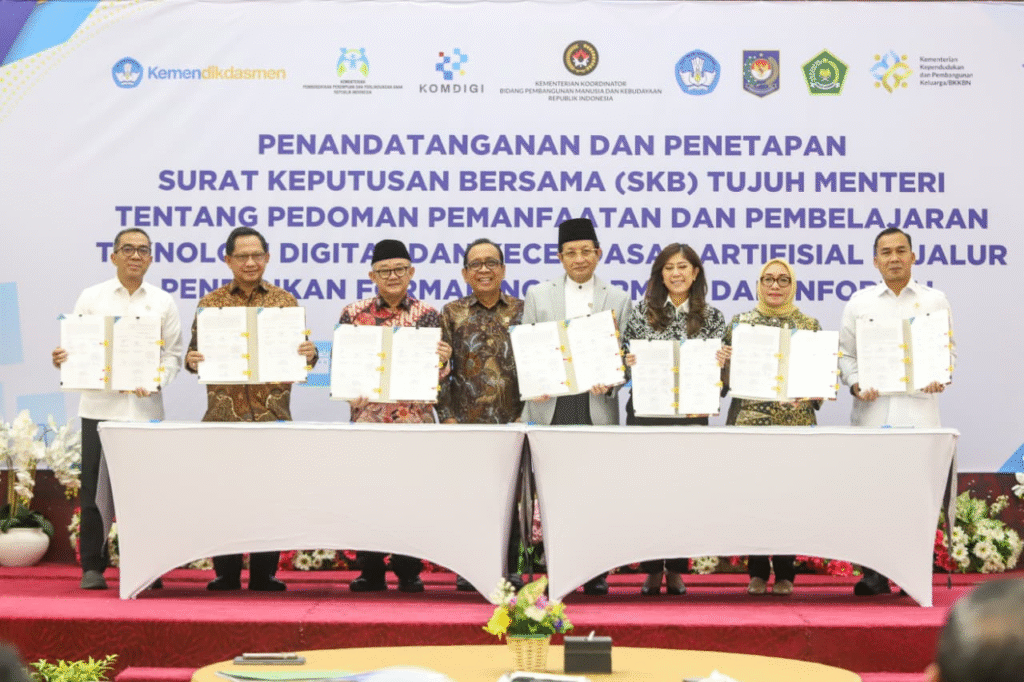
The joint decree explicitly states that AI use in education must be human-centered. Technology should function as a tool for strengthening students’ intellectual capacity rather than becoming a substitute that causes critical-thinking abilities to decline because of dependence on instant results. The decree even uses the term “cognitive debt” to describe this risk. This wording reflects concern that excessive dependence on AI could gradually weaken the thinking processes education is supposed to develop.
Coordinating Minister for Human Development and Cultural Affairs Pratikno emphasized that digital technology and AI should empower children rather than manipulate or disadvantage them. Minister of Communication and Digital Affairs Meutya Hafid also highlighted the large number of children using the internet in Indonesia as a key reason why protection must remain a priority.
The seven ministries involved include the Ministry of Home Affairs, Ministry of Religious Affairs, Ministry of Primary and Secondary Education, Ministry of Higher Education, Science, and Technology, Ministry of Communication and Digital Affairs, Ministry of Women’s Empowerment and Child Protection, and Ministry of Population and Family Development. The cross-sector scope reflects recognition that AI governance in education cannot be handled by a single ministry. Minister of Primary and Secondary Education Abdul Mu’ti said that 55,000 teachers had already received training across Indonesia. Coding and AI subjects have also been available as optional subjects starting from Grade 5 of elementary school since the 2025–2026 academic year.
Both countries begin with the same concern: younger generations may gradually lose their ability to think deeply amid the convenience offered by AI. Their responses, however, are different because each country is addressing the issue through a different policy mechanism.
Estonia has chosen to address the issue by changing how its population is taught to interact with AI from an early stage. Its government works directly with global AI developers to redesign how students engage with the technology. The result is an AI tutor deliberately designed to be somewhat “annoying” by forcing students to think rather than simply handing over answers. This approach addresses cognitive offloading directly at the product-design level.
Indonesia has taken a regulatory and coordinative path. The Seven-Minister Joint Decree establishes ethical principles, distributes responsibilities across ministries, and provides clear boundaries for educational institutions. The approach creates a governance foundation that previously did not exist. Schools now have a formal reference for determining how AI should be used in their classrooms.
Differences in scale also influence the two countries’ choices. Estonia has around 154 upper-secondary schools and a relatively small population, making coordinated nationwide experimentation more manageable. Indonesia faces a vastly different challenge involving hundreds of thousands of educational institutions, infrastructure gaps between regions, and significant differences in teacher readiness. In that context, establishing a cross-ministerial regulatory framework is a logical foundational step, although implementation at the school level will require time before its outcomes can be properly measured.
There is also one important similarity between the two approaches. Both Indonesia’s joint decree and Estonia’s AI Leap program argue that AI should not simply be banned, but instead managed in ways that support human thinking. Indonesia’s decree uses the term “human-centered,” while AI Leap applies the principle of “learn to think with AI, not let AI think for you.” Both formulations point toward the same objective, even though their implementation tools differ.
Both approaches are still at an early stage. AI Leap is collecting data from student chat logs and standardized cognitive tests through a large-scale randomized controlled trial, while Indonesia does not yet have an equivalent evaluation mechanism. The effectiveness of both policies may only become clear several years from now, when sufficient data on their cognitive impact on students become available. However, the question they are attempting to answer applies to anyone who interacts with AI every day.
The habit of relying on AI for quick answers is not limited to students. Professionals in many fields, from journalists to data analysts, now use generative AI as part of their everyday working routines. The same question therefore applies outside education: does using AI encourage people to think more critically, or does it gradually weaken the habit of verifying, comparing, and evaluating information?
The debate raised by Kallas and the policy introduced by Indonesia touch on a principle that extends far beyond school policy. The way people design their interactions with AI determines whether the technology strengthens or weakens their ability to think. A Socratic tutor that forces students to respond to further questions and an ethical framework that encourages skepticism toward AI-generated outputs represent two versions of the same principle. Humans must remain the ones doing the thinking rather than becoming passive recipients of answers.
The principle behind Estonia’s experiment and Indonesia’s policy is easy to understand, even though consistently applying it is much more difficult. AI should be positioned as a tool that supports thinking, not as a replacement for the thinking process itself.
The distinction ultimately comes down to how people interact with the technology. Does using AI encourage someone to ask additional questions and consider different perspectives, or does it make them stop thinking once an answer appears?

You can no longer tell AI astroturfing from genuine public opinion by reading the text. Generative AI writes as fluently…

binomedia

Who controls money in the blockchain era? When Bitcoin launched in 2008, the answer sounded simple: no single party, because…
binomedia
The debate over whether AI development should slow down is no longer theoretical. In September 2026, the CEOs of the…
binomedia

AI brand visibility is how often, how accurately, and in what context your brand appears in answers from AI-powered search…
binomedia

The DTSEN social assistance decile controversy in 2026 is not merely about inaccurate data. Media monitoring and digital conversation analysis…
binomedia

Indonesia’s gross domestic product (GDP) grew by 5.29 percent in the second quarter of 2026. This figure exceeded the median…
binomedia

One Event, Two Market Moves On Monday, August 10, 2026, Indonesia’s rupiah closed 0.79% higher at IDR 17,755 per US…
binomedia

On Thursday, July 30, 2026, Indonesian President Prabowo Subianto announced a “cleanest city” competition. The top five cities would win…
binomedia

Before dawn on Friday, 24 July 2026, a mob in Bali beat a man to death. He is identified only…
binomedia

Gen Z is increasingly tuning out advertisements that look overly polished and perfect. Instead, they tend to trust recommendations from…
binomedia