

How to Tell AI Astroturfing From Genuine Public Opinion
You can no longer tell AI astroturfing from genuine public opinion by reading the text. Generative AI writes as fluently…
-
binomedia
- October 2, 2026

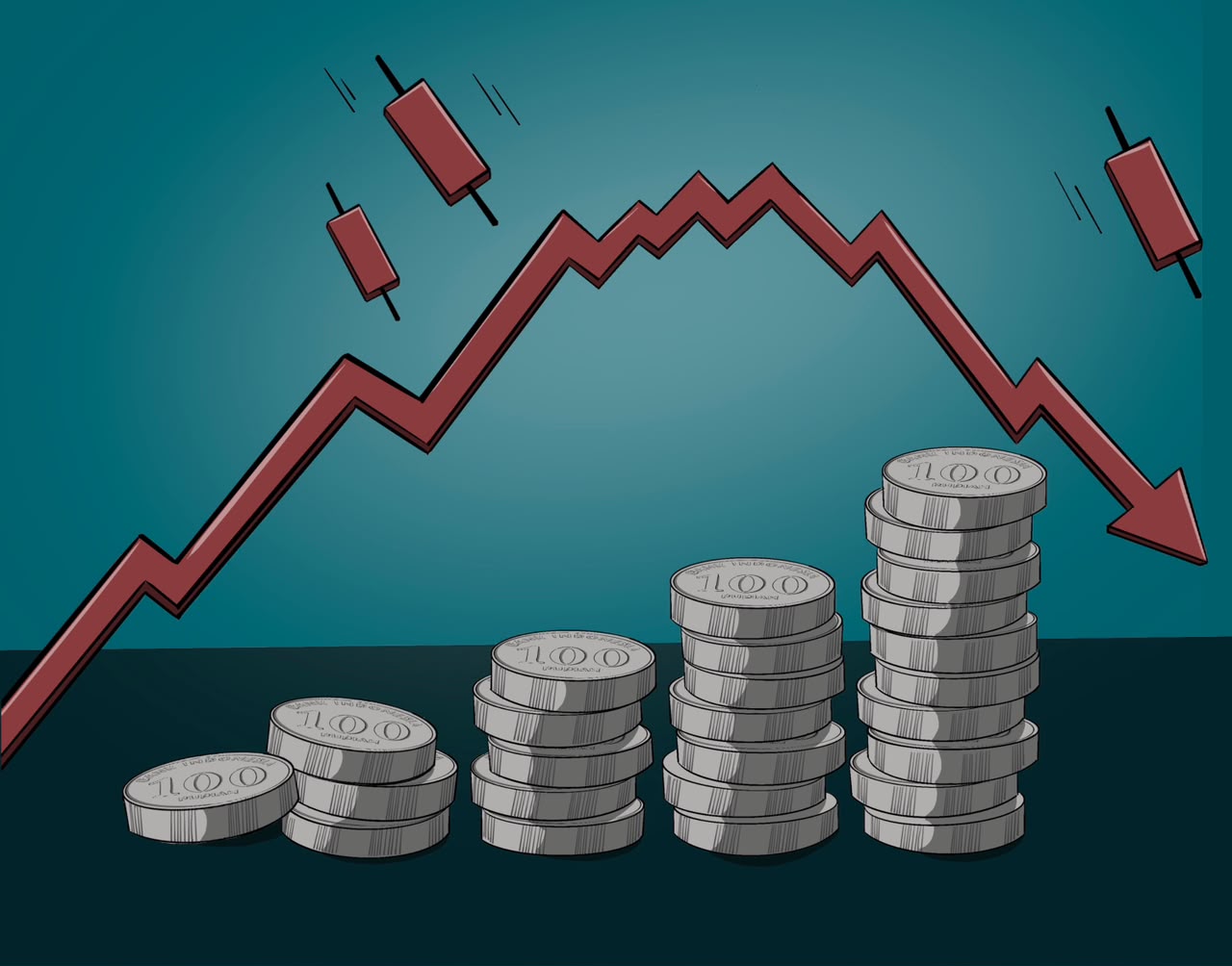
On Monday, August 10, 2026, Indonesia’s rupiah closed 0.79% higher at IDR 17,755 per US dollar. On the same day, the Jakarta Composite Index (IHSG) fell 0.69% to 6,365.37. Both moves traced back to the same trigger: President Prabowo Subianto named Destry Damayanti as the sole pick for Governor of Bank Indonesia, the country’s central bank.
Headline risk for investors starts right here. Media outlets had to pick one angle from a story with two faces. The headline you read that morning shaped whether you walked away with hope or worry.
One investor saw the rupiah headline and got a bullish signal. Another opened the IHSG story and got a bearish one. Both headlines were true. Neither told the full story. The problem was never about lies. The problem was that one headline cannot capture what happens when a currency gains and a stock index drops at the same time.
This gap matters more than it used to. Indonesia’s retail investor base has grown fast. Many of these investors read market news through feeds or social media that show headlines with no extra context. A buy or sell choice can form in seconds after reading one line on a phone screen. The less context you get, the more power a single angle holds over your view.
This article uses data from the second week of August 2026 to break down how that works. You will see how three outlets gave three clashing signals in 35 minutes. You will learn why the rupiah and IHSG moved apart from the same trigger. And you will find steps to guard your choices from the traps that headline framing sets.
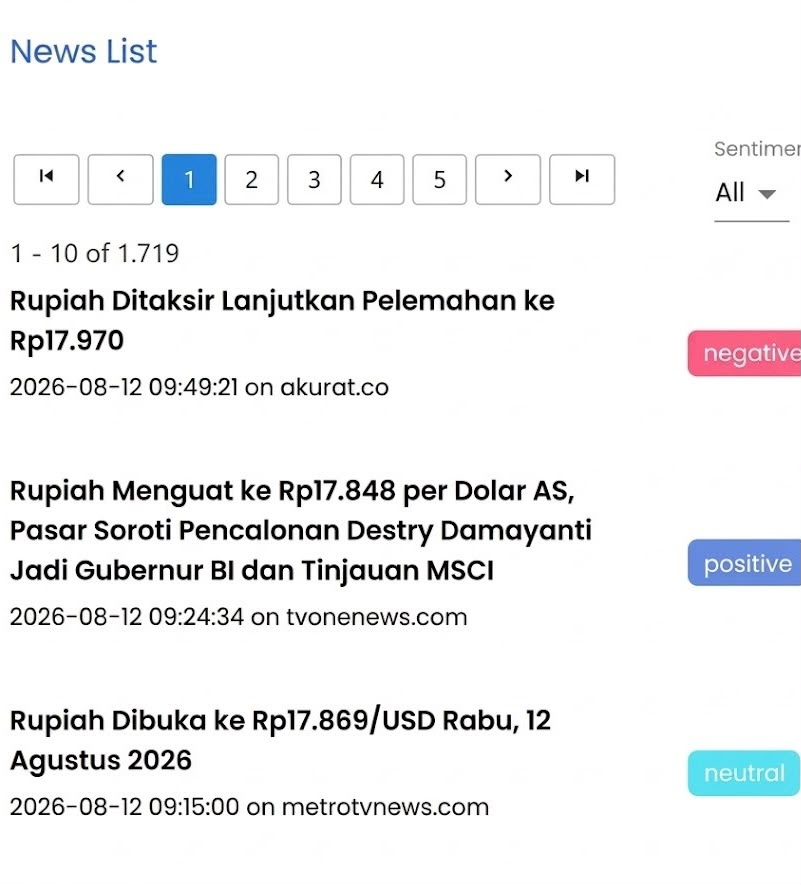
Look at three headlines that aired close together on the morning of August 12, 2026. At 09:15, metrotvnews.com ran “Rupiah Dibuka ke Rp17.869/USD Rabu, 12 Agustus 2026,” a flat report of the opening rate. Nine minutes later, at 09:24, tvonenews.com posted a headline tying rupiah strength to the Destry pick and a coming MSCI review. At 09:49, akurat.co posted a headline warning of likely rupiah weakness toward IDR 17,970.
Three outlets. Under 35 minutes. Three reads of the same currency move. All three were true. The split was not about data but about which angle each outlet chose: flat, upbeat, or guarded. A reader who saw just one got a partial view of a market that was far more layered than “good” or “bad.”
This split is not a press failure. Headlines work under tight rules: short, eye-catching, and written on deadline. Every newsroom picks the angle that fits its readers best. The issue sits on the reader’s side. An investor who reads one headline treats one angle as the whole picture, when the whole picture only forms if you line up several angles.
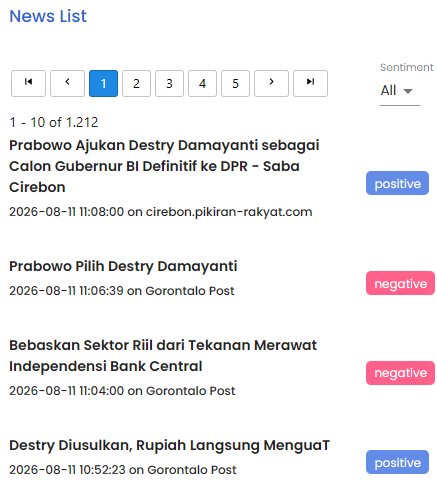
A sharper case comes from tracking the topic “Prabowo Panggil Cagub BI” (Prabowo calls in central bank governor pick) in Newstensity, a media tracking tool that found 1,212 articles on this topic. Gorontalo Post, a single newsroom, ran headlines with opposing tones within 14 minutes on August 11. At 10:52, it ran a positive headline about the rupiah rising after the Destry pick. At 11:06, it ran a negative one about Prabowo’s choice. Between them, at 11:04, a third headline struck a negative tone about central bank freedom. One newsroom, less than 15 minutes, three clashing signals from the same story. If one outlet can flip its framing that fast, leaning on a single source means large gaps in your view.
Many headlines that day shared a simple premise: the Destry pick moved markets. The real picture was less tidy.
Analysts at Kontan, a major Indonesian business daily, noted that the IHSG had run into overbought range before it pulled back. The dip was a cool-down after a multi-day rally. It lined up with the Destry news by chance, not by cause.
Sector data from Bisnis.com backed this reading. The leading declines came from Petrindo Jaya Kreasi (down 4.05%), Barito Pacific (down 3.63%), Indika Energy (down 3.33%), Telkom Indonesia (down 3.32%), and Indosat (down 3.23%). These were commodity and telecom stocks under strain from their own sector forces. The selling had no link to doubts about the central bank pick. An investor who read “IHSG falls after Destry news” could easily mistake a routine pullback for a vote of no trust. The sector data told a different story.
The rupiah’s gain had a separate cause. Kompas.com said the rupiah rose as the US dollar index (DXY) weakened across global markets. Hopes around the Destry pick added a second push. The rupiah drew support from two sides at once: global (weaker DXY) and local (Destry optimism). The IHSG faced its own headwinds from technicals and sector pressure. Two tools, two driver sets, one event that headlines stitched together as “the cause.”
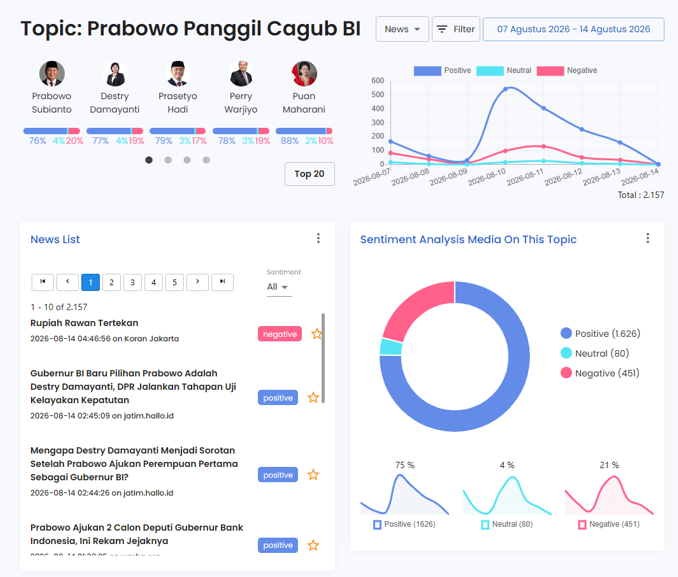
Newstensity data for the topic “Prabowo Panggil Cagub BI” over August 7 through 14, 2026, caught the scale of press focus. A total of 2,157 articles covered the topic, up from 1,719 in an earlier count. Tone across all coverage: 75% positive (1,626 articles), 4% neutral (80), 21% negative (451). Top outlets by volume: kontan.co.id, RCTI+, tribunnews.com, bisnis.com, kompas.com, CNBC Indonesia, and Bloomberg Technoz.
While 2,157 articles focused on the Destry pick, three other forces that mattered just as much for market direction got little headline space. All three were active that same week, but they rarely showed up in headlines built around “market reaction to Destry.”
Consumer trust was sliding. Indonesia’s Consumer Confidence Index (IKK) slipped from 117.8 in June to 116.8 in July 2026. The reading stayed above 100, the line that marks overall optimism. But the three-month slide gave market players a reason to watch consumer spending trends.
MSCI’s August review added weight, not relief. Results came on August 13, 2026, in the early hours (Jakarta time). MSCI kept its freeze policy, active since July. No new stocks from Indonesia entered the Global Standard Indexes. GOTO, one of Indonesia’s biggest tech firms, was cut from the main MSCI index. CPIN moved down to the Small Cap Index. Nine more stocks lost their spots in the MSCI Small Cap Index. When stocks drop off MSCI lists, index funds that track MSCI cut their Indonesia share. OJK, the local market regulator, had hoped the freeze would lift. It did not.
US price data came in line. US CPI for July 2026, released on August 12, showed yearly price growth slowing to 3.4% from 3.5% in June. Core yearly growth fell to 2.5%. The result matched forecasts, so its impact on the dollar and rupiah stayed mild. For Indonesian investors, US CPI matters because it shapes bets on what the Federal Reserve will do with rates, which in turn guides capital flows into markets like Indonesia.
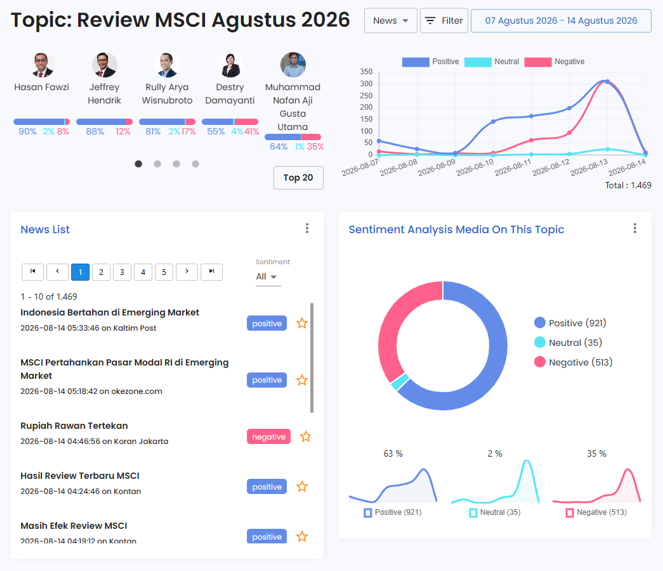
Newstensity data for “Review MSCI Agustus 2026” (August 7 through 14, 2026) tracked a clear shift. Article count hit 1,469, nearly triple the 535 articles before results came out. Tone also shifted: 63% positive (921), 2% neutral (35), 35% negative (513). The negative share jumped from 21% to 35% versus the pre-results period. Kontan.co.id led both volume and negative share for this topic.
To map framing more clearly, we looked at 27 unique headlines from the Destry topic. This sample came from a pool of 2,014 articles as of August 13, 04:10 Jakarta time, spanning August 12 and 13. This was not a full census. The goal was to read patterns from what was on hand. Results showed fairly steady differences by media tier.
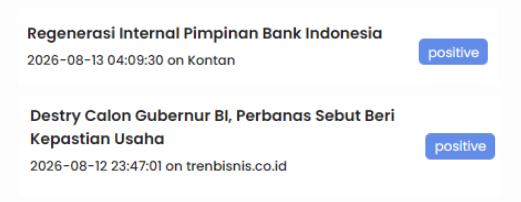
Business and money media (Kontan and trenbisnis.co.id) chose framing that calmed the market. Kontan ran the Destry story under “Regenerasi Internal Pimpinan Bank Indonesia” (internal leadership change at Bank Indonesia), without naming Destry at all. This framing cast the event as a routine process, not a debatable political move. The choice fits these outlets’ core readers: market players whose reactions can shift asset prices directly.

Major national media like Tirto chose a neutral, process-based tone. Headlines in this tier logged formal steps, such as the presidential letter reaching parliament (DPR), without judging the person named in it.

Smaller and local outlets (keuangandigital.com, harianjogja.com and espos.id) showed the most uniform pattern, and it leaned positive. Most headlines followed the form “Ini Alasan Prabowo Pilih Destry…” (Why Prabowo chose Destry…), a frame that backs the choice rather than probing it. This sameness is worth noting. It may point to shared source material being reposted across many sites.

Outliers cut across tiers. Media Indonesia, a major outlet, picked a skeptical frame: “Destry dan Ujian Berat Menjaga Kredibilitas Bank Indonesia” (Destry and the tough test of keeping Bank Indonesia credible). NusantaraTV also showed up twice with negative framing. These cases prove that framing variety exists within every tier, even when the trend is stable.
The sample also exposed content cloning that investors should note. Two sets of word-for-word matching headlines appeared on different sites within very short spans. One pair ran three minutes apart on trenbisnis.co.id and keuangandigital.com. A second pair ran 30 seconds apart on trenbisnis.co.id and beritamassa.com. The site trenbisnis.co.id showed up in both pairs, hinting it may serve as a wire source that other sites copy at speed. This pattern fits what press critics call churnalism: content recycled with no added value. A single framing ends up looking as though many voices back it, when it starts from one point. For an investor who counts sources as a proxy for truth, this pattern poses real danger. Volume does not prove truth when the root is single.
In finance, the pattern mapped in this article has a formal name: headline risk. It is the risk to an asset’s value that stems from market response to news headlines, not from real changes in the asset itself. The rupiah-IHSG case is a clean match: an investor who acted on one headline risked a wrong read of the market because that headline showed only one face.
This links to research in behavioral finance. De Bondt and Thaler’s 1985 study in The Journal of Finance (volume 40, issue 3) found that investors tend to overreact to sudden or striking news. That excess response pushes prices past what the real value calls for. Retail investors with tight portfolios face more risk here. A big reaction to one headline can move a large share of a smaller portfolio, unlike at a large fund where the impact spreads across many assets.
A second trap is reading time overlap as cause and effect. The IHSG fell on the same day the Destry news broke. But analysts pointed to overbought conditions and sector strain as the closer cause. Headlines that placed both events next to each other, without noting that the link was timing rather than cause, risked building a false picture. An investor who took that headline at face value might sell for the wrong reason.
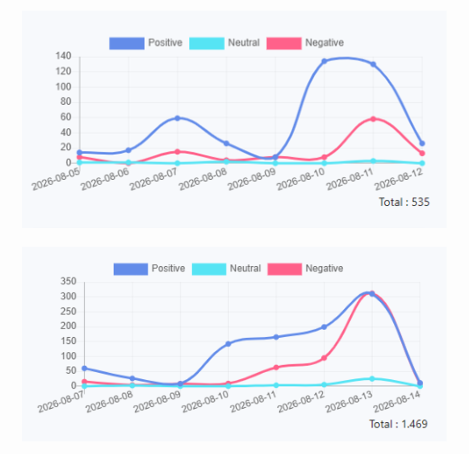
A third trap is timing of coverage. Newstensity data showed that media wait for hard results before they give an issue heavy play. Before the MSCI review results landed, the MSCI topic drew only 535 articles, less than one-third the volume of the Destry topic (1,719) over the same span. After the results came out (freeze kept, GOTO cut), MSCI coverage nearly tripled to 1,469 articles, closing in on the Destry topic at 2,157.
This sets up a bind for investors. Those who rely on headline cues for early moves need MSCI context before results drop, not after. But media gave it late, once the market had already shifted. Investors reading headlines in the early phase got a skewed diet: heavy on Destry, light on MSCI, though both held weight for their portfolios.
These three traps stack. An investor reads a headline linking two events that shared a timestamp (the timing trap) and reacts too fast because the tone is bold (overreaction). At the same time, context about MSCI is missing because media had not covered it in proportion (timing of coverage). The outcome is a choice built on a partial view, the exact risk that headline risk warns about.
Knowing that headlines can mislead is step one. Step two is building reading habits that resist framing bias. These steps work right away.
Read at least three sources from different media tiers for any event that touches your portfolio. As the case above showed, business media, major national outlets, and local or niche sites can frame the same event with very different tones. Checking across tiers gives you a view closer to the full picture and cuts the risk of locking into one angle.
Split facts from framing in every headline you read. Every headline holds both facts (numbers, events) and framing (word choice, order, context kept or dropped). Train yourself to spot each. When a headline says “rupiah gains,” ask: gains versus when? What drove it? Does the move match other signals like the stock index, the DXY, or foreign fund flows?
Check technical and sector factors before accepting a headline’s implied cause. The IHSG fell from overbought levels and sector pressure on commodities and telecoms, not from the Destry sentiment. Before you decide that a political or economic event caused a market move, look for a technical read (support levels, overbought or oversold signals) or a sector story (commodity prices, industry rules) that fits more closely. This habit alone can keep you from trading on a media story instead of market data.
Watch for matching headlines from different sites. As the cloning data showed, the same headline can pop up on many domains in seconds. If three sites report the same thing in the same words, odds are high all three trace to one wire source. Counting “many sources agree” from cloned content is a false sense of proof, not real checks.
For firms whose choices depend on reading market signals across many sources at once, media tracking tools can map which framing leads and which context gets missed. Newstensity is built for this job, letting you see how one event plays across hundreds of angles at the same time, and flagging the cloning patterns that can warp your read.
A rising rupiah and a falling stock index on the same day did not point to a confused market. The two moves came from many factors at work in parallel: some tied to the Destry Damayanti pick, others (IHSG technical strain, global DXY weakness, MSCI review results) with no link to it at all. A short headline rarely holds all of that at once.
For retail investors whose choices rest on a clear read of market conditions, relying on one headline risks a partial or warped picture. That risk grows when cloned content makes many sources look as though they agree while they copy from the same origin.
Knowing what headline risk is, reading how media at different tiers frame the same event, and making a habit of checking several sources form the most basic shield you can build. Markets are never as simple as one headline. Strong choices always rest on a fuller picture than one line of text can hold.

You can no longer tell AI astroturfing from genuine public opinion by reading the text. Generative AI writes as fluently…

binomedia

Who controls money in the blockchain era? When Bitcoin launched in 2008, the answer sounded simple: no single party, because…
binomedia

The debate over whether AI development should slow down is no longer theoretical. In September 2026, the CEOs of the…
binomedia

AI brand visibility is how often, how accurately, and in what context your brand appears in answers from AI-powered search…
binomedia

The DTSEN social assistance decile controversy in 2026 is not merely about inaccurate data. Media monitoring and digital conversation analysis…
binomedia
Indonesia’s gross domestic product (GDP) grew by 5.29 percent in the second quarter of 2026. This figure exceeded the median…
binomedia

Artificial intelligence (AI) is transforming education faster than most education systems can respond. Machines can now search for information, summarize…
binomedia

On Thursday, July 30, 2026, Indonesian President Prabowo Subianto announced a “cleanest city” competition. The top five cities would win…
binomedia

Before dawn on Friday, 24 July 2026, a mob in Bali beat a man to death. He is identified only…
binomedia

Gen Z is increasingly tuning out advertisements that look overly polished and perfect. Instead, they tend to trust recommendations from…
binomedia