

Downgrade Lifestyle: Indonesia’s Real Economic Signal
What Is “Downgrade Lifestyle” and Why Is It Trending on Threads? Since early September 2026, the term “downgrade lifestyle” has…
-
binomedia
- October 9, 2026


Companies today use AI to read customer data, monitor public conversations, measure reputation, map issues, and support strategic decision-making. In media monitoring and social media monitoring, AI can process millions of data points in a short time, something no human team could do alone.
But speed has its limits. A system can calculate how many negative conversations appeared today and identify the words most frequently discussed. What is harder to answer is this: why is the public angry? Is a comment a serious criticism or sarcasm? Can AI understand the political, cultural, and emotional context behind a conversation, or is it only counting words?
This is where Human-in-the-Loop in sentiment analysis becomes relevant. This approach does not replace humans with AI. AI accelerates data processing, while humans validate the results, read the context, and translate the data into insights that can be used for business decisions.
For companies, positive, negative, and neutral numbers alone are not enough. Reputation is shaped by developing narratives, the actors involved, the channels spreading the issue, and the way the public interprets a company’s actions — not merely by conversation volume.
Deloitte’s “State of AI in the Enterprise” report shows that AI adoption continues to grow as companies seek to improve productivity and efficiency. AI has entered operational and business strategy processes, no longer functioning merely as a technology experiment.
As AI is used more widely, the need for human oversight also increases. When AI begins to influence important decisions, its results must be trustworthy, explainable, and accountable. Companies cannot simply pursue automation.
PwC’s “Global M&A Industry Trends” report shows a similar pattern in another field: AI can support screening, due diligence, valuation, and transaction analysis. However, in high-value decisions, human judgment remains decisive. Data accelerates the process; experience and contextual understanding determine the quality of the decision.
The same logic applies to sentiment analysis. AI helps companies see patterns in public conversations, but communication decisions should not rely solely on a dashboard. Companies still need people who can assess whether an issue is truly dangerous, needs a response, or simply needs to be monitored. Human-in-the-Loop in sentiment analysis becomes the bridge between data and decision-making.
Human-in-the-Loop in sentiment analysis involves humans in the AI workflow, especially during validation, correction, interpretation, and decision-making. AI is not left to work automatically without supervision.
AI collects and processes data from social media posts, public comments, forums, videos, and other digital conversations. It then provides initial classifications such as positive, negative, neutral, mixed, or irrelevant. However, that initial classification is not necessarily the final conclusion.
Humans need to check whether the label given by AI is accurate. A comment that looks positive may actually be sarcasm. Criticism toward a company may come from real customers or may simply be part of a trend. Negative sentiment may be triggered by a product, service, price, policy, or another issue attached to the company.
Without Human-in-the-Loop, sentiment analysis stops at numbers. With Human-in-the-Loop, companies understand the story behind those numbers.
A simple example: a company sees negative sentiment rise after launching a new product. AI may show words such as “expensive,” “disappointed,” and “not suitable” as dominant terms. Human analysts need to read deeper into the meaning of the sentences. Is the public disappointed because of the price, product quality, promotional communication, or unmet expectations? Machines rarely answer these questions on their own.
Sentiment analysis may look simple on the surface: the system reads text, recognizes certain words, and assigns a label. The problem is that human language is far more complex than a list of words.
One word can mean different things depending on context. The word “good” can be praise, but it can also be sarcasm. A sentence such as “Great service, I only had to wait two hours” literally contains a positive word, but its meaning is clearly negative.

Source: Socindex Dashboard
Digital conversations in Indonesia make this challenge even greater. The public often mixes Indonesian, regional languages, slang, emojis, abbreviations, memes, and popular culture references. A comment that looks light may contain harsh criticism. A negative comment does not always signal a crisis if the context is only joking.
Research on “computational sarcasm analysis on social media” shows that sarcasm is a major challenge in sentiment analysis because the literal meaning of a sentence often differs from the speaker’s actual intent. Another study on “detecting sarcasm in multimodal social platforms” adds that understanding sarcasm on social media also depends on visual context and platform format, not only text. AI helps read patterns. Reading meaning remains human work.
A common weakness in sentiment analysis is that it focuses too much on positive, negative, and neutral classification, even though sentiment is only the surface. Behind it, there is a narrative shaping public perception.
Negative sentiment can emerge for many reasons: disappointment with service, anger about pricing, doubt about a company’s commitment, or media framing. Sometimes negative sentiment is triggered by an external issue that becomes attached to the company.
If a company only reads negative numbers, its response is usually generic: a statement saying it “listens to public aspirations” or is “committed to improving service.” Responses like these often fail to address the root problem because the root problem was never truly read.
Human-in-the-Loop helps companies move from sentiment tracking to narrative intelligence — from asking “how many negative conversations are there?” to asking “what narrative is making the public react?”
An issue can begin as a consumer complaint, develop into criticism of management, enter media coverage, and then become a wider public conversation. If a company only looks at sentiment numbers, this type of escalation can easily be detected too late.
Human analysts read these changes: who is driving the issue, how the media frames the story, what public emotion is dominant, and what reputational risk may emerge if the issue continues to grow.
In a Human-in-the-Loop system, humans do not replace AI. Their role is to ensure that AI results are not wrong, shallow, or misleading through several processes.
Humans define sentiment standards because not all organizations interpret sentiment in the same way. Customer criticism may be considered negative, or it may be treated as constructive feedback, depending on the context in which it is expressed.
Humans also examine ambiguous data. Not all data needs to be read manually, but conversations containing sarcasm, sensitive issues, public conflict, or potential reputational crises require human validation.
Humans assess the weight of an issue. AI may detect the word “boycott” in a conversation, but determining whether it is a serious threat or only a temporary emotional expression remains human work.
Human correction also provides feedback to the system. If AI frequently misreads sarcastic comments or local language, those corrections can be used to improve the model, making the system more accurate over time.
In the end, humans determine the business implications. AI may show that negative sentiment is rising, but the strategic questions still need to be answered by people: should the company respond? Is clarification needed? Should the issue be escalated to management, or is monitoring enough?
AI produces output. Humans turn it into decisions.
Relying entirely on AI in sentiment analysis brings several concrete risks.
The most direct risk is misclassification. AI can misread sarcasm, local languages, political context, or comments with mixed emotions. When these errors happen at scale, they can mislead the entire analysis.
From there, another risk appears: overreaction. A company may panic when it sees negative sentiment rising, even though the issue is only active within a small community with limited reach. A response that comes too quickly may actually amplify the issue.
The opposite risk is underreaction. A company may assume the situation is safe because sentiment does not yet look extreme, even though a negative narrative is slowly being built by influential actors.
There is also the risk of data bias. AI works based on the data and models used to train it. If the training data is not representative, the results will be biased. The system may be accurate in reading formal language, but weak in reading slang, memes, or regional languages.
The most fundamental risk is weak accountability. In strategic decisions, a company cannot simply say, “the system recommended it.” There must be people who understand, examine, and take responsibility for the final interpretation.
In media monitoring practice, companies do not only need a system that can quickly collect data. They need an analytical process that can distinguish between conversations that are truly risky and those that are only temporarily noisy. This is where the Human-in-the-Loop approach becomes relevant for platforms such as Binokular.
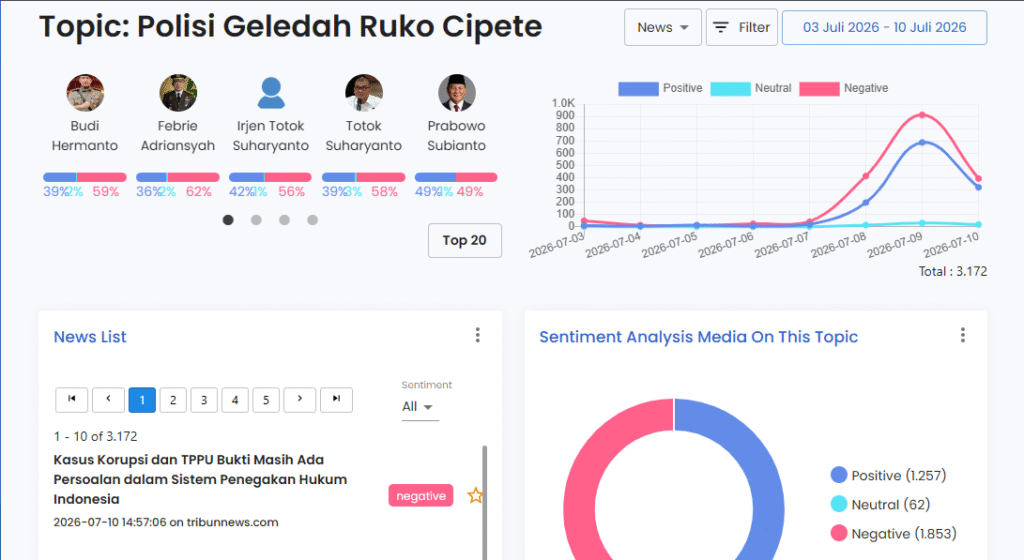
Binokular helps companies read media coverage, public conversations, and issue dynamics in a more structured way. Through media monitoring and sentiment analysis, companies can see how an issue develops, which actors are mentioned most often, which channels are most active, and how public sentiment moves over time.
Source: Dashboard Newstensity
But the value of media monitoring does not stop at the dashboard. The data that appears must be translated into insight. When negative sentiment toward a company rises, the next question is not only “how many negative conversations are there?” but also what caused it, who is driving the narrative, whether it has the potential to become a crisis, and what response would be most appropriate.
Human analysts answer these questions. Binokular accelerates data collection and grouping; analysts read the context, validate the results, and prepare recommendations. This combination makes Binokular relevant not merely as a media monitoring tool, but as part of a decision support system — a place where companies understand reputation, anticipate communication risks, evaluate campaigns, and determine more accurate responses to public issues.
Many companies already have sentiment analysis dashboards. But not every dashboard produces good decisions. A dashboard that only displays positive, negative, and neutral numbers, conversation volume, and word clouds is not necessarily enough to read a situation.
Numbers may look objective, charts may look neat, and classifications may look convincing. But if the raw data is wrong or the interpretation is shallow, the dashboard only makes the mistake look more professional.
Human-in-the-Loop turns a dashboard into a decision support system. Numbers are still displayed, but they are accompanied by context. Charts are still used, but their meaning is explained. Word clouds remain useful, but they are not treated as the final conclusion.
A mature dashboard answers three questions: what is happening, why it is happening, and what should be done. AI is strong at answering the first question. The other two still require humans.
Sentiment analysis has become an important part of communication strategy, reputation management, and business decision-making. AI makes the process much faster. But public opinion cannot always be read literally. There is sarcasm, irony, mixed emotion, social context, political dynamics, and differences in language style across platforms that machines may not fully capture.
Human-in-the-Loop in sentiment analysis addresses this gap. AI processes large amounts of data; humans validate, interpret, and translate the results into the right decisions.
The challenge for companies is not choosing between AI and humans, but building a system that combines both proportionally. In the end, companies should not only be fast at reading the public. They must truly understand what the public feels, questions, and expects.

What Is “Downgrade Lifestyle” and Why Is It Trending on Threads? Since early September 2026, the term “downgrade lifestyle” has…

binomedia

You can no longer tell AI astroturfing from genuine public opinion by reading the text. Generative AI writes as fluently…
binomedia

Who controls money in the blockchain era? When Bitcoin launched in 2008, the answer sounded simple: no single party, because…
binomedia

The debate over whether AI development should slow down is no longer theoretical. In September 2026, the CEOs of the…
binomedia

AI brand visibility is how often, how accurately, and in what context your brand appears in answers from AI-powered search…
binomedia

The DTSEN social assistance decile controversy in 2026 is not merely about inaccurate data. Media monitoring and digital conversation analysis…
binomedia

Indonesia’s gross domestic product (GDP) grew by 5.29 percent in the second quarter of 2026. This figure exceeded the median…
binomedia

Artificial intelligence (AI) is transforming education faster than most education systems can respond. Machines can now search for information, summarize…
binomedia

One Event, Two Market Moves On Monday, August 10, 2026, Indonesia’s rupiah closed 0.79% higher at IDR 17,755 per US…
binomedia

On Thursday, July 30, 2026, Indonesian President Prabowo Subianto announced a “cleanest city” competition. The top five cities would win…
binomedia