Michael Kusuma Head Of Investor Relations Sampoerna Agro
“Binokular makes it easier for us to obtain up-to-date information and news. Its monitoring reports are comprehensive and customizable, and features like news archive searching are very useful. The range of services allows personnel with high mobility to access the website, newsletters, and SMS alerts.”
Arif Haryanto Corporate Communication Department, PT Angkasa Pura I (Persero)
“Binokular is a smart solution! Monitoring media spread across 13 regions in central to eastern Indonesia, where Angkasa Pura I airports are located, becomes easy and fast with Binokular. The accuracy and relevance of the captured news are commendable. Binokular’s comprehensive and user-friendly web service makes news documentation searches easier. Binokular also helps us respond quickly to any negative news with its SMS alert service. Kudos to all these innovations, Binokular!”
Miranti Hadisusilo Corporate Secretary & Legal Director, PT Matahari Department Store Tbk
“Binokular has been incredibly helpful for our media monitoring, covering news related to our company, industry, and competitors. Up-to-date information is essential for market analysis, allowing us to respond quickly when necessary.”
Eko Harmonsyah Director of Strategic Planning and Public Relations, Bank Indonesia
“Media monitoring has become easier with Binokular. The necessary information can be searched quickly and accurately using its search engine. The interface is also quite user-friendly. But most importantly, the responsive and proactive service from the Binokular team is extremely helpful.”)
The corruption case involving the procurement of Chromebook laptops, which ensnared former Minister of Education, Culture, Research, and Technology Nadiem Anwar Makarim, reveals a familiar pattern in Indonesia’s public sphere: a policy that initially belonged to the domain of education and digital transformation is ultimately read more strongly as a matter of law, elite power, and accountability.
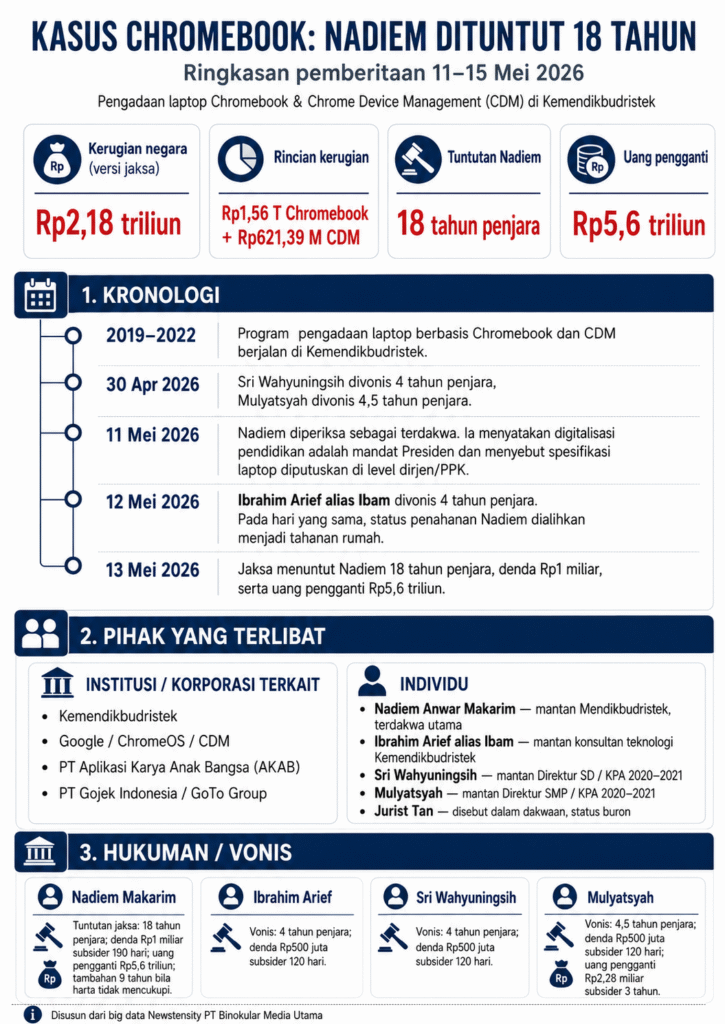
The tragedy began with a procurement program for Chromebook-based laptops and Chrome Device Management in the Ministry of Education, Culture, Research, and Technology during the 2019–2022 period. In the legal construction of the case, the program is no longer understood merely as an education digitalization project, but as a procurement issue questioned from the perspective of governance, specifications, decision-making processes, and alleged state losses. According to prosecutors, the state loss reached Rp2.18 trillion, consisting of Rp1.56 trillion related to Chromebooks and Rp621.39 billion related to CDM.
The chronology shows a rapid escalation. On April 30, 2026, Sri Wahyuningsih was sentenced to four years in prison, while Mulyatsyah was sentenced to 4.5 years. On May 11, Nadiem was questioned as a defendant and stated that education digitalization was a presidential mandate, while the laptop specifications were decided at the director general or procurement official level. On May 12, Ibrahim Arief, also known as Ibam, was sentenced to four years in prison, and on the same day, Nadiem’s detention status was changed to house arrest. The pressure peaked on May 13, when prosecutors demanded an 18-year prison sentence for Nadiem, a Rp1 billion fine, and Rp5.6 trillion in replacement money.
The parties involved are divided into two major groups. From the institutional and corporate side, there are the Ministry of Education, Culture, Research, and Technology; Google, ChromeOS, and CDM; PT Aplikasi Karya Anak Bangsa; and PT Gojek Indonesia or GoTo Group. From the individual side, the central figure is Nadiem Anwar Makarim, former Minister of Education and the main defendant in the media narrative. Other names that appear include Ibrahim Arief, also known as Ibam, former technology consultant to the ministry; Sri Wahyuningsih, former Director of Elementary Schools and budget user authority for 2020–2021; Mulyatsyah, former Director of Junior High Schools and budget user authority for 2020–2021; and Jurist Tan, who is mentioned in the indictment and remains a fugitive.
The involvement of many actors means the Chromebook case cannot be read merely as a personal case. It stands at the intersection of education policy decisions, procurement bureaucracy, government relations with technology vendors, and criminal evidentiary mechanisms.
Share of Voice in News Coverage and Social Media Conversations
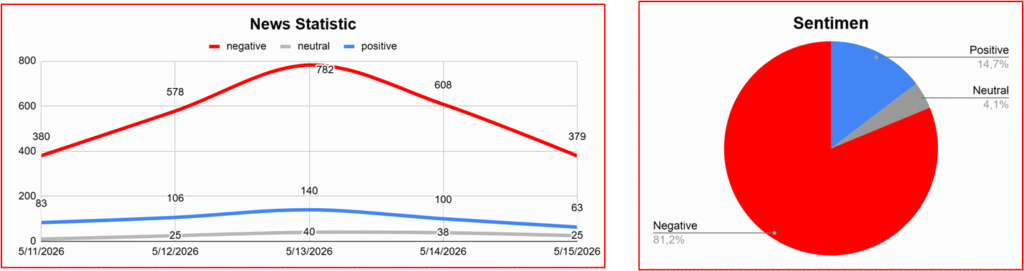
In mass media, this issue generated 3,357 articles during the period of May 11–15, 2026. The peak of coverage occurred on May 13, amplified by the topic of prosecutors demanding an 18-year sentence for Nadiem and Rp5.6 trillion in replacement money. News sentiment leaned heavily negative at 81.2%, while positive sentiment reached 14.7% and neutral sentiment 4.1%. This means the media was not only reporting the development of the case, but also building a strong reputational crisis atmosphere around the defendant and the legal process.
The dominance of negative sentiment in mass media can be understood because the main sources of news came from court proceedings, prosecutors’ demands, statements by the defendant, external responses, and public interpretation of the severity of the proposed punishment. In media logic, an 18-year sentence demand and trillions of rupiah in replacement money make a far stronger headline than technical discussions about laptop effectiveness in education. As a result, the education issue is pushed aside by the criminal issue, even though the root of the case remains in the education sector.
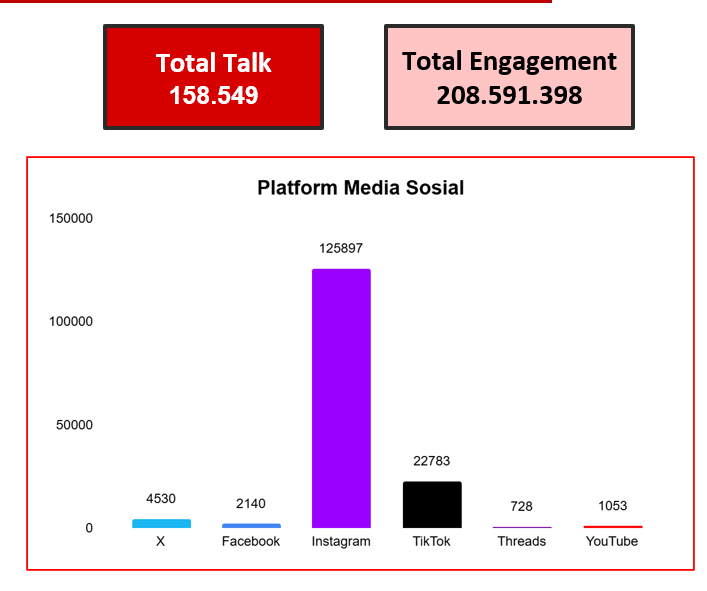
On social media, the scale was far larger. The data recorded 158,549 conversations with total engagement of 208,591,398, showing that the issue was not only discussed, but also massively consumed, shared, and monitored by the public. Instagram became the most dominant channel with 125,897 conversations, or around 79% of total talk. TikTok ranked second with 22,783 conversations, while X recorded only 4,530 conversations. Facebook, YouTube, and Threads were far below the three main channels.
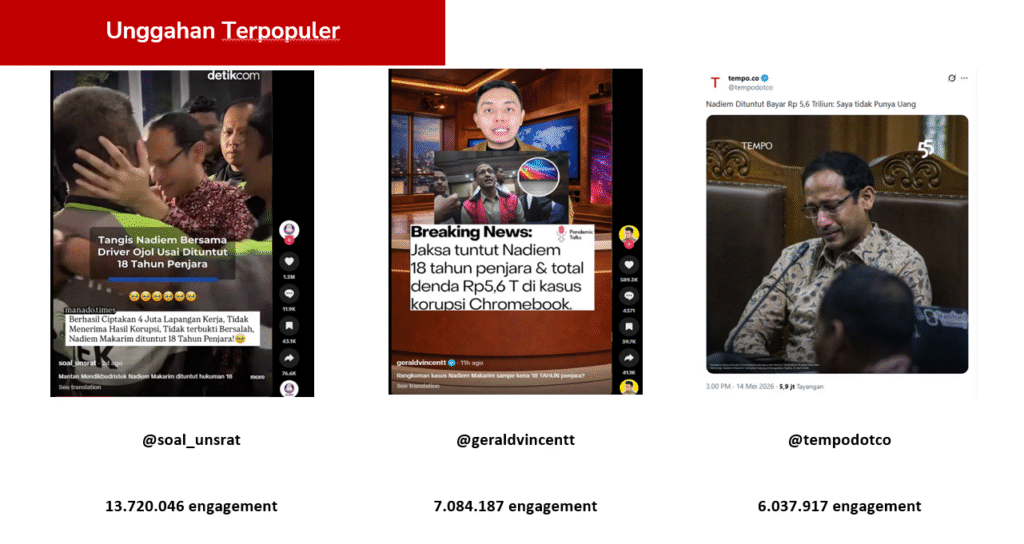
When an issue dominates on X, it usually moves as elite debate, real-time political conversation, or text-based argumentation. But when an issue is stronger on Instagram and TikTok, the pattern of opinion formation is different. It moves through video clips, emotional captions, the defendant’s face, courtroom moments, crying gestures, short headlines, and visual framing.
In short, mass media forms legal and reputational pressure, while social media amplifies its emotional reach. Mass media provides the fuel: courtroom facts, sentence demands, loss figures, and statements from actors. Social media turns that fuel into simplified public narratives: “Nadiem faces 18 years,” “heavier than terrorists,” “has no money,” “corruption or criminalization,” and “education digitalization failed or was sacrificed.” The greatest risk lies in oversimplification: the public may misread a prosecutor’s demand as a verdict, the legal process as final truth, or the defendant’s defense as proof of innocence.
From Prosecutors’ Demands to the “Shadow Team”
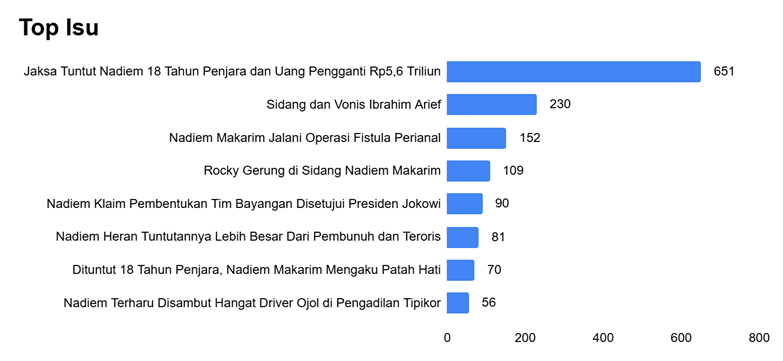
In mass media, the most dominant issue was the prosecutors’ demand, far surpassing other issues because it contained three powerful journalistic elements: a big name, a big number, and a heavy sentencing threat. The second topic was the trial and verdict of Ibrahim Arief, which strengthened the construction that the case did not stand on one person alone, but involved a network of decisions, consultants, and bureaucratic actors.
However, one issue drew particular attention and triggered theoretical debate: Nadiem’s claim about the formation of a “Shadow Team” with the approval of President Joko Widodo. This issue created political ripples. Was this corruption a failure of the formal bureaucratic system, or the result of involving non-formal actors in state decision-making?
Other topics, such as Nadiem’s perianal fistula surgery, Rocky Gerung’s presence at the trial, Nadiem’s response to the prosecutors’ demand, and the emotional moment when Nadiem said he was heartbroken, show that the coverage did not remain entirely within the realm of substantive law. Much of it moved into personal and symbolic drama. The media did not only highlight the content of the indictment or evidentiary construction, but also the defendant’s body, emotions, social relations, and expressions.
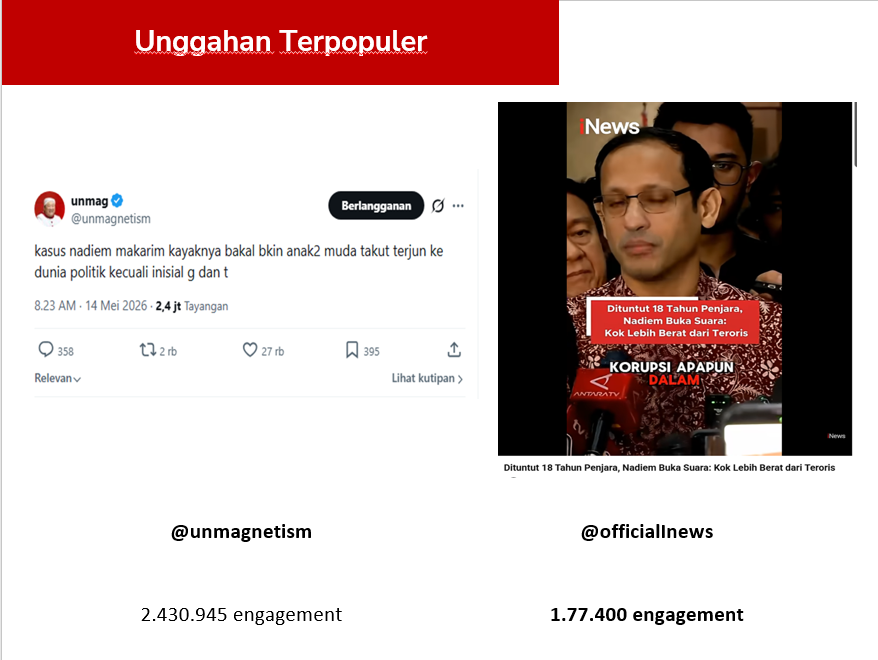
On social media, the dominant issues moved more sharply toward human interest and moral judgment. Popular posts showed a clear pattern: clips of Nadiem crying, narratives that his sentence was “heavier than terrorists,” public responses saying the case could make young people afraid to enter politics, and references to international media coverage.
From this, it becomes clear that the public was not discussing Chromebook as a learning device. The public was mostly discussing “Nadiem,” “the 18-year sentence demand,” “state losses,” “replacement money,” “the shadow team,” “legal justice,” and “the fate of a reformist figure in bureaucracy.” Education became only the entry point, not the center of conversation. This is a serious problem because the policy’s impact on students, teachers, schools, and learning quality did not become the main angle. What dominated were questions of who was guilty, who was sacrificed, who should be responsible, and whether the punishment was considered proportional.
A quote from John Dewey offers an important contrast: “the school must itself be a community life.” In Dewey’s view, school is not merely a place for distributing devices, but a social space where shared experience is built. If the Chromebook case is only read as criminal drama, the most basic education questions may disappear: did the devices truly help schools, were teachers ready to use them, did students benefit, and was education digitalization designed as an ecosystem or merely as a procurement project?
News Ontology, Actors, Demographics, and Public Emotions
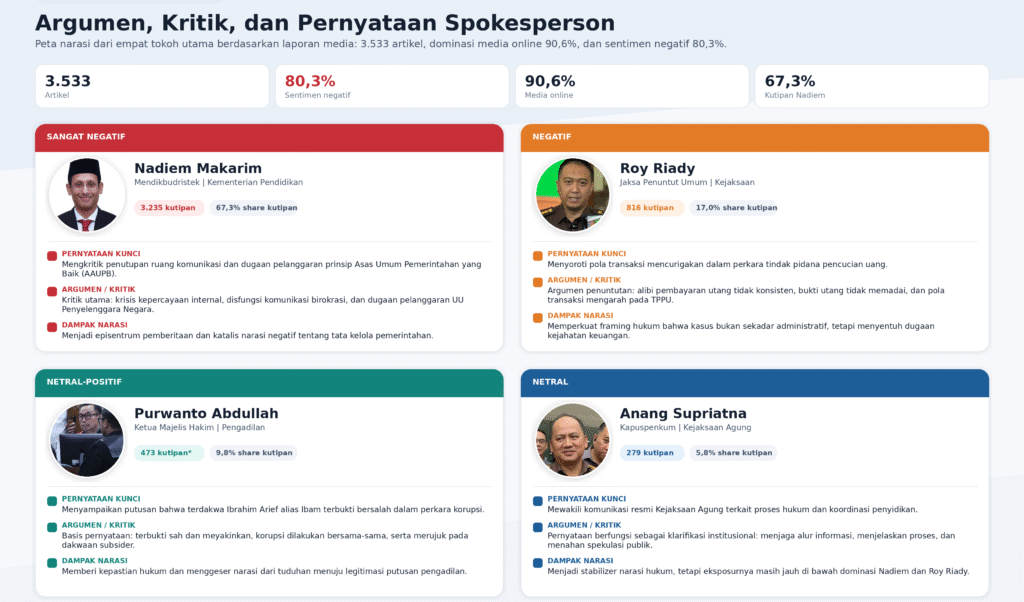
News network analysis shows Nadiem Anwar Makarim as the most central node. He is connected to many legal actors, bureaucratic figures, Chromebook-related issues, and policy narratives. This means the news does not merely mention Nadiem as an individual, but makes him the center of the case construction. In simple terms, the public sees this case through Nadiem’s face first, and only afterward sees the procurement structure, the ministry, vendors, and other actors.
Several names appear around Nadiem, including Ibrahim Arief, Roy Riady, Purwanto Abdullah, and Anang Supriatna. Ibrahim Arief appears as an important node because he is connected to court actors, prosecutors, and several other figures. Roy Riady strengthens the narrative of proving money laundering. Purwanto Abdullah provides judicial legitimacy through the corruption verdict. Anang Supriatna serves as the official communication channel of the Attorney General’s Office. In other words, the network structure shows that this issue has already been dominated by the language of law: evidence, demands, verdicts, indictments, investigative coordination, and institutional responses.
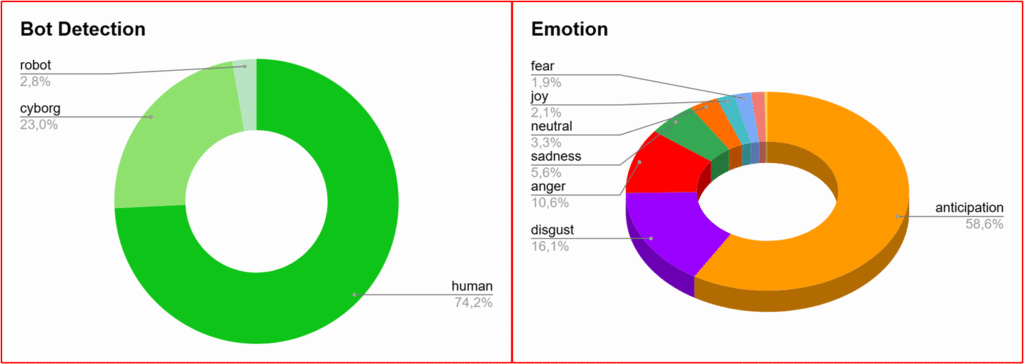
From the bot detection side, the conversation was still dominated by human accounts at 74.2%. This indicates that public attention to the case was relatively organic. However, the 23% share of cyborg accounts needs attention because semi-automated or repetitive accounts can accelerate the spread of certain frames. Pure robot accounts reached only 2.8%, meaning the risk of full bot manipulation was not dominant, but narrative amplification by accounts with unnatural behavior still needs to be monitored.
From the emotional side, anticipation was the largest emotion at 58.6%. The public appeared to be waiting for further developments: whether there would be an appeal, new clarification, trial developments, political responses, or further defense. Disgust at 16.1% and anger at 10.6% are the most important reputational signals. This means part of the public was not only following the case as news, but had already framed it as a moral issue: some were angry because they saw alleged corruption, while others were disappointed because they felt the legal process was disproportionate.
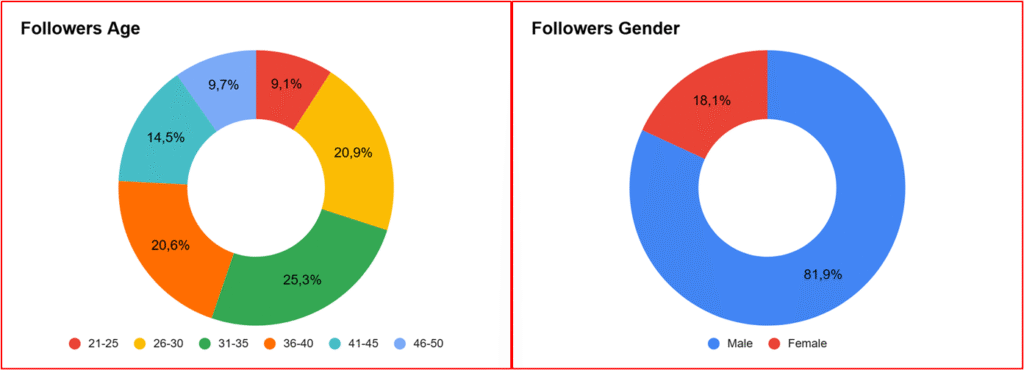
The conversation demographics were dominated by productive middle-age groups. The 31–35 age group was the largest at 25.3%, followed by 26–30 at 20.9%, and 36–40 at 20.6%. This shows that the issue was strong among young adults and professionals, groups that are relatively familiar with technology, education, bureaucratic careers, reform, and policy politics. From the gender side, men dominated at 81.9%, while women accounted for 18.1%. This imbalance is important because it may make the conversation more legalistic, confrontational, and political, while the perspectives of parents, teachers, families, and students become less visible.
Avoiding the Trap of Intellectual Laziness
This case speaks about three things at once. First, it speaks about public policy accountability. Education digitalization is a legitimate and even necessary agenda, but good intentions are not enough. Public policy must still be proven through orderly processes, strong documents, clear division of authority, and procurement mechanisms that do not open the door to conflicts of interest. In modern bureaucracy, a big idea without a neat audit trail can easily turn into a legal risk.
Second, the case speaks about the boundary between innovation and procedure. Many bureaucracies want to move quickly, but the state does not work like a startup. Speed must still submit to governance. In the public sector, decisions must be explainable to auditors, law enforcement officers, parliament, media, and the public. Otherwise, innovation will lose its institutional protection. Montesquieu once warned that anyone who holds power tends to carry it as far as possible, so “power should be a check to power.” In this context, large-scale procurement requires strong internal control, not merely trust in a figure or a transformation narrative.
Third, the case speaks about the quality of the public sphere. The public has the right to be angry about alleged corruption, but the public also has the duty to preserve reason. The healthiest stance is neither blindly defending a figure nor punishing before the evidence is complete. The public needs to distinguish between prosecutors’ demands, judges’ verdicts, media opinion, viral video clips, and legally tested facts. John Rawls called justice “the first virtue of social institutions.” This means that institutions that are efficient, popular, or seemingly modern must still be corrected if they are unjust; conversely, a valid legal process must also be protected so that it does not turn into social persecution.
Therefore, the public should adopt four principles. First, demand full transparency over the procurement process, not merely be satisfied with courtroom drama. Second, uphold the presumption of innocence until the legal process is truly complete. Third, do not equate criticism of the program with hatred of education digitalization. Fourth, reject overly simple narratives, both those that say “this is all corruption” and those that say “this is all criminalization.” Both are intellectually lazy if not supported by evidence.
Legal Issues Dominate the Public Narrative
There is an irony captured in this monitoring data: the discussion about “the fate of education” was overwhelmingly defeated by the discussion about “the fate of Nadiem.” The public sphere was more intense in debating whether an 18-year prison sentence was too heavy and whether Rp5.6 trillion in replacement money made sense, rather than discussing the future of school digitalization after this case. In the sociology of law, this phenomenon shows the judicialization of politics, where a public policy issue such as education quickly turns into a purely legal battleground. As Michel Foucault argued, law is a mechanism of power. The public focus that shifted into the judicial realm shows that society is more hungry for punishment and retribution than for systemic improvement over the failure to achieve educational goals.
There are several reasons why legal issues defeated education issues. First, law has clear actors, and in media logic, clear actors are easier to report than systemic impacts that require deeper research.
Second, law provides conflict ready for consumption. An 18-year sentence demand, Rp5.6 trillion in replacement money, comparisons with sentences for other crimes, and the defendant’s emotional expression are powerful material for headlines and short videos. In contrast, questions such as “Were Chromebooks effective for learning?” or “Were teachers ready to use the devices?” do not generate the same viral effect. As a result, the public becomes attached more quickly to legal drama than to education policy evaluation.
Third, Nadiem himself carries symbolic weight. He is not only a former minister, but also a figure associated with startups, innovation, youth, technology, and bureaucratic reform. When a figure like this enters a corruption case, public conversation automatically moves toward more emotional questions: can reformists be crushed by the system, will young people become afraid to enter government, or can innovation jargon cover weaknesses in governance? This explains why one popular post highlighted the concern that this case could make young people afraid to enter politics.
Fourth, the data does not show a dominant narrative from teachers, school principals, parents, or beneficiaries of the devices. Yet they are the groups most relevant to assessing whether the policy was useful, problematic, or failed on the ground. When the voices of beneficiaries are absent, the education issue loses its social body. What remains is an elite case, loss figures, and symbols of power.
This is where Max Weber feels relevant. He described politics as “a strong and slow boring of hard boards” that requires passion and perspective. Bureaucratic reform, including education digitalization, is indeed hard and slow work. But precisely because it is difficult, it cannot rely only on the courage to make decisions. It must be accompanied by patience in building procedures, documentation, control, and public communication that can withstand scrutiny.
Closing: Lessons Learned for Indonesia’s Bureaucracy
The first lesson: bureaucracy cannot rely only on vision. In administrative and procurement law, vision is only the starting point. What matters is how that vision is translated into decisions, who provides recommendations, what documents are used, how specifications are prepared, who approves them, which vendors benefit, and whether there is a correction mechanism when risks appear.
The second lesson: innovation must have institutional guardrails. Indonesian bureaucracy often falls into two extremes. On one side, it is too rigid, causing innovation to die before being tested. On the other side, it places too much trust in visionary figures, making procedure seem like an obstacle. Both are dangerous. Healthy public innovation requires room for experimentation, but it also requires compliance, risk assessment, procurement governance, and decision documentation. Without those guardrails, officials may think they are making breakthroughs, while law enforcement may see deviations.
The third lesson: technology procurement must not be treated like ordinary goods purchasing. Laptops, operating systems, device management, vendor ecosystems, teacher training, data security, maintenance, and curriculum integration are one policy package. If the state focuses only on devices, digitalization will fall into mere logistics. If the state focuses only on vision, procurement becomes vulnerable to being driven by grand narratives without adequate technical control. Bureaucracy must understand technology as an ecosystem, not merely as an item in a catalog.
The fourth lesson: accountability must be built from the beginning, not after a case explodes. Many institutions only start explaining when they are already in crisis. That is too late. For high-value projects, policy justification documents, needs assessment results, technology selection considerations, meeting notes, risk registers, conflict-of-interest declarations, and periodic audits must be prepared from the start. Not to play defensively, but so that public decisions can be rationally accounted for.
The fifth lesson: bureaucratic communication must be able to explain the difference between policy failure, administrative error, and criminal offense. Not every suboptimal policy is corruption. Not every loss or inefficiency automatically indicates malicious intent. But not every grand agenda can be used as a shield to avoid criminal responsibility either. These three categories must be distinguished with discipline. If not, the public will continue to move between two extreme poles: punishing every official who dares to take risks, or forgiving every deviation in the name of innovation.
The sixth lesson: bureaucracy needs to build a culture of documented courage. Public officials must indeed have the courage to make decisions. But courage without documentation can easily look like negligence. In the context of the state, courage is not only about making quick decisions; courage also means leaving behind a trail of reasoning, accepting evaluation, opening data, and being ready to be corrected. The essence of modern bureaucracy is not a bureaucracy that is afraid to move, but a bureaucracy that moves with evidence.
In the end, the Chromebook case is an uncomfortable mirror for Indonesia. But the most important conclusion is not merely whether one figure is guilty or not. That belongs to the court. The larger lesson is how the state ensures that public policy does not depend only on figures, jargon, or good intentions. The state must build systems that allow major decisions to be tested, corrected, and held accountable. Without that, every transformation agenda will carry the same risk: praised today as innovation, read tomorrow as deviation.
Artificial intelligence (AI) is transforming education faster than most education systems can respond. Machines can now search for information, summarize…