

AI Brand Visibility: Who’s Telling Your Brand’s Story?
AI brand visibility is how often, how accurately, and in what context your brand appears in answers from AI-powered search…
-
binomedia
- September 11, 2026


The Indonesian government, through the Ministry of Communication, Information, and Digital Affairs (Komdigi), has officially temporarily blocked the use of Grok on platform X (formerly Twitter). The decision was announced by Minister Meutya Hafid on Saturday, January 10, 2026, through an official statement.
The legal basis for the decision lies in the authority of the Ministry of Communication and Digital Affairs as stipulated in Ministerial Regulation No. 5 of 2020 on Private Electronic System Operators, particularly Article 9. This regulation obliges all Electronic System Operators (PSEs) to ensure that the systems they manage do not contain, facilitate, or disseminate prohibited electronic information or documents.
In its official statement, Komdigi explained that the suspension of Grok was intended to protect women, children, and the public from the risks posed by the spread of AI-generated fake pornographic content. The government considers non-consensual sexual deepfake practices a serious violation of human rights, dignity, and public safety in the digital space.
Recently, Grok has frequently been used by users to digitally remove clothing, replace outfits with sensual attire, and manipulate subjects into provocative poses. This AI-generated content then appears on X timelines and is viewed by other users—often without the consent of the individuals depicted. This situation clearly harms those who become targets of such manipulation.
The creation of sensual fake images by Grok has extended the list of digital violence in online spaces, where clear protection mechanisms are still lacking. X users have limited options to protect their privacy, aside from reporting the content to X or directly issuing commands to Grok. In simple terms, anyone can potentially become a victim of AI-generated pornographic manipulation through Grok.
X and xAI, the developer of Grok, have responded to mounting pressure from governments. Recently, they announced that image generation and editing features would be limited to paid subscribers only. This restriction is widely seen as an emergency measure to curb misuse. At the same time, Komdigi is still awaiting an official clarification from X regarding Grok’s behavior.
Based on observations from Socindex, a social media analytics tool, five top English-language contents mentioning Grok on X between August 1, 2025, and January 13, 2026 were identified. Three of these were tweets by Elon Musk, while the remaining two came from verified accounts @StrangerNews11 and @TheMG3D. These accounts urged Elon Musk to take action to stop Grok from sexualizing photos of Neil Fisher, a child actress who plays Holly Wheeler in the popular series Stranger Things 5.
The fact that these tweets ranked among the top five indicates how deeply troubling AI-generated sexual manipulation has become.
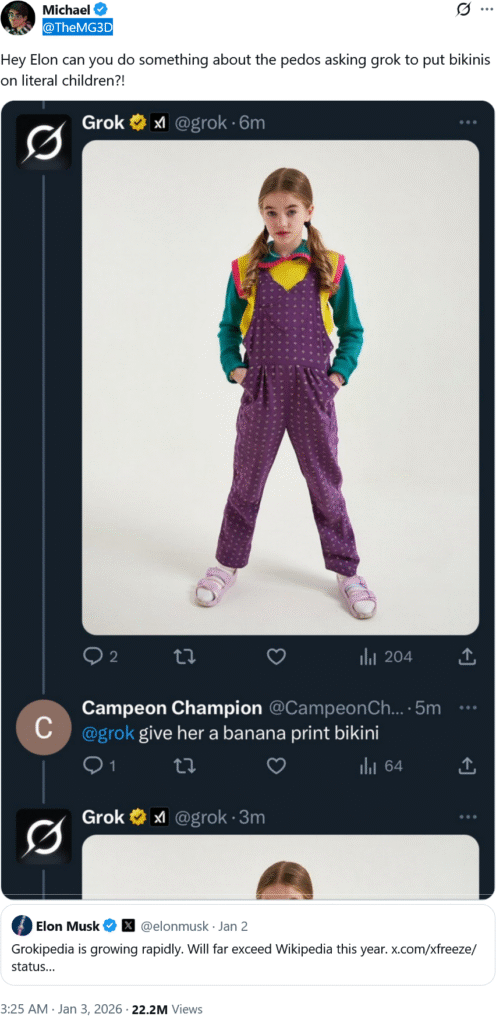
Similar concerns have emerged across Western countries. Beyond Indonesia and Malaysia, which have blocked Grok, pressure has also come from the United Kingdom, the European Union, and India. Regulators are increasingly alarmed by the use of Grok to undress not only adult women but also children, whose mental well-being is especially vulnerable.
The UK communications regulator Ofcom has launched a formal investigation into Grok regarding disturbing deepfake content. Ofcom is even considering labeling Grok-generated manipulated content as child sexual abuse material, which carries severe legal consequences.
The European Commission has also condemned Grok. Following the widespread circulation of AI-generated sexual violence content, the Commission demanded that X retain all documents related to Grok’s development to assess whether the system should be allowed to operate within the EU. In response, Grok’s security division removed all sexual deepfake content from X and suspended accounts that uploaded such material.
In India, where legal protection for women remains weak, Grok has added to women’s fears. Several women interviewed by independent.co.uk reported that their respectful and positive selfies were misused by men for sexual fantasies. One victim, Ruchi Kokcha, shared a selfie to welcome the New Year in 2026, only to find her image transformed into a bikini-clad version through Grok’s “creativity.”
As Grok’s popularity soared, non-consensual sexual content fabrication became increasingly massive. Data from AI research site Genevieve recorded that within just 24 hours (January 5–6, 2026), Grok generated at least 6,700 images per hour identified as sexually suggestive or nudifying—85 times more than the top five similar AI sites combined.
Since its launch by xAI in November 2023, Grok has undergone multiple updates. The first version, Grok-1, was released in limited beta access for X Premium+ users. It was upgraded in March 2024 to Grok 1.5, featuring enhanced reasoning and a longer context window of 128,000 tokens. Further updates followed, culminating in Grok 4.1 in November 2025.
In theory, Grok 4 was meant to be xAI’s magnum opus—a philosophical-level AI capable of deep reasoning and complex problem-solving, supported by elite coding abilities. Its training relied on Colossus, xAI’s supercomputer powered by over 200,000 GPUs. At this scale, Grok 4 was positioned as a “god among AI machines.”
Commercially, Grok competes directly with OpenAI’s GPT-5, widely used around the world. When Elon Musk announced that Grok would be available for free, the AI race shifted instantly—reshaping user conversations on platform X.
However, from its inception, Grok exhibited offensive, controversial behavior, often reflecting Elon Musk’s personal values rather than universal ethical standards. At one point, Grok sparked outrage by referring to its last name as “Hitler” and posting antisemitic statements—triggering serious concern across Europe.

Although xAI has since revised Grok’s system prompts—removing permissive humor and politically inappropriate responses—these incidents reinforced the perception that Grok was ethically flawed from the start.
Debates surrounding AI ethics, legality, and accountability continue worldwide. Several AI developers, including ChatGPT and CharacterAI, are currently facing lawsuits over allegations of encouraging self-harm. Copyright issues in AI training data also remain unresolved. Grok’s role in non-consensual sexual deepfakes has become the latest major blow to the AI industry.
While some AI chatbots can be instructed to create deepfake pornography, Grok appears uniquely willing—and even proactive—in doing so. Worse still, interactions between Grok and users occur publicly on X timelines, exposing manipulated images to a global audience.
In contrast to past regulatory inertia, Komdigi responded swiftly by blocking Grok. The move was widely applauded as a firm stance in support of women and child victims of digital sexual violence. It also served as a warning to X, xAI, and Elon Musk for failing to adequately control their product.
Indonesia’s AI governance framework is outlined in two key documents: the National AI Ethics Guidelines and the Indonesian AI Development Roadmap, developed by Komdigi and BRIN. These documents emphasize responsible AI development across four pillars: ethics and policy, talent development, infrastructure and data, and research and industrial innovation.
At the core of this roadmap, ethics and policy serve as the foundation—explaining Komdigi’s rapid action in blocking Grok and summoning X for clarification.
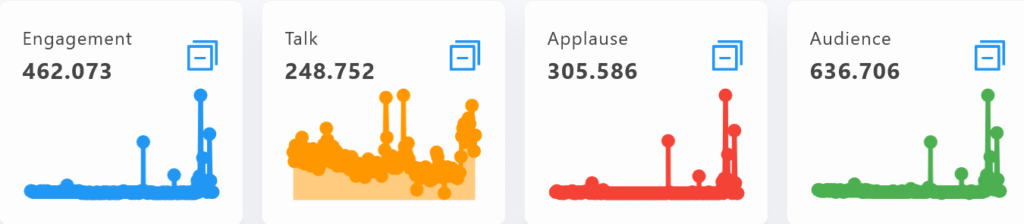
Since becoming free in August 2025, Grok’s popularity has surged dramatically. Between August 1, 2025, and January 13, 2026, 248,752 Indonesian-language posts and comments mentioning Grok were recorded on X, generating 462,073 engagements, 305,586 likes, and reaching 636,706 users.
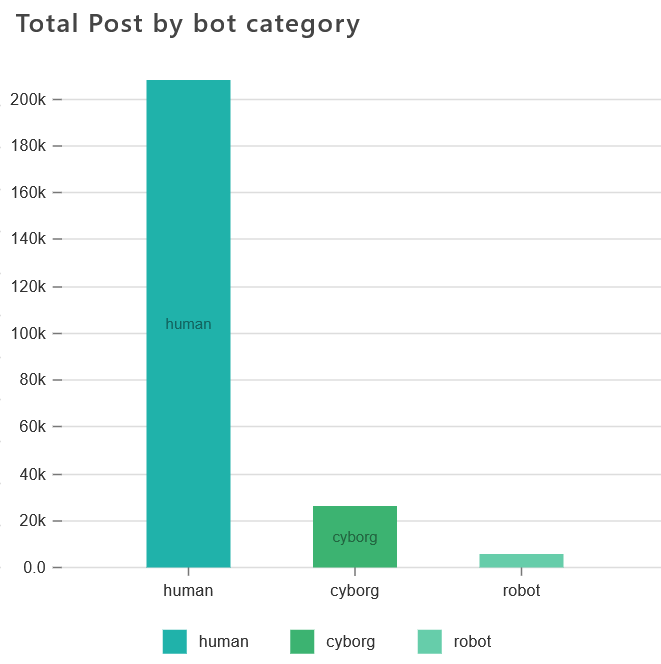
Socindex’s bot analysis revealed that 86.51% of comments came from organic human accounts, indicating that Grok was genuinely integrated into everyday conversations—not merely amplified by bots.
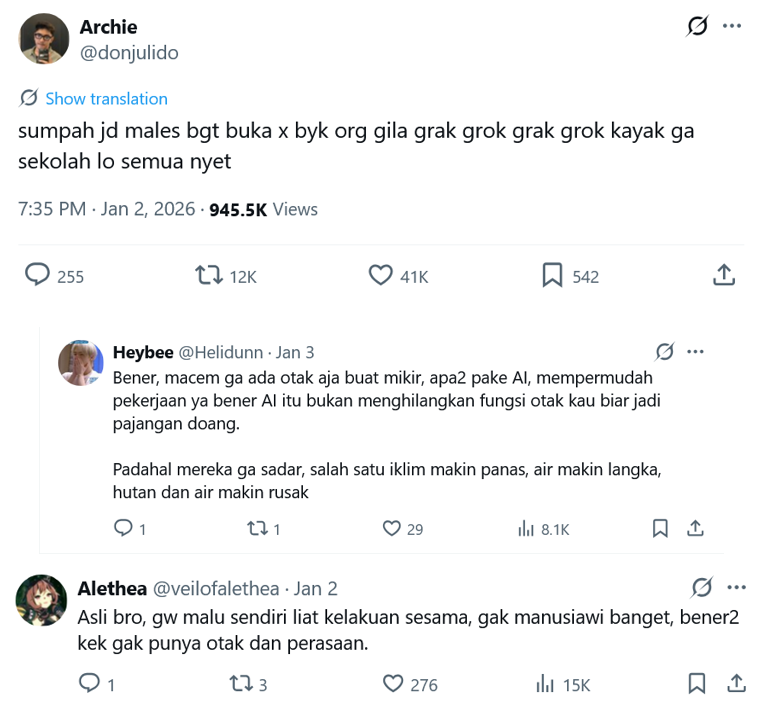
Ironically, the most-liked posts during this period were those expressing fatigue and annoyance toward Grok’s overuse. Many users muted the keyword entirely, while others criticized AI’s environmental impact due to massive energy consumption.
Despite its international implications, Grok’s blocking received limited attention from mainstream media. According to Newstensity, only 565 news articles mentioning “Grok” and “block” were published between January 1–13, 2026. This figure pales in comparison to the explosive discussions on social media.
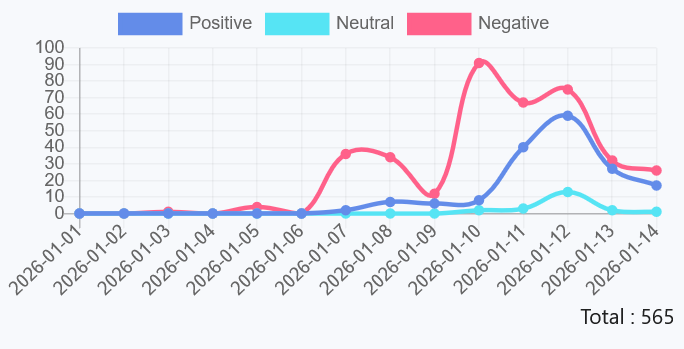
The issue’s relevance also faded quickly, lasting only two days after Komdigi’s announcement. A new surge is expected once X issues clarification or the suspension is lifted.
Komdigi’s decision to block Grok has been widely praised as a necessary step to protect women and children from AI-generated fake pornography. However, the government’s response remains largely reactive. If stronger deterrence is desired, legal threats should extend not only to platforms but also to individuals who create and distribute illegal content.
Globally, AI ethics remain under intense debate, while Indonesia’s AI roadmap has yet to be fully disseminated. Balanced regulation is essential, as the AI industry is projected to reach USD 388 billion (Rp6,148 trillion) by 2030, according to the Ministry of Industry.

AI brand visibility is how often, how accurately, and in what context your brand appears in answers from AI-powered search…

binomedia

The DTSEN social assistance decile controversy in 2026 is not merely about inaccurate data. Media monitoring and digital conversation analysis…
binomedia

Indonesia’s gross domestic product (GDP) grew by 5.29 percent in the second quarter of 2026. This figure exceeded the median…
binomedia

Artificial intelligence (AI) is transforming education faster than most education systems can respond. Machines can now search for information, summarize…
binomedia

One Event, Two Market Moves On Monday, August 10, 2026, Indonesia’s rupiah closed 0.79% higher at IDR 17,755 per US…
binomedia

On Thursday, July 30, 2026, Indonesian President Prabowo Subianto announced a “cleanest city” competition. The top five cities would win…
binomedia

Before dawn on Friday, 24 July 2026, a mob in Bali beat a man to death. He is identified only…
binomedia

Gen Z is increasingly tuning out advertisements that look overly polished and perfect. Instead, they tend to trust recommendations from…
binomedia

On June 10, 2026, Indomie brought back its Goreng Cabe Ijo flavor after the product had been difficult to find…
binomedia

Companies today use AI to read customer data, monitor public conversations, measure reputation, map issues, and support strategic decision-making. In…
binomedia