Michael Kusuma Head Of Investor Relations Sampoerna Agro
“Binokular makes it easier for us to obtain up-to-date information and news. Its monitoring reports are comprehensive and customizable, and features like news archive searching are very useful. The range of services allows personnel with high mobility to access the website, newsletters, and SMS alerts.”
Arif Haryanto Corporate Communication Department, PT Angkasa Pura I (Persero)
“Binokular is a smart solution! Monitoring media spread across 13 regions in central to eastern Indonesia, where Angkasa Pura I airports are located, becomes easy and fast with Binokular. The accuracy and relevance of the captured news are commendable. Binokular’s comprehensive and user-friendly web service makes news documentation searches easier. Binokular also helps us respond quickly to any negative news with its SMS alert service. Kudos to all these innovations, Binokular!”
Miranti Hadisusilo Corporate Secretary & Legal Director, PT Matahari Department Store Tbk
“Binokular has been incredibly helpful for our media monitoring, covering news related to our company, industry, and competitors. Up-to-date information is essential for market analysis, allowing us to respond quickly when necessary.”
Eko Harmonsyah Director of Strategic Planning and Public Relations, Bank Indonesia
“Media monitoring has become easier with Binokular. The necessary information can be searched quickly and accurately using its search engine. The interface is also quite user-friendly. But most importantly, the responsive and proactive service from the Binokular team is extremely helpful.”)
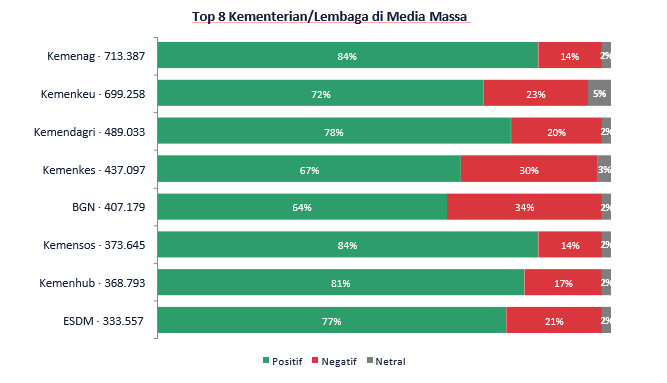
Most positive news coverage: Kemenag, Kemenkeu and Kemendagri in the news media, and Kemensos, BGN and Kemenkeu on social media. Most negative: law enforcement in the news media, and MBG governance, the Kopdes Merah Putih and forest and land fires on social media.
Jakarta — To mark two years of the Prabowo-Gibran government, PT Binokular Media Utama (“Binokular”) reviewed how news outlets covered, and social media users discussed, the performance of ministries, state institutions and priority programs. News coverage leans positive. Social media users praise programs whose benefits they feel directly. Criticism concentrates on a few large issues.
Binokular used Big Data Analytics and artificial intelligence (AI) tools, and a team of data monitoring analysts and consultants re-checked the results. It monitored news and social media from October 20, 2024 to October 14, 2026, covering 49 ministries, five state institutions and eight government priority programs. Binokular read the two lenses together to see where news coverage and public perception agree and where they differ.
A. Monitoring of the News Mass Media
The Ministry of Religion, Ministry of Finance and Ministry of Home Affairs Enter the Top 3 Most Positives;
Law Enforcement Becomes the Most Negative Topic for the Government
Across 5,461,704 news articles on 49 ministries, three ministries had the highest share of voice, meaning the largest volume of coverage. The Ministry of Religious Affairs (Kemenag) led with 713,387 articles. The Ministry of Finance (Kemenkeu) followed with 699,258, and the Ministry of Home Affairs (Kemendagri) with 489,033. Positive sentiment stood at 84 percent, 72 percent and 78 percent for the three. The biggest issues were teacher welfare and stronger madrasah and Islamic boarding school (pesantren) programs for Kemenag. For Kemenkeu it was tax revenue performance, and for Kemendagri stronger integrity among regional heads.
All the top eight ministries were dominated by positive sentiment, ranging from 64 to 84 percent. The Ministry of Social Affairs and the Ministry of Religion recorded the highest positive portion (84 percent), followed by the Ministry of Transportation (81 percent), the Ministry of Home Affairs (78%), and the Ministry of Energy and Mineral Resources (77%). BGN was the lowest with 64 percent positive and 34 percent negative.
Among state institutions, the House of Representatives (DPR RI) recorded 71 percent positive and 27 percent negative sentiment. Its biggest issue was street demonstrations and public pressure (82,783 articles). Bank Indonesia drew 76 percent positive sentiment, mostly tied to a stronger rupiah exchange rate (106,306 articles). The People’s Consultative Assembly (MPR RI) and the Regional Representatives Council (DPD RI) recorded 77 percent and 80 percent.
The Attorney General’s Office (Kejaksaan Agung) was the one institution with dominant negative sentiment: 62 percent negative and 33 percent positive across 387,573 articles. Coverage focused on case handling and law enforcement. It included the takeover and detention of a suspect in the Asabri money laundering (TPPU) case: Febrie Adriansyah, a former Deputy Attorney General for Special Crimes (Jampidsus) (47,330 articles).
Nicko Mardiansyah, News Manager at Binokular Big Data Analytics (“Newstensity”), said the pattern points two ways at once. “Predominantly positive coverage shows that government programs and policies get wide room in the media. Negative sentiment toward law enforcement institutions should be read as a signal that the public wants clarity and firmness in how cases are handled,” Nicko said.
B. Social Media Monitoring
Ministry of Social Affairs, BGN and Ministry of Finance Highest Positive in Social Media; Netizens Most Appreciate Programs That Feel Direct
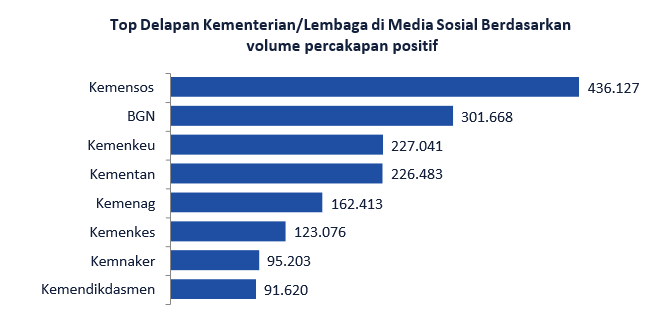
Danu Setio Wihananto, Social Media Manager at Binokular Big Data Analytics (“Socindex”), said Kemensos drew the most appreciation from social media users over the two years. “The Ministry of Social Affairs is the ministry or agency that social media users appreciated most during the two years of government, with 436,127 positive conversations. People’s Schools (Sekolah Rakyat) were among the most praised programs. So were the Family Hope Program (Program Keluarga Harapan) and the Staple Food Program (Program Sembako). The National Nutrition Agency (BGN) ranks second with 301,668 appreciation mentions. They came through the Free Nutritious Meals (MBG) program for schoolchildren, pregnant women, nursing mothers and toddlers. The Ministry of Finance follows in third place (227,041). Its drivers were the Lebaran transport ticket stimulus, the 50 percent electricity tariff discount, and the holiday allowance (THR) and 13th-month salary for civil servants,” Danu explained.
Kementan (226,483) won praise for higher rice production, a higher government purchase price (HPP) for unhusked rice, and lower subsidized fertilizer prices. Kemenag (162,413) earned it through madrasah revitalization and free halal certification. Kemenkes (123,076) earned it through the Free Health Checks program (Cek Kesehatan Gratis). The Ministry of Manpower (Kemnaker, 95,203) drew praise for the National Internship and vocational training. The Ministry of Primary and Secondary Education (Kemendikdasmen, 91,620) won it for digital learning and the Smart Indonesia Program (Program Indonesia Pintar).
Kemensos, Kemenkeu, Kementan, Kemenag and Kemenkes all rank in the top eight in both news media and social media. Kemensos is positive on both. Kemenkes has the lowest positive sentiment in the news yet still earns praise from social media users for Free Health Checks.
MBG Draws the Most Attention Among the Eight Priority Programs
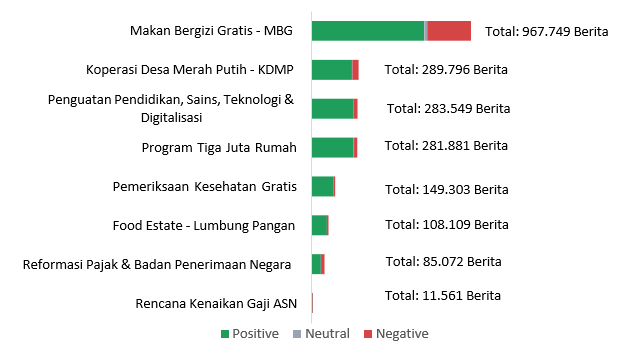
Among the eight priority programs, Free Nutritious Meals (MBG) recorded the highest news volume. It drew 967,749 articles, about 44 percent of all coverage of the eight programs, with 71 percent positive and 27 percent negative sentiment. The biggest positive issue was the President’s commitment (151,333 articles). All three of the biggest negative issues also concerned MBG. They were poisoning incidents (48,942 articles), alleged corruption and legal problems (46,359 articles), and turmoil in the governance of the National Nutrition Agency (22,366 articles).
The Red and White Village Cooperatives (Koperasi Desa Merah Putih, KDMP) came second with 289,796 articles, 86 percent positive and 13 percent negative. The main negative spotlight fell on a controversy over the budget for Latsarmil and for outlets (32,157 articles). Tax Reform and the Civil Servant Pay Raise Plan carry larger negative shares than the other programs, at 25 and 23 percent.
Netizens’ Criticism Focuses on Three Topics: MBG Governance, Kopdes Merah Putih and Karhutla
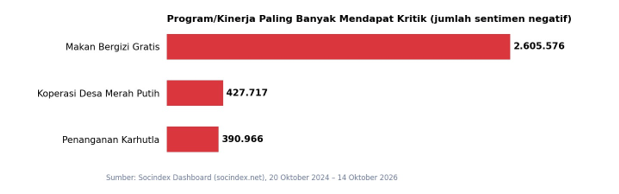
On social media, Ridho Marpaung, VP Operations at Binokular Big Data Analytics, named the three programs or areas of performance that drew the most criticism. “The three biggest issues on social media over these two years are MBG governance with 2,605,576 negative sentiments, the Red and White Village Cooperatives (Kopdes Merah Putih) with 427,717, and the handling of forest and land fires (karhutla) with 390,966,” Ridho said.
Criticism of MBG targets many parts of delivery. Users raised food safety and quality, including food poisoning cases in several regions. They also pointed to the hygiene of SPPG kitchens, the quality of program operators and how well the budget is used. On the Red and White Village Cooperatives, users focused on infrastructure readiness, the viability of the business model, budget transparency and the risk of poor governance. They also questioned the Latsarmil training for prospective Kopdes managers and where those managers will be placed.
On forest and land fires, users judged the response in Sumatra and Kalimantan from August to October 2026 as slow and inadequate. Smog spread wider in September and October 2026, began to affect residents’ health and daily activity, and drew complaints from several neighboring countries.
Ridho said social media works as a public arena. Users voice aspirations, critical views and concern there, and pro and con opinions meet on current topics. “The three big topics, MBG governance, the Kopdes Merah Putih and forest fires, deserve the government’s serious attention as a way to listen to public voices. The government should answer the high negative sentiment on these topics with serious follow-up. The press and social media users bring out facts and data faster because they have no ‘bureaucratic’ procedure. The government can gather these facts and data to complement what its own systems already collect and process for decisions and policy,” Ridho said.
What Should the Government Watch?
Based on the media monitoring findings, Binokular recommends that the government pay attention to eight points. They run from protecting national and democratic pillars to closer work with the press.
First, the government needs to remain consistent in protecting the four pillars of the Indonesian nation: Pancasila, the 1945 Constitution and its amendments, the Unitary State of the Republic of Indonesia, and Bhinneka Tunggal Ika. At the same time, it is essential to properly maintain the four pillars of democracy: the executive, the legislature, the judiciary, and the press. Second, aim for the success of expanding government programs and continue building on the success of those whose benefits are felt directly by the public, such as social assistance, public nutrition, fiscal stimulus, and food, alongside strengthening the education, science, and technology sectors.
Third, MBG governance needs continuous improvement by maintaining food safety standards and SPPG kitchen hygiene, handling food poisoning cases, ensuring budget accountability, and improving BGN’s public communication. Fourth, prepare and open up the Kopdes Merah Putih by communicating the budget and the placement of managers more clearly, ensuring that high positive sentiment in the news does not sit too far from social media criticisms.
Fifth, respond to forest and land fires quickly and clearly through prompt, transparent public communication and the delivery of concrete assistance to affected residents, given that smog directly impacts health and has drawn cross-border attention. Sixth, handle legal cases openly and consistently—particularly addressing the Attorney General’s Office’s dominant negative sentiment over internal individual cases—so that the government and law enforcement officials (APH) can maintain firm enforcement while delivering justice to the vulnerable and powerless ordinary people (wong cilik).
Seventh, strengthen government public relations by actively involving and empowering Public Relations Bureaus (Humas) in shaping leadership decisions and policies, explaining them to the public, and responding to emerging issues. Eighth, bring in communication experts, practitioners, and journalists to help capture public messages, gather on-the-ground facts and data, provide communication input, and serve as an effective bridge between the government and society.
Jakarta — Although Indonesia ultimately conceded to Saudi Arabia 2‑3 in the Group B fourth‑round Asian qualifiers at King Abdullah Sports City Stadium, Jeddah,…