Michael Kusuma Head Of Investor Relations Sampoerna Agro
“Binokular makes it easier for us to obtain up-to-date information and news. Its monitoring reports are comprehensive and customizable, and features like news archive searching are very useful. The range of services allows personnel with high mobility to access the website, newsletters, and SMS alerts.”
Arif Haryanto Corporate Communication Department, PT Angkasa Pura I (Persero)
“Binokular is a smart solution! Monitoring media spread across 13 regions in central to eastern Indonesia, where Angkasa Pura I airports are located, becomes easy and fast with Binokular. The accuracy and relevance of the captured news are commendable. Binokular’s comprehensive and user-friendly web service makes news documentation searches easier. Binokular also helps us respond quickly to any negative news with its SMS alert service. Kudos to all these innovations, Binokular!”
Miranti Hadisusilo Corporate Secretary & Legal Director, PT Matahari Department Store Tbk
“Binokular has been incredibly helpful for our media monitoring, covering news related to our company, industry, and competitors. Up-to-date information is essential for market analysis, allowing us to respond quickly when necessary.”
Eko Harmonsyah Director of Strategic Planning and Public Relations, Bank Indonesia
“Media monitoring has become easier with Binokular. The necessary information can be searched quickly and accurately using its search engine. The interface is also quite user-friendly. But most importantly, the responsive and proactive service from the Binokular team is extremely helpful.”)
For a long time, Gen Alpha has been positioned as a future market. That perspective is starting to fall behind. In February 2026, Bloomberg highlighted Gen Alpha as a generation that is already helping drive consumption, not simply because they have their own money, but because their influence on family purchasing decisions is becoming increasingly visible. In this article, the definition of Gen Alpha follows McCrindle: those born between 2010 and 2024. By that definition, in 2026 Gen Alpha includes very young children through early teenagers.
The key point is this: while discussions about Gen Alpha and consumer behavior still stop at the assumption that they will “become buyers later,” many brands are already too late to read the market shift that is happening right now. McCrindle writes that Gen Alpha has brand influence and consumer influence beyond their age. Morning Consult also shows that Gen Alpha children ask for purchases several times a week, and their influence is strongest in groceries, snacks, toys, and family restaurant choices.
Gen Alpha and Consumer Behavior Begin on Screens
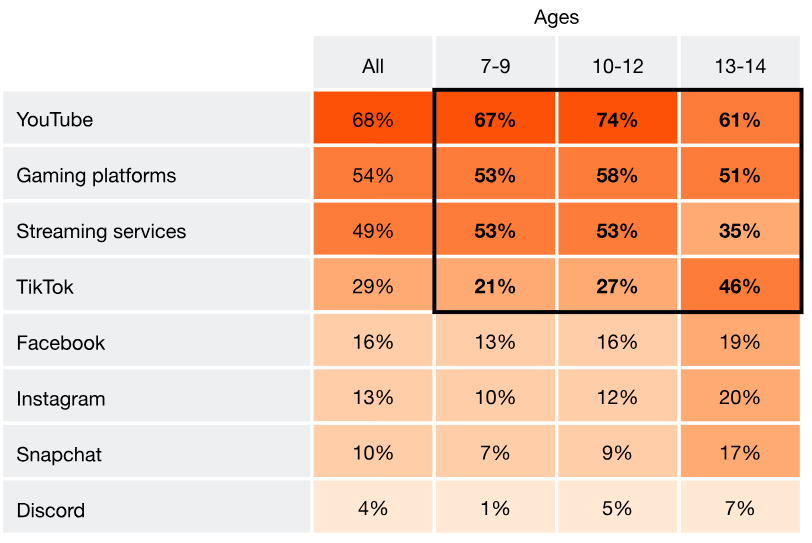
Understanding Gen Alpha and consumer behavior no longer starts at the store shelf. It starts on a screen. PwC found that 61% of Gen Alpha respondents said social media influences their desire to buy something. At the same time, 68% regularly use YouTube, 54% use gaming platforms, and 49% use streaming services. TikTok also shows an interesting pattern: regular usage rises from 21% among children aged 7–9 to 46% among those aged 13–14.
Picture 1. Table showing where Generation Alpha spends time on social media. Source: PwC Survey (2026).
These figures matter because they show that children’s preferences are no longer shaped mainly by conventional advertising. Those preferences grow through reviews, unboxing content, creator videos, algorithms, and repeated exposure across digital platforms. McCrindle even describes Gen Alpha as being born in the “great screen age,” when screens appear very early as tools for entertainment, education, and everyday routine. In this context, Gen Alpha and consumer behavior move through content that feels fluid, personal, and constantly present, not just through occasional campaigns.
PwC also offers another clue that brands often overlook. The main reasons children leave an app are boredom, too many ads, and slow loading times. That means Gen Alpha’s attention cannot be won through exposure alone. The digital experience has to feel relevant, fast, and not overly pushy. This explains why Gen Alpha and consumer behavior must be understood not only through messaging, but also through the digital experience surrounding that message.
How Children Influence Household Spending
Many people still measure children’s influence by pocket money. But Morning Consult shows that more than three in five parents say their Gen Alpha children routinely influence grocery purchases, and a similar pattern appears in the toy category. Once children are older than three, around 80% of parents say their children influence all, most, or some of the family’s grocery and snack choices. Among children aged 9–11, 74% of parents say their children help shape family restaurant decisions.
This is where the meaning of Gen Alpha and consumer behavior becomes clearer. That influence usually does not come in the form of big, instantly visible decisions. It grows through small but repeated requests. A child asks for a specific snack, becomes interested in a brand seen in a video, pushes a restaurant choice, or reminds parents about a product that is trending. Taken separately, each action looks minor. But when it happens over and over, the effect becomes a direction for household spending. Morning Consult’s data shows this is happening now, not later.
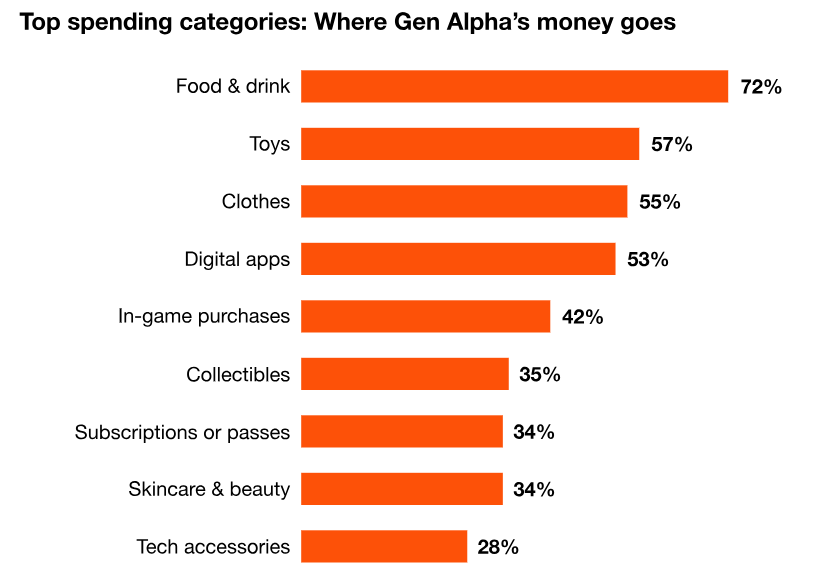
PwC strengthens this picture from the transaction side. As many as 72% of Gen Alpha children say they buy food and drinks, 57% buy toys, and 55% buy clothing. Digital spending is also significant: 53% buy apps or one-time downloads, 34% buy subscriptions or passes, and 42% make in-game purchases. Even 52% say they have added items to a shared online shopping cart for parents to review before checkout.
Picture 2. Chart showing where Gen Alpha spends money. Source: PwC Survey (2026).
Because of that, Gen Alpha and consumer behavior are no longer relevant only for toy brands or children’s entertainment. Morning Consult notes that Gen Alpha’s influence on electronics, personal care, experiences, and sports spending increases sharply with age. This means categories once considered “not yet relevant for children” are actually being influenced much earlier through the home and through digital platforms.
Why This Shift Must Be Read Through Digital Conversation
For brands, the main problem is not simply knowing that Gen Alpha has influence. The real problem is reading that change fast enough. Gen Alpha preferences can shift because of a certain video, a certain creator, a certain trend, or a certain conversation that suddenly explodes on social media. Shifts like this usually appear first as conversation, and only later show up in sales data. When social media and video platforms become the main route through which interest is formed, then Gen Alpha and consumer behavior must also be read through the traffic of conversation surrounding them.
At this point, media monitoring becomes important. Brands cannot simply wait for monthly sales reports or periodic surveys. They need to see which topics are starting to rise, which narratives are beginning to stick to certain categories, which accounts or creators are driving attention, and how sentiment is developing before an issue fully matures in the market. In other words, understanding Gen Alpha and consumer behavior requires the ability to read early signals, not just measure the final outcome.
The Role of Media Monitoring in Reading Market Signals Earlier
In the context of this article, media monitoring is relevant not as a forced promotional add-on, but as an answer to the need to read a market that is moving faster and faster. When Gen Alpha and consumer behavior are shaped by cross-platform conversation flows, companies need media monitoring to capture early signals: which issues are rising, which themes are starting to repeat, which sentiments are forming, and which narratives may influence family decisions.
For communication and marketing teams, the value of media monitoring is not just in counting mentions. Its value lies in reading context. A spike in conversations about skincare for younger users, viral snacks, a certain game, or schoolchildren’s digital habits may not immediately show up at the checkout counter. But that spike can become an early sign that interest is shifting. In that kind of situation, media monitoring functions as a tool to help brands read the direction of conversation before the market moves further.
From that position, media monitoring does not need to be forced into the narrow role of being a “solution for Gen Alpha.” The stronger position is this: when Gen Alpha and consumer behavior are increasingly shaped by digital conversation, Binokular helps brands monitor issues, map narratives, and read sentiment so their communication strategies do not fall behind changes in audience behavior.
Brand Mistakes When Reading Gen Alpha
Several mistakes still happen frequently. First, brands treat Gen Alpha as one uniform demographic block. Yet the ICC stresses that children aged 12 and under and teenagers aged 13–18 are different groups, with different developmental stages and different protection needs. Because of that, discussing Gen Alpha and consumer behavior without age segmentation will produce shallow analysis.
Second, brands focus too narrowly on advertising. For Gen Alpha, influence moves through a more fluid digital ecosystem: content, community, recommendations, platform habits, and repetition.
Third, brands read conversation volume without reading context. A spike in discussion does not always mean a solid change in interest. Because of that, good media monitoring must be able to read volume, actors, tone of conversation, and the possible impact on household consumption.
Closing
The conclusion is firm. Gen Alpha and consumer behavior are not future issues. They are already market realities today. Gen Alpha’s influence can be seen in snack choices, groceries, family restaurants, games, apps, and personal care categories that are beginning to enter the household radar. But that influence is born not only from money. It comes from attention, digital habits, and fast-moving conversation.
Because of that, brands that want to understand Gen Alpha and consumer behavior cannot rely only on sales dashboards. They have to read conversation early. They need to know which issues are growing, which narratives are sticking, and which signals are starting to influence households. That is where media monitoring becomes important. And that is where Binokular can be positioned naturally: as a tool that helps brands capture change faster, read sentiment more sharply, and build communication strategies that do not lag behind the market.
When geopolitical tensions surge—such as in a scenario of US–Iran escalation—business risks often appear long before operational disruptions become visible….
The government’s decision to appoint personnel from the Nutrition Fulfillment Service Unit (SPPG) as Government Employees with Work Agreements (PPPK),…