Michael Kusuma Head Of Investor Relations Sampoerna Agro
“Binokular makes it easier for us to obtain up-to-date information and news. Its monitoring reports are comprehensive and customizable, and features like news archive searching are very useful. The range of services allows personnel with high mobility to access the website, newsletters, and SMS alerts.”
Arif Haryanto Corporate Communication Department, PT Angkasa Pura I (Persero)
“Binokular is a smart solution! Monitoring media spread across 13 regions in central to eastern Indonesia, where Angkasa Pura I airports are located, becomes easy and fast with Binokular. The accuracy and relevance of the captured news are commendable. Binokular’s comprehensive and user-friendly web service makes news documentation searches easier. Binokular also helps us respond quickly to any negative news with its SMS alert service. Kudos to all these innovations, Binokular!”
Miranti Hadisusilo Corporate Secretary & Legal Director, PT Matahari Department Store Tbk
“Binokular has been incredibly helpful for our media monitoring, covering news related to our company, industry, and competitors. Up-to-date information is essential for market analysis, allowing us to respond quickly when necessary.”
Eko Harmonsyah Director of Strategic Planning and Public Relations, Bank Indonesia
“Media monitoring has become easier with Binokular. The necessary information can be searched quickly and accurately using its search engine. The interface is also quite user-friendly. But most importantly, the responsive and proactive service from the Binokular team is extremely helpful.”)
In recent times, public attention has again turned to leadership dynamics at the local level. Various cases involving regional heads—such as those linked to Ade Yasin and Terbit Rencana Perangin-angin—show that local political issues are no longer confined to their regions. They quickly enter the national public sphere, spread across media platforms, and become debated on social media. One issue that has emerged in this landscape is the case involving Sudewo, the Regent of Pati, which has been widely reported by national media.
The Sudewo case did not appear in the public sphere as a stand-alone legal event. It surfaced amid rising public sensitivity toward the integrity of public officials, government transparency, and accountability of power. In this context, any information related to a regional head can easily attract media attention—especially when it has the potential to affect public trust in local government institutions.
This development indicates that the relationship between local politics and the national public sphere has become increasingly fluid, alongside the growth of digital public spaces that allow local issues to gain visibility within broader political discourse. National media play a major role in framing and distributing regional issues, shaping their social and political meaning at the national level (Saputra & Dhona, 2024). National outlets are now willing to elevate local issues as part of wider political discourse. When a case is repeatedly covered, it gradually transforms from a factual incident into a public narrative loaded with social and political meaning.
At this point, the Sudewo case is not only about what happened, but also about how the event is framed, disseminated, and interpreted. To understand these dynamics more fully, communication studies and media data analysis become essential.
Case Summary and Early Coverage Dynamics
Broadly, the Sudewo case developed through several key phases that shaped public attention:
The issue began with media reports regarding alleged matters involving Sudewo in his capacity as a regional head.
National and regional media started to repeatedly raise the issue, especially in the early phase of its emergence.
Statements and clarifications from related parties became part of the reporting, but did not always stop the flow of speculation.
Public conversations on social media developed in parallel with online media coverage.
The issue gradually shifted from factual matters to discussions about integrity and leadership.
This shows that an issue does not end at a single moment; it moves dynamically following the rhythm of coverage and public response.
Media, Agenda Setting, and the Formation of Public Perception
In mass communication studies, media play an important role in determining which issues the public considers relevant. Through agenda-setting mechanisms, media influence how important an issue seems by the intensity and consistency of its coverage.
This concept explains that media do not always decide what the public must think, but they strongly influence what the public should think about. Explanations of this concept are widely discussed in communication literacy studies on agenda setting.
In the Sudewo case, repeated coverage, the chosen angle, and the use of certain wording contributed to shaping public perception. What initially appeared administrative and factual gradually came to be perceived as a broader leadership issue. In this context, media are not merely delivering information; they are also framing the social reality consumed by the public.
Sentiment Dynamics in Media Coverage
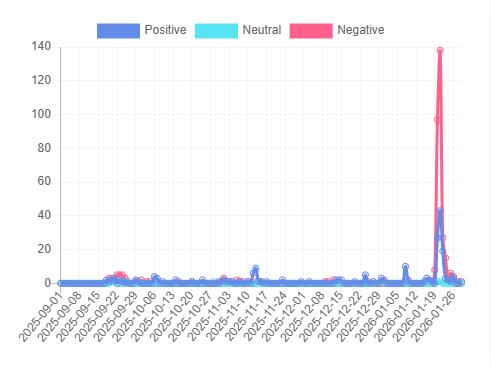
Picture 1: Sentiment dynamics of media coverage regarding the Sudewo Pati Regent case. Source: Processed by Newstensity.
Based on media tracking and Newstensity data, the early phase of the issue began to appear around September 2025, when several policies and governance dynamics in Pati Regency started receiving attention from local media. At this stage, reporting remained focused on regional policy issues, government–community relations, and public responses to decisions considered controversial. National media had not shown significant attention.
Toward the end of 2025, coverage intensity began to rise, coinciding with demonstrations in Pati. These protests became a key moment because they introduced conflict and public dissatisfaction—elements that carry high news value. Even so, at this phase the issue was still positioned as a local matter. The narrative had not explicitly shifted toward legal enforcement, and media sentiment remained mixed.
Therefore, the emergence of the Sudewo issue can be understood as an accumulation of local dynamics—regional policy debates, community responses, and demonstrations—that gradually built media attention.
Over time, this accumulation began to generate broader interest. What was initially understood as a local governance matter gradually moved beyond its local context. The turning point came when events in Pati began intersecting with national-level actors and narratives, marking the Sudewo issue’s entry into an escalation phase.
The escalation phase occurred on 20–21 January 2026, when coverage of Sudewo surged significantly. Newstensity data show a sharp increase in the volume of online media articles during this period, accompanied by a dominant negative sentiment far exceeding positive or neutral sentiment.
This escalation was driven not only by ongoing demonstrations, but also by the entry of the Corruption Eradication Commission (KPK) into the news narrative. Linking the issue to the KPK shifted it from a local issue to a national one. Media began framing developments in terms of public accountability and potential legal implications, increasing news value and expanding audience reach.
At this stage, reporting did not merely describe events; it also shaped public perception by emphasizing conflict, official integrity, and broader political impacts. This escalation explains why media and public attention increased dramatically in a short time.
Media Framing Patterns in the Sudewo Case
Unlike frequency-based analysis (e.g., word clouds), Newstensity data in this case is better interpreted through sentiment composition and coverage intensity rather than keyword dominance. The absence of a word cloud underscores that framing should be read through narrative emphasis, not only individual word choices.
Media framing of the Sudewo case is reflected in the consistently dominant negative sentiment during the early coverage phase. Media tended to place the issue in a problematic frame, focusing on allegations, political consequences, and impacts on local leadership legitimacy. This approach limited the growth of narratives centered on clarification or image recovery.
In addition, the relatively fast decline in coverage volume suggests an episodic framing pattern: the issue spikes early and then fades as new developments slow. However, even as intensity decreased, negative sentiment continued to dominate overall composition—indicating that early framing produced a lasting residue on public perception.
Thus, media framing in the Sudewo case was built not through narrative diversity, but through accumulated critical coverage within a short period—enough to shape how the public remembers the issue.
Communication Strategy and Reputation Risk
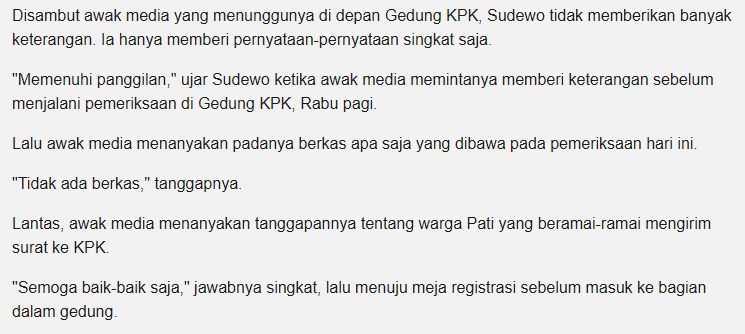
In crisis situations, the communication of public officials can determine the direction of an issue. In the Sudewo case, the public response tended to be reactive and defensive, focused on clarification and position statements.
Source : Kompas TV
Based on the screenshot of Sudewo’s statement while complying with the KPK call, his answers appear brief and do not provide sufficient explanation—such as “Complying with the summons,” “No documents,” and “Hopefully everything is fine” when asked by journalists about the case (Kompas.TV).
This approach can be important to respond to accusations, but it has limitations if not balanced with a more comprehensive narrative. When messaging focuses only on defense, the public narrative space becomes easier for media coverage and social media conversations to dominate.
From a crisis communication perspective, this condition risks extending the life of the issue. A regional head’s reputation is evaluated not only by factual truth, but also by the ability to manage perception and build public trust.
Closing
The Sudewo Pati Regent case shows that public issues in the digital era never stand alone. They are shaped by interactions among facts, media, and public perception. Media act as the bridge between events and meaning-making, while the public builds interpretations through circulating information.
Through communication studies and media data analysis, this article aims to provide a clearer reading that does not stop at sensationalism, but places the case within a wider framework. By understanding how media frame issues and how sentiment evolves, the public can see that social reality is always the product of a complex communication process.
The government’s decision to appoint personnel from the Nutrition Fulfillment Service Unit (SPPG) as Government Employees with Work Agreements (PPPK),…
The Indonesian government, through the Ministry of Communication, Information, and Digital Affairs (Komdigi), has officially temporarily blocked the use of…