Michael Kusuma Head Of Investor Relations Sampoerna Agro
“Binokular makes it easier for us to obtain up-to-date information and news. Its monitoring reports are comprehensive and customizable, and features like news archive searching are very useful. The range of services allows personnel with high mobility to access the website, newsletters, and SMS alerts.”
Arif Haryanto Corporate Communication Department, PT Angkasa Pura I (Persero)
“Binokular is a smart solution! Monitoring media spread across 13 regions in central to eastern Indonesia, where Angkasa Pura I airports are located, becomes easy and fast with Binokular. The accuracy and relevance of the captured news are commendable. Binokular’s comprehensive and user-friendly web service makes news documentation searches easier. Binokular also helps us respond quickly to any negative news with its SMS alert service. Kudos to all these innovations, Binokular!”
Miranti Hadisusilo Corporate Secretary & Legal Director, PT Matahari Department Store Tbk
“Binokular has been incredibly helpful for our media monitoring, covering news related to our company, industry, and competitors. Up-to-date information is essential for market analysis, allowing us to respond quickly when necessary.”
Eko Harmonsyah Director of Strategic Planning and Public Relations, Bank Indonesia
“Media monitoring has become easier with Binokular. The necessary information can be searched quickly and accurately using its search engine. The interface is also quite user-friendly. But most importantly, the responsive and proactive service from the Binokular team is extremely helpful.”)
In January 2026, the internet was shaken by the viral spread of a book titled “Broken Strings: Fragments of a Stolen Youth” by actress Aurelie Moeremans. The book could be downloaded for free via a link in Aurelie’s Instagram bio. In it, Aurelie reveals past trauma and her struggle to escape violence and regain control of her life. The book’s virality not only signaled a rise in personal-literacy narratives on social media, but also triggered a national wave of discussion about child grooming—an issue rarely talked about openly.
In short, “Broken Strings” recounts Aurelie Moeremans’ personal experience as a victim of child grooming within a toxic relationship when she was 15. She describes the dynamics of an unhealthy relationship with an adult man nearly twice her age, disguised under the name “Bobby.” What initially appeared fine later became manipulative, involving emotional and physical abuse.
Aurelie clarifies that as a teenager, she did not realize that what she was experiencing was grooming. According to Winters et al. (2021), grooming is a series of deceptive actions carried out by perpetrators by targeting victims, gaining access, isolating children, building trust (including with adults in the child’s environment), and gradually acclimating children to sexual content or physical touch before abuse occurs.
The honesty and detail in this memoir generated strong emotional reactions from readers. Many netizens expressed solidarity and empathy in the comments, with some sharing similar traumatic experiences. Some readers felt the book successfully portrayed survivors’ trauma in a deep and complex way.
Despite widespread support, “Broken Strings” also sparked debate. Various speculations emerged about the identity of the adult male character. Some netizens speculated and linked “Bobby” to specific real-life individuals.
Timeline & Volume of Discussion
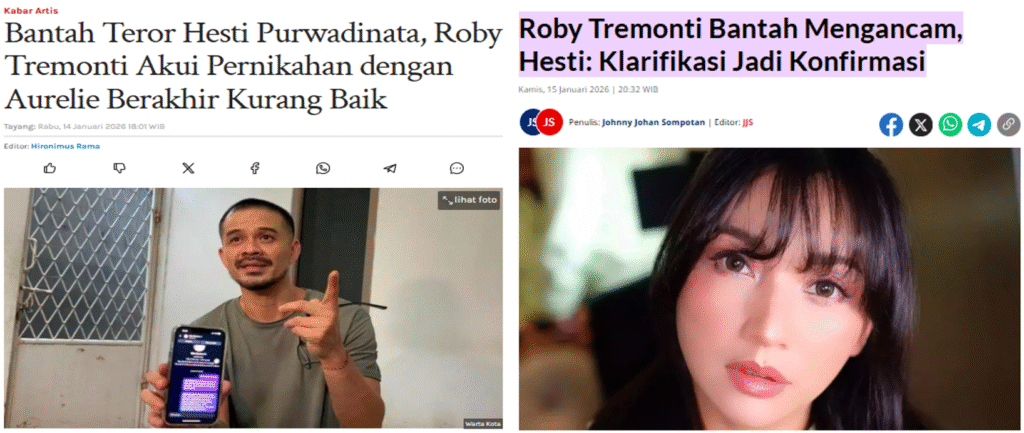
The book was previously released on 10 October 2025. However, massive public conversation only exploded in January 2026, when the free download link began circulating widely.
Using big-data media monitoring tools Newstensity and Socindex for the period 1–16 January 2026, early conversations about “Broken Strings” were first detected on 3 January 2026, when Aurelie Moeremans officially announced the re-release of the free e-book “Broken Strings: Fragments of a Stolen Youth” on her social media. The re-release was done after the account related to the book had been hacked and lost.
The decision to share the e-book for free became a catalyst that pushed the public to dissect the memoir in depth. Within days, discussion of Aurelie’s experience as a child grooming victim by a figure disguised as “Bobby” filled timelines. Netizens quickly identified the figure as Roby Tremonti, which then triggered backlash from the person concerned.
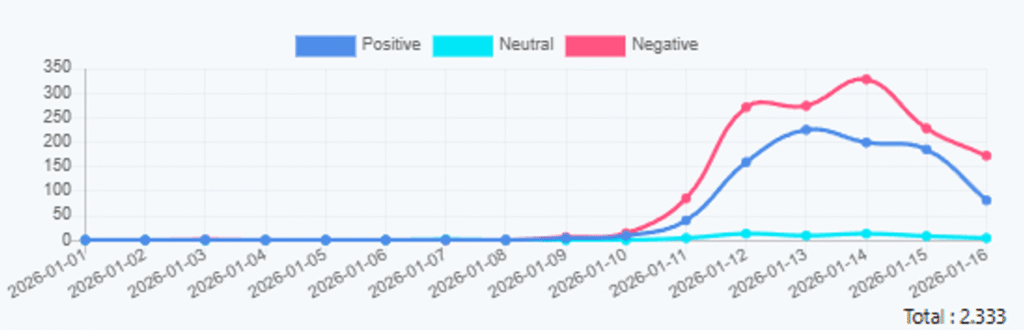
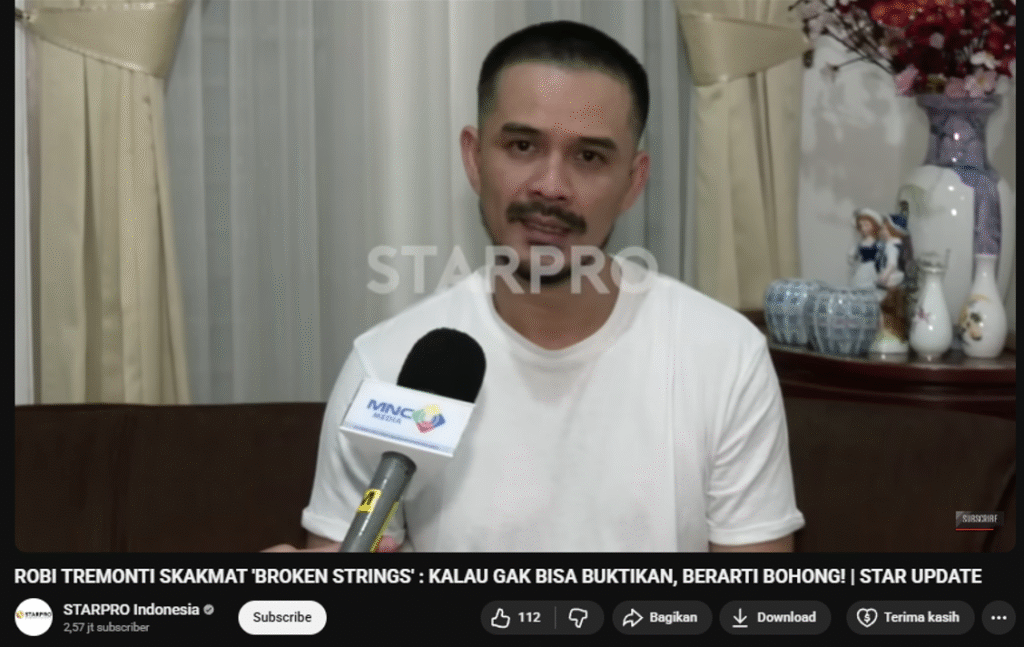
Tensions peaked on 12–14 January 2026. Roby Tremonti appeared publicly to provide a clarification, but his response was heavily criticized for using a mathematical analogy seen as irrelevant to the substance of the alleged violence. Newstensity and Socindex data show 14 January 2026 as the peak of mass-media and social-media coverage, driven by the viral spread of the clarification video and the emergence of broad support from fellow artists and the public.
Picture 1: Timeline of the “Broken Strings” topic in mass media (source: Newstensity)
Newstensity recorded that during 1–16 January 2026, there were 2,333 articles discussing “Broken Strings” and Aurelie Moeremans. Coverage with a negative tone dominated the public space through heartbreaking narratives about Aurelie’s past. The main focus in this category was harsh condemnation of the perpetrator, as well as reports on alleged threats targeting Aurelie and public figures supporting the survivor. In contrast, positive-toned coverage emerged as moral resistance in the form of an extraordinary wave of support for Aurelie. Many media outlets highlighted appreciation for her courage in breaking the silence, while also opening space for more educational discussion about trauma recovery and mental health.
Meanwhile, neutral-toned coverage tended to be informative and functional, focusing on access information for the public to obtain the “Broken Strings” e-book for free via an official link. Overall, these findings suggest that within roughly two weeks, the issue grew beyond celebrity gossip into a broader awareness movement about child grooming, sexual violence, and public solidarity in Indonesia in early 2026.
Picture 2: Social-media conversation statistics on “Broken Strings” (source: Socindex)
The “Broken Strings” discussion on social media throughout 1–16 January 2026, based on Socindex monitoring, showed extremely high public engagement. Cumulative data indicate total engagement exceeded 987 million interactions, with audience reach approaching 2 billion accounts exposed to the issue.
Socindex recorded 12,852 conversations. While this conversation count is not especially high, the intensity of public emotional response stands out in the “applause” indicator, which surged to more than 37 million appreciations. This surge reflects strong public support and the dominance of positive sentiment during certain periods.
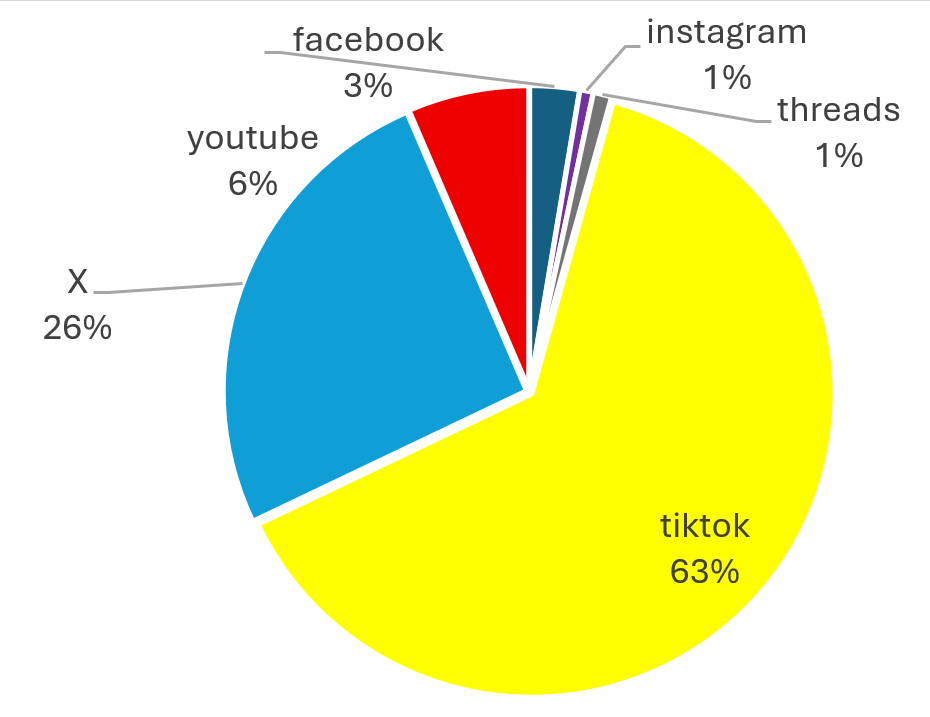
Socindex data show the volume of discussion was heavily dominated by two social platforms. TikTok was the most dominant platform, accounting for 63% of total discussion volume, followed by X contributing 26%. Other platforms such as YouTube (6%), Facebook (3%), Instagram (1%), and Threads (1%) contributed only marginally. This concentration highlights a shift in the social-media landscape, where short-form video platforms have become the primary force in shaping public opinion and attention in Indonesia.
Picture 3: Distribution of the “Broken Strings” topic across social-media platforms (source: Socindex)
Issues Being Discussed
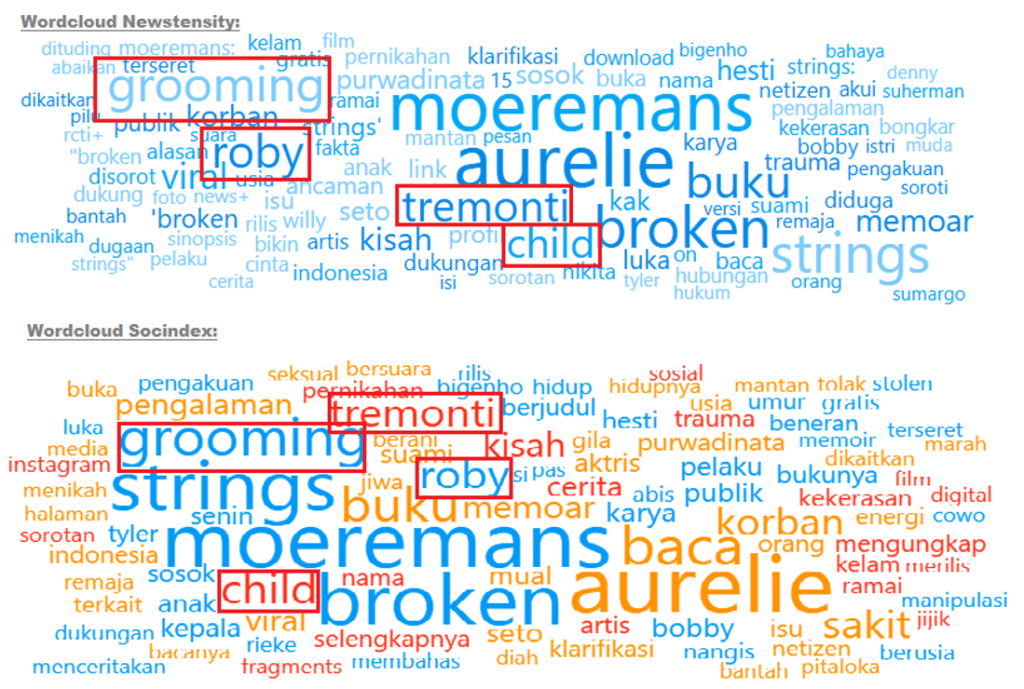
Monitoring results from Newstensity and Socindex for 1–16 January 2026 show the most dominant keywords in this topic were “child grooming” and “Roby Tremonti.”
Picture 4: Word cloud for the “Broken Strings” topic (source: Newstensity & Socindex)
Child Grooming Discourse
Response from Kak Seto & KPAI
In the book, it is told that Aurelie’s mother once visited the National Commission for Child Protection (Komnas PA), which at the time was led by Kak Seto. However, Aurelie’s mother felt she did not receive clarity on outcomes or concrete steps from the institution, so Aurelie remained in a child grooming situation carried out by a perpetrator with the initials “Bobby.”
This situation triggered a wave of criticism toward Kak Seto. Netizens revisited digital traces related to the complaint that Aurelie’s family had reportedly made in the past, leading to an assumption that Kak Seto was not responsive enough or tended to ignore the report. Responding to this, on 14 January 2026, Kak Seto issued a statement condemning all forms of child grooming. He also reminded the public that reopening an old case should not become an arena for mutual accusations, spreading slander, or personal attacks.
KPAI Commissioner Sylvana viewed this practice as a serious threat that is often not recognized as a criminal act—especially because it happens gradually within close relationships, including online spaces where cases continue to increase. She appreciated Aurelie’s courage in sharing her traumatic experience and emphasized that the story should be understood as a public warning about the danger of sexual violence against children in everyday life. According to KPAI, the discourse should be directed toward increasing vigilance, strengthening prevention, and pushing the state to provide effective handling and fulfill victims’ rights—while becoming momentum to strengthen child legal protection in Indonesia.
DPR Response
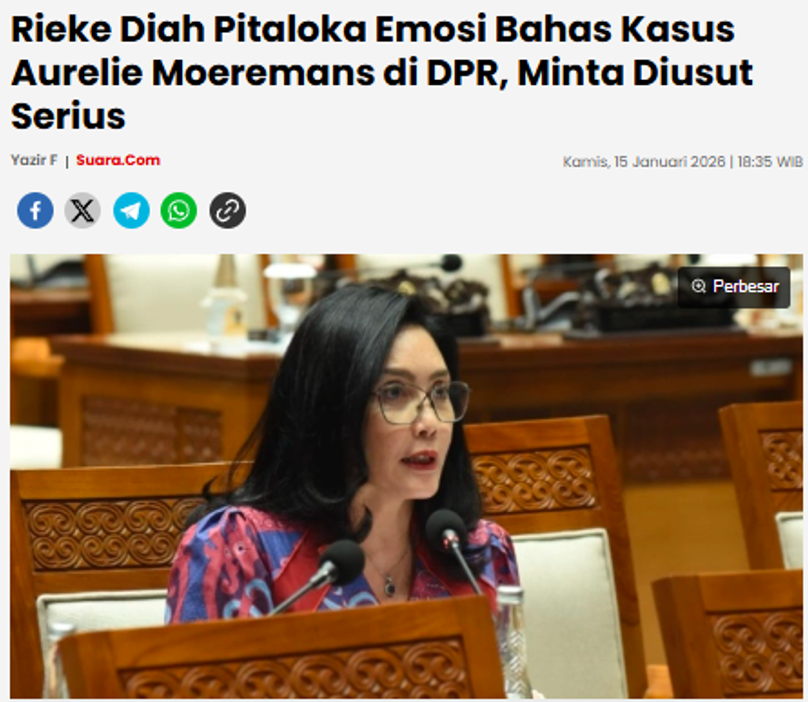
Member of the Indonesian House of Representatives (DPR) Commission XIII, Rieke Diah Pitaloka, highlighted the child grooming issue revealed by Aurelie Moeremans during a Commission XIII meeting with Komnas HAM and Komnas Perempuan on 15 January 2026. Rieke argued that social media plays an important role as a channel for justice struggles through what she called “Viral for Justice,” while referencing the free “Broken Strings” e-book that contains Aurelie’s traumatic experience due to grooming.
Rieke stressed that child grooming is a systematic crime method in which perpetrators build emotional closeness to create victim dependency, which then ends in sexual violence or exploitation. She also expressed concern about the lack of state and institutional response, and criticized the absence of firm and comprehensive positions from Komnas HAM and Komnas Perempuan.
Furthermore, Rieke warned of attempts to normalize sexual violence against children through perpetrator-defense narratives on social media, packaged under the pretext of romance or marriage. Therefore, she urged Komnas HAM and Komnas Perempuan to take a clear and firm position so that the child grooming issue does not fade, given its serious impact on the psychological and physical condition of younger generations.
Following up on this aspiration, Deputy Chair of DPR Commission XIII Willy Aditya stated that Commission XIII would schedule further meetings, including a Public Hearing (RDPU), to discuss the child grooming phenomenon more deeply. This RDPU is planned as a follow-up to Aurelie’s case during her adolescence, although the schedule has not yet been set. This step underscores DPR’s commitment to encouraging serious discussion on child protection and addressing child grooming practices in Indonesia.
KemenPPPA Response
The Ministry of Women’s Empowerment and Child Protection (KemenPPPA) appreciated the publication of “Broken Strings” by Aurelie Moeremans as a form of courage from a survivor of sexual violence in revealing traumatic experiences. Ratna Susianawati, Deputy for Special Child Protection at KemenPPPA, viewed the step as a positive example because not all survivors have the mental strength to speak up. KemenPPPA emphasized that every disclosure of a case will be followed up seriously as part of recovery and justice fulfillment, and that it opens space for direct dialogue with survivors to hear their experiences and needs fully.
Furthermore, KemenPPPA sees the book as important in increasing public awareness of child grooming and violence against children, which have often remained hidden. Through a personal-experience narrative, the book is considered capable of educating the public about psychological manipulation patterns in child grooming while encouraging early prevention. KemenPPPA emphasized the importance of cross-sector collaboration, strengthening education, and open communication between parents and children to strengthen the child protection system and create a safe environment for younger generations.
Roby Tremonti’s Clarification Became a Target of Mockery
Roby Tremonti, whom the public linked to the “Bobby” figure in the memoir, issued a clarification through social media and a brief interview. He denied accusations he considered one-sided, stated there were differing perspectives on past events, and asked the public to stop cyberbullying him and his family. Roby also signaled the possibility of taking legal steps for alleged defamation, while expressing a desire for the polemic not to drag on. He emphasized that their past relationship involved complex household dynamics and could not be simplified into a perpetrator–victim framework.
Roby Tremonti’s clarification triggered further debate in the public sphere. Instead of calming the polemic, his response strengthened polarization of public opinion. Most netizens remained on Aurelie Moeremans’ side, arguing that the grooming patterns described in “Broken Strings” align with psychological characteristics long explained by experts. Some child-protection activists also viewed Roby’s stance as a form of denial often seen in cases of violence within personal relationships.
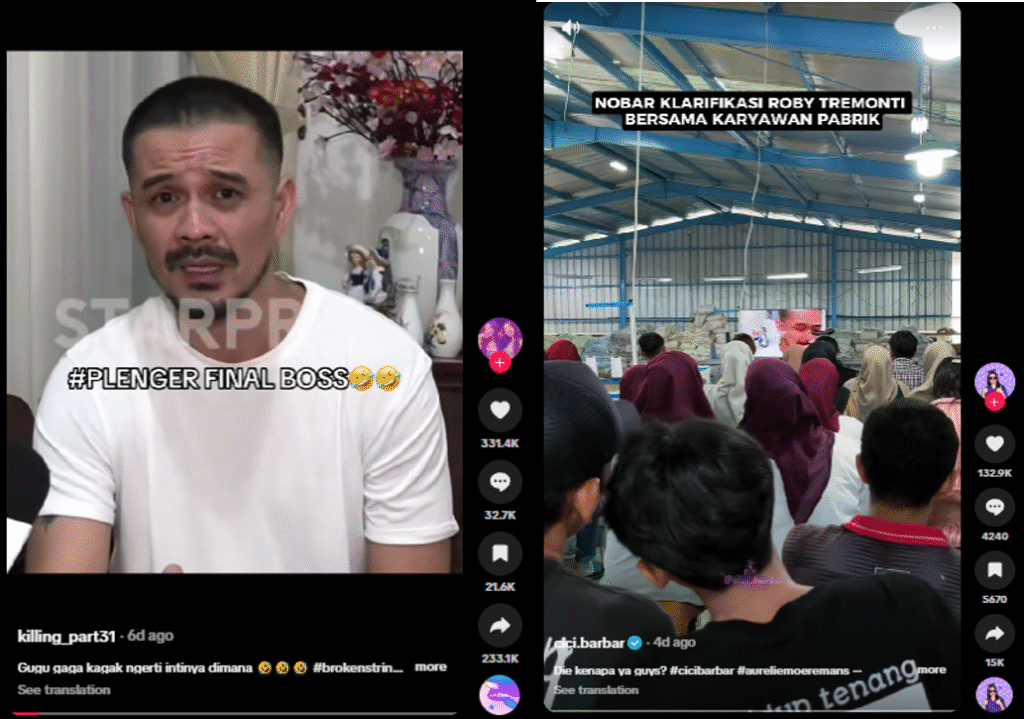
Netizen reactions to Roby’s clarification were dominated by negative sentiment. His detailed explanation and mathematical analogy were considered confusing and irrelevant, leading to widespread sarcastic comments and mockery on social media. Some netizens even described the clarification as a blunder resembling parody and further damaging his public image. Parts of his statement were turned into parodies and memes on platforms such as TikTok and X.
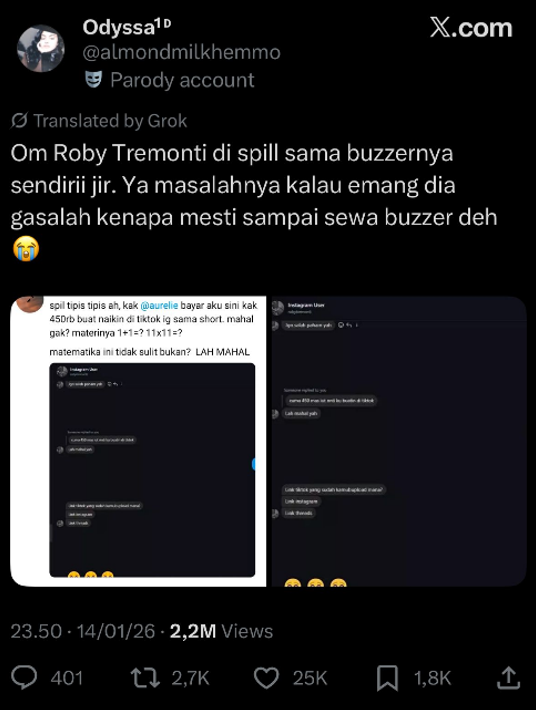
Additionally, netizens suspected attempts to steer public opinion through “buzzer” services, based on screenshots of conversations circulating on social media. This allegation further strengthened negative perceptions of Roby’s clarification. His reaction that seemed “triggered” by the “Bobby” character was interpreted by the public as an indirect confirmation of his connection to the character, rather than a convincing denial.
Roby’s defense by showing wedding documentation also generated new interpretations among netizens. The public highlighted details mentioned in the book—such as a wedding dress allegedly claimed as a filming prop—which were seen as further supporting the narrative of manipulation in “Broken Strings.” Amid these dynamics, support for Aurelie as a survivor strengthened further, while Roby became a target of sharp criticism and cyberbullying.
Roby Tremonti was also suspected of threatening Hesti Purwadinata after she openly supported Aurelie Moeremans. Through her personal Instagram account, Hesti expressed deep empathy for Aurelie’s past trauma and appreciation for her courage in exposing child grooming practices. However, that support had consequences: on 12 January 2026, Hesti and her husband, Edo Borne, were reportedly sent threats and intimidation via WhatsApp and Instagram DMs from parties allegedly unhappy with her statement.
Roby Tremonti publicly admitted he did contact Hesti’s husband, but denied making threats. He argued the communication was polite because he felt hurt at being cornered one-sidedly. Although denied, this polemic grew and became part of the media peak on 14 January 2026, when Hesti responded that Roby’s clarification increasingly confirmed the truth of the pressure.
Roby Tremonti also publicly expressed a desire to be invited to the Curhat Bang podcast hosted by Denny Sumargo, hoping to present his defense and balance the public narrative. However, Denny Sumargo chose not to provide that platform—a decision seen as a firm stance in favor of child protection issues and an effort to avoid defense narratives that could retraumatize survivors.
That decision received a positive response from the public and was directly appreciated by Aurelie Moeremans. She viewed Denny’s stance as reflecting integrity and sensitivity toward violence against children, as well as a form of public-figure moral responsibility in keeping the discussion space from becoming a tool for justification or normalization of child grooming.
Amid the pro-and-con debate around “Broken Strings,” Tengku Zanzabella offered a different perspective regarding Roby Tremonti’s position. She emphasized the importance of the presumption of innocence and reminded the public not to immediately assume someone is guilty based solely on a one-sided narrative in a memoir. Zanzabella also criticized the rise of “netizen courts,” which she believed close space for clarification and can turn into character assassination. Her statement sparked further debate on social media.
In the midst of growing debate, Aurelie issued a statement urging the public not to bully any individual or party mentioned in her memoir. She emphasized that writing “Broken Strings” was intended as a tool for self-recovery and public education, not as a personal attack on anyone.
Conclusion
Overall, the “Broken Strings” phenomenon succeeded in shifting an issue once seen as private into a national matter demanding public attention. Aurelie’s courage in speaking out not only created room for her own recovery, but also pushed state institutions such as the DPR, KemenPPPA, and child-protection advocates to re-examine and be accountable for institutional standards and responses. This narrative demonstrates that honest and courageous personal literacy can function as effective social pressure—triggering policy change and increasing collective awareness of the latent danger of child grooming in Indonesia.
Ultimately, “Broken Strings” is not merely a record of Aurelie Moeremans’ past experiences, but a symbol of resistance against a culture of silence that has long allowed violence to continue—while also serving as a call for survivors’ voices to be respected and for child protection to be realized through real commitment, not mere rhetoric.
The government’s decision to appoint personnel from the Nutrition Fulfillment Service Unit (SPPG) as Government Employees with Work Agreements (PPPK),…
The Indonesian government, through the Ministry of Communication, Information, and Digital Affairs (Komdigi), has officially temporarily blocked the use of…