

Downgrade Lifestyle: Indonesia’s Real Economic Signal
What Is “Downgrade Lifestyle” and Why Is It Trending on Threads? Since early September 2026, the term “downgrade lifestyle” has…
-
binomedia
- October 9, 2026

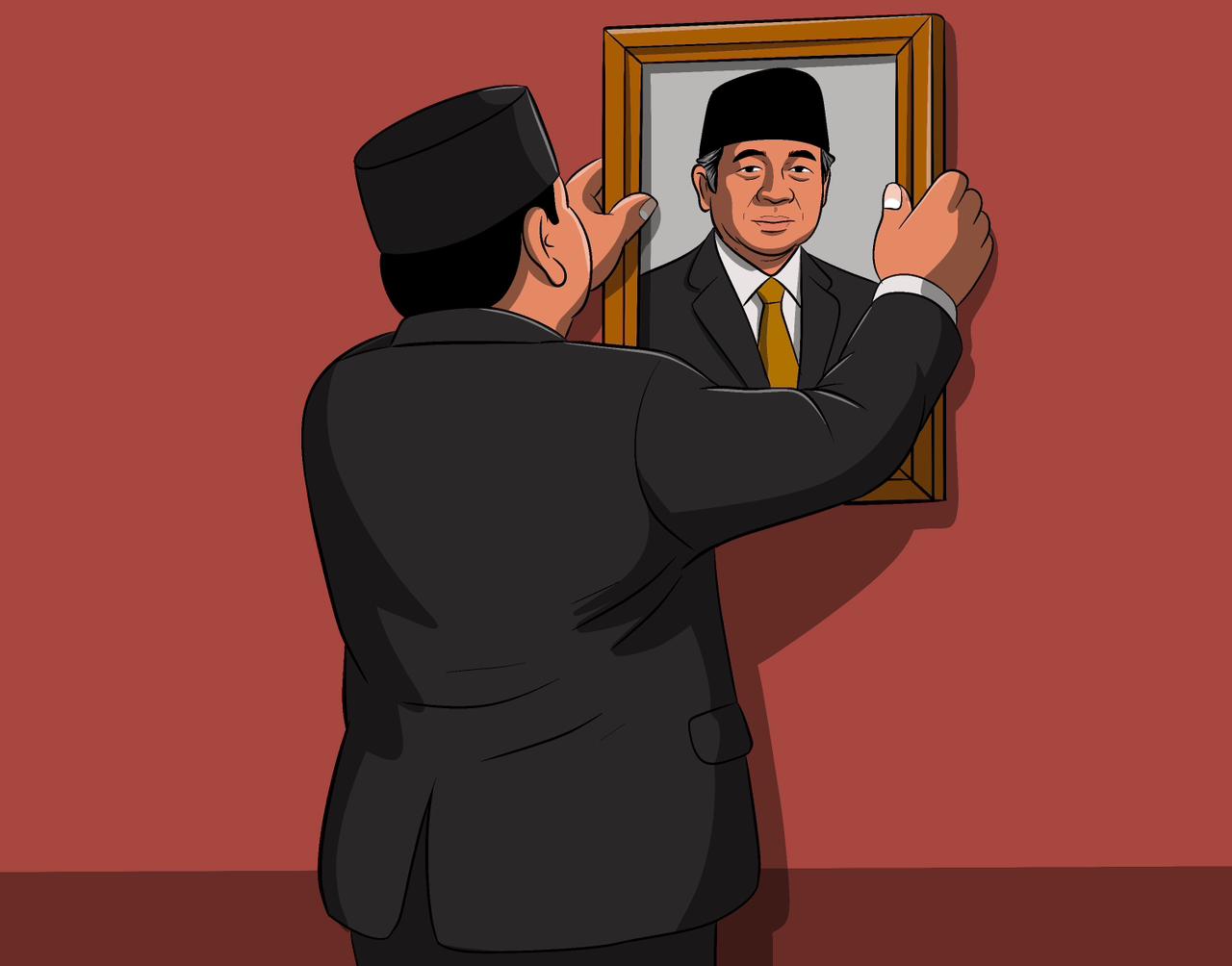
The 2025 commemoration of National Heroes’ Day turned out to be more controversial than usual. Out of roughly 40 proposed names, only ten were accepted — one of them being Indonesia’s second president, Soeharto, who also happens to be the father-in-law of the current president.
The announcement immediately sparked nationwide debate over whether Soeharto deserved the honor. The idea was not new — similar proposals surfaced in 2010 and 2015, but both were rejected as “too premature.” This time, however, under President Prabowo Subianto’s administration, the proposal was approved.
The decision reignited old wounds and polarized the public discourse. Indonesians were suddenly transported back into the shadows of their own history — between nostalgia for the stability of the New Order era and memories of repression, censorship, and corruption.
Through big-data media monitoring using Newstensity and Socindex, this article maps the narratives of support and opposition surrounding Soeharto’s elevation as a National Hero.
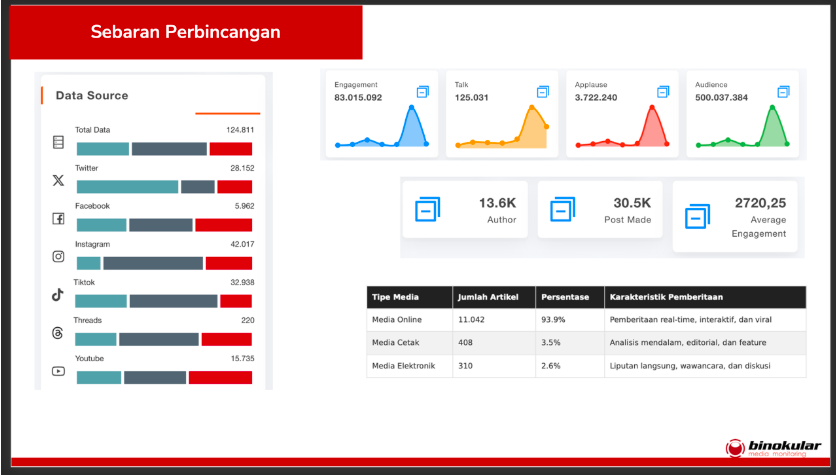
Between 5–11 November 2025, Newstensity recorded 11,760 news articles related to national awards and honors. The volume peaked around 10 November, indicating strong media attention around Heroes’ Day.
Online outlets dominated coverage with 93.9% of total publications, followed by print media (3.5%) and broadcast media (2.6% or 310 articles).
On social media, Socindex tracked 83 million engagements from 13,600 active accounts that produced about 30,500 posts. Instagram led with 42,017 contents, followed by TikTok with 32,938.
Sentiment analysis showed a contrast between the two ecosystems:
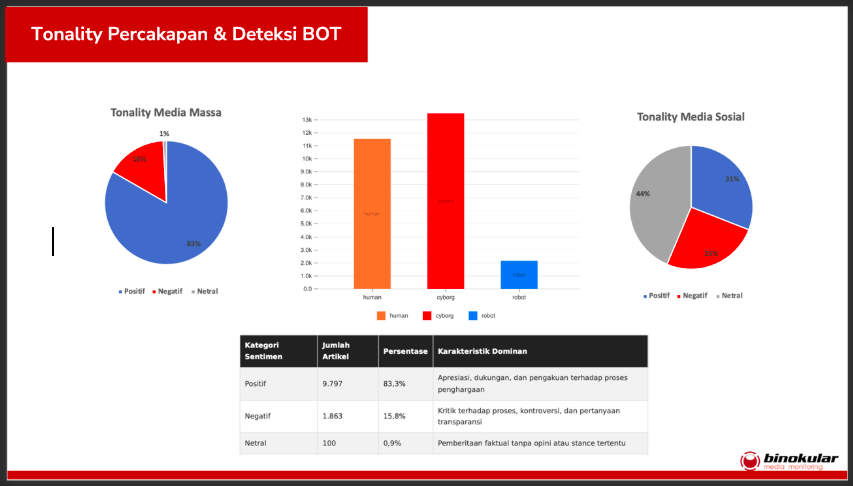
This difference reflects how both spaces operate. While mass media adheres to journalistic formality and relies on government sources, social media remains an organic arena of expression, often used by civil-society groups to advocate for dissenting views.
Interestingly, cyborg or semi-automated accounts (13,000+) outnumbered verified human accounts (11,000+), suggesting possible networked attempts to amplify particular narratives.
The dominance of positive media coverage (83%) implies that four out of five reports leaned toward supportive or constructive framing. Yet, the negative 16% coverage still played a critical role as a form of public accountability and balance.
Five prominent figures dominated the coverage:
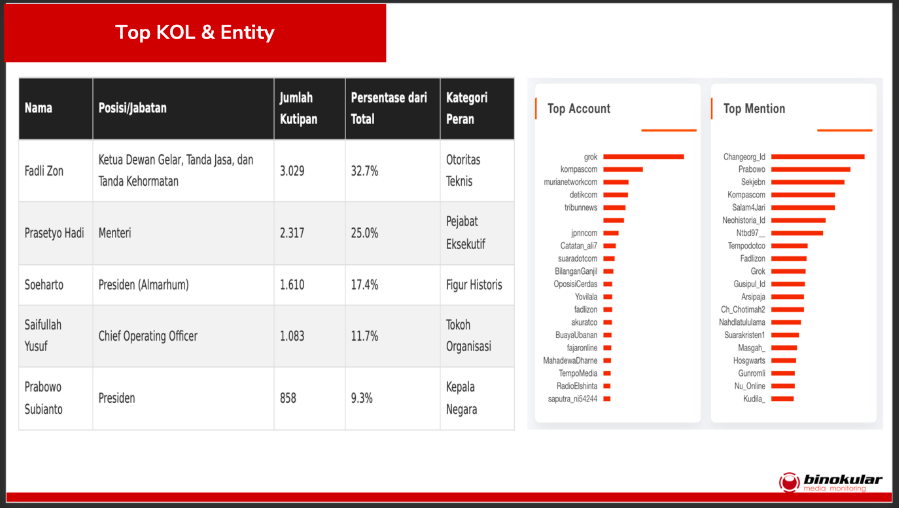
Meanwhile, on social media, the AI chatbot account @grok became the most-mentioned handle, as users flooded it with questions about why Soeharto’s award was controversial, especially regarding past human-rights violations. The petition platform @ChangOrg_ID also gained attention through campaigns rejecting Soeharto’s new title.
Thus, mainstream media tended to highlight the procedural legitimacy of the award, while social media expressed emotional resistance and activism-led criticism.
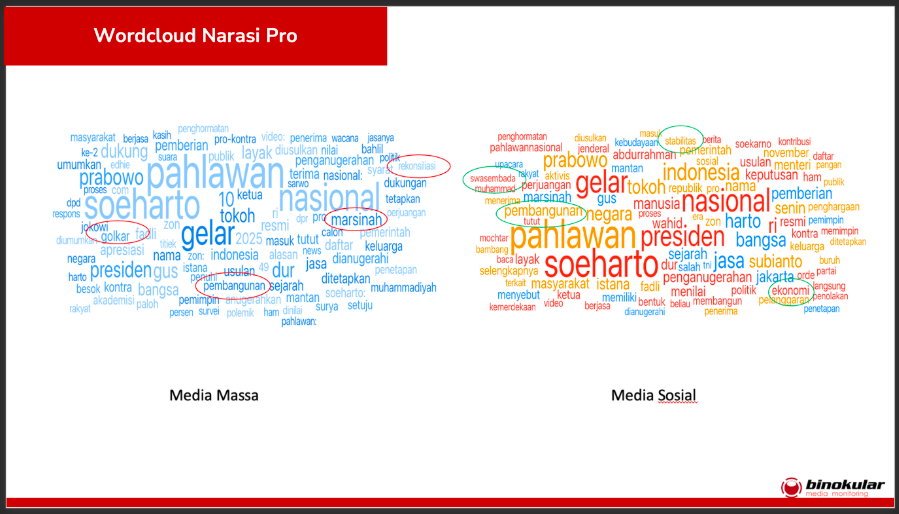
Supporters largely focused on Soeharto’s role in economic growth and national stability, echoing his long-standing image as the “Father of Development.” An interesting term surfaced: “reconciliation.”
This appeared alongside the name Marsinah — a labor activist who became a symbol of resistance during the New Order. Awarding both Soeharto and Marsinah the same honor in 2025 was seen as a symbolic gesture of national reconciliation, bridging opposing sides of history.
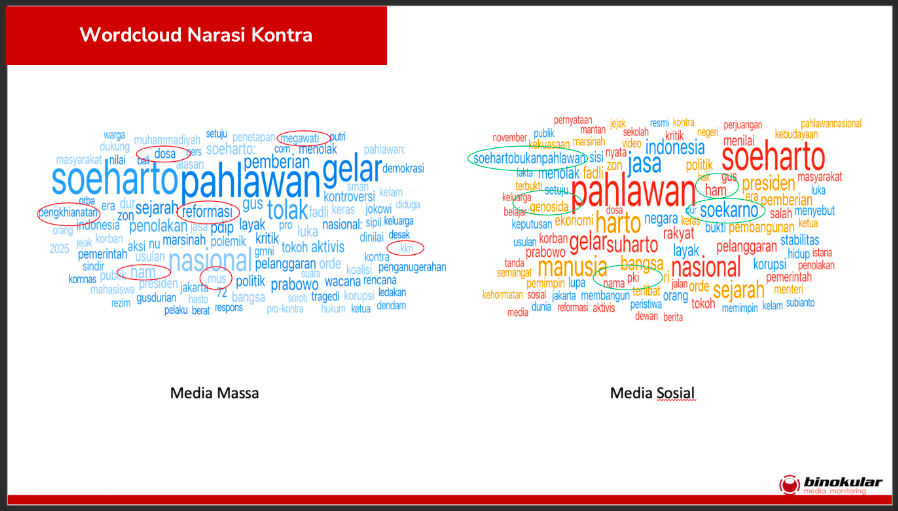
Fadli Zon emphasized the rigorous review process behind the selection by saying that all proposed names underwent extensive research by the National Titles and Honors Committee (TP2GP).
Saifullah Yusuf, another official, highlighted the symbolic aspect:
“The essence of this honor is not material, but moral — it serves to inspire families and future generations.”
In short, the pro narrative framed Soeharto’s title as a unifying gesture — a recognition of his contributions to economic progress and national order, while encouraging forgiveness through historical reconciliation.
Opposition came primarily from activists, scholars, religious figures, and digital-native youth.
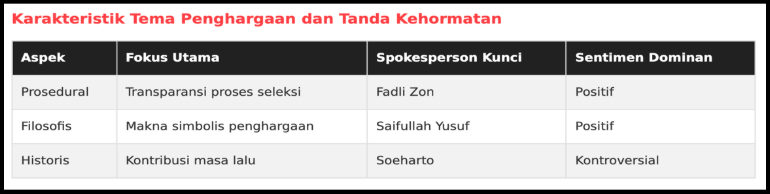
Prominent cleric Gus Mus openly rejected the decision, arguing that Soeharto’s record on human rights disqualified him. The Indonesian Democratic Party of Struggle (PDIP) also abstained from attending the ceremony, signaling Megawati Sukarnoputri’s disapproval.
Key themes in the opposition narrative included:
The hashtag #SoehartoBukanPahlawan (“Soeharto Is Not a Hero”) trended widely, with accounts like @barengwarga leading online campaigns.
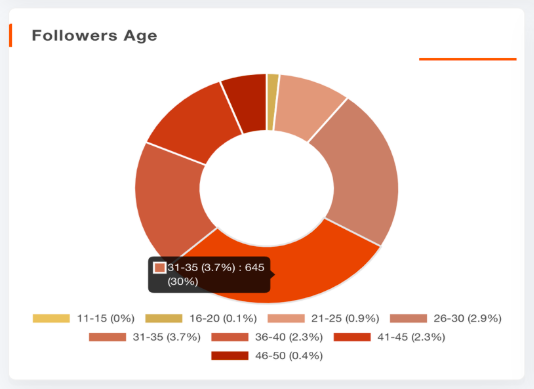
Demographic data from Socindex showed that 30% of anti-Soeharto engagement came from users aged 31–35, indicating that younger digital generations were among the loudest critics.
From the data, two opposing narratives clearly emerged:
This tension illustrates how the politics of memory plays out in digital spaces — where the past is continuously reinterpreted through public debate.
The controversy over Soeharto’s title underscores that the label “National Hero” is no longer merely historical symbolism; it has become a battleground for national identity and collective memory.
According to Newstensity and Socindex data, Indonesians remain deeply divided: some remember Soeharto as a pillar of development, while others reject his legacy of authoritarianism.
History, like democracy itself, remains unfinished — constantly rewritten, renegotiated, and reimagined.
Soeharto may now be officially recognized as a National Hero, but the true meaning of that title will depend on how Indonesia chooses to remember its past.

What Is “Downgrade Lifestyle” and Why Is It Trending on Threads? Since early September 2026, the term “downgrade lifestyle” has…

binomedia

You can no longer tell AI astroturfing from genuine public opinion by reading the text. Generative AI writes as fluently…
binomedia

Who controls money in the blockchain era? When Bitcoin launched in 2008, the answer sounded simple: no single party, because…
binomedia

The debate over whether AI development should slow down is no longer theoretical. In September 2026, the CEOs of the…
binomedia

AI brand visibility is how often, how accurately, and in what context your brand appears in answers from AI-powered search…
binomedia

The DTSEN social assistance decile controversy in 2026 is not merely about inaccurate data. Media monitoring and digital conversation analysis…
binomedia

Indonesia’s gross domestic product (GDP) grew by 5.29 percent in the second quarter of 2026. This figure exceeded the median…
binomedia

Artificial intelligence (AI) is transforming education faster than most education systems can respond. Machines can now search for information, summarize…
binomedia

One Event, Two Market Moves On Monday, August 10, 2026, Indonesia’s rupiah closed 0.79% higher at IDR 17,755 per US…
binomedia

On Thursday, July 30, 2026, Indonesian President Prabowo Subianto announced a “cleanest city” competition. The top five cities would win…
binomedia