Michael Kusuma Head Of Investor Relations Sampoerna Agro
“Binokular makes it easier for us to obtain up-to-date information and news. Its monitoring reports are comprehensive and customizable, and features like news archive searching are very useful. The range of services allows personnel with high mobility to access the website, newsletters, and SMS alerts.”
Arif Haryanto Corporate Communication Department, PT Angkasa Pura I (Persero)
“Binokular is a smart solution! Monitoring media spread across 13 regions in central to eastern Indonesia, where Angkasa Pura I airports are located, becomes easy and fast with Binokular. The accuracy and relevance of the captured news are commendable. Binokular’s comprehensive and user-friendly web service makes news documentation searches easier. Binokular also helps us respond quickly to any negative news with its SMS alert service. Kudos to all these innovations, Binokular!”
Miranti Hadisusilo Corporate Secretary & Legal Director, PT Matahari Department Store Tbk
“Binokular has been incredibly helpful for our media monitoring, covering news related to our company, industry, and competitors. Up-to-date information is essential for market analysis, allowing us to respond quickly when necessary.”
Eko Harmonsyah Director of Strategic Planning and Public Relations, Bank Indonesia
“Media monitoring has become easier with Binokular. The necessary information can be searched quickly and accurately using its search engine. The interface is also quite user-friendly. But most importantly, the responsive and proactive service from the Binokular team is extremely helpful.”)
Jakarta — Although Indonesia ultimately conceded to Saudi Arabia 2‑3 in the Group B fourth‑round Asian qualifiers at King Abdullah Sports City Stadium, Jeddah, early Thursday morning (9 October 2025, WIB), the national team’s performance was still appreciated by the public. Waves of news coverage and social‑media conversations noted that the Garuda, quoting coach Patrick Kluivert, played “like a lion”.
Indonesia briefly took the lead through a penalty calmly converted by Kevin Diks in the first half after a handball by Saudi player Hassan Al‑Tombaki. Shortly afterwards Saleh Abdul Alshamat equalised. Thirty‑one minutes later, The Green Falcons went 2‑1 up when Feras Albrikan converted a penalty following a foul by Yakob Sayuri. Saudi Arabia widened the gap in the 62nd minute as Albrikan scored his second goal. The score stood at 3‑1 until the 86th minute, when Indonesia narrowed the deficit through another penalty confidently dispatched by Kevin Diks. The dramatic match ended 2‑3.
Using big‑data monitoring tools, PT Binokular Media Utama (“Binokular”) traced the information flows produced by the mass media and public conversations on social media. From 8 October (21:00) to 9 October (09:00), the study mapped news highlights and online buzz related to the Indonesia vs Saudi Arabia match.
Match of the Knights: From Midfield Wounds to Appreciation
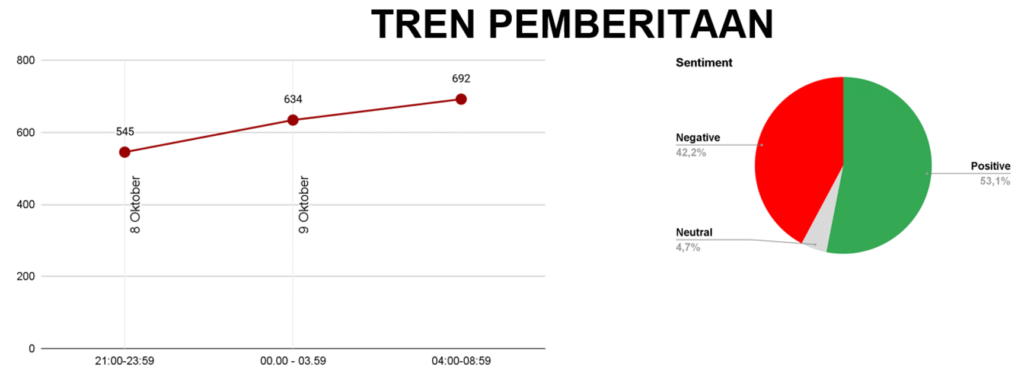
The defeat to Saudi Arabia was bitter, but from it emerged a steel‑like spirit uniting the nation: “Garuda Never Flies Alone.” Newstensity data recorded 1 775 news articles across online, print and broadcast media during the reporting period, while Socindex tools captured 45 875 conversations with 5.6 million engagements on social media. Social‑media chatter peaked earlier at 1:00 a.m. WIB right after the final whistle, whereas news coverage peaked between 4:00 and 9:00 a.m., signalling verification and narrative building processes in the press.
Mass media framed the defeat through a constructive lens (unlike the spontaneity and emotional dominance of social media). Positive tone dominated at 53.1 %, followed by negative at 42.2 % and neutral at 4.7 %. Negative media sentiment contained rational criticism, spotlighting coordination lapses in midfield and defence that directly led to Saudi goals.
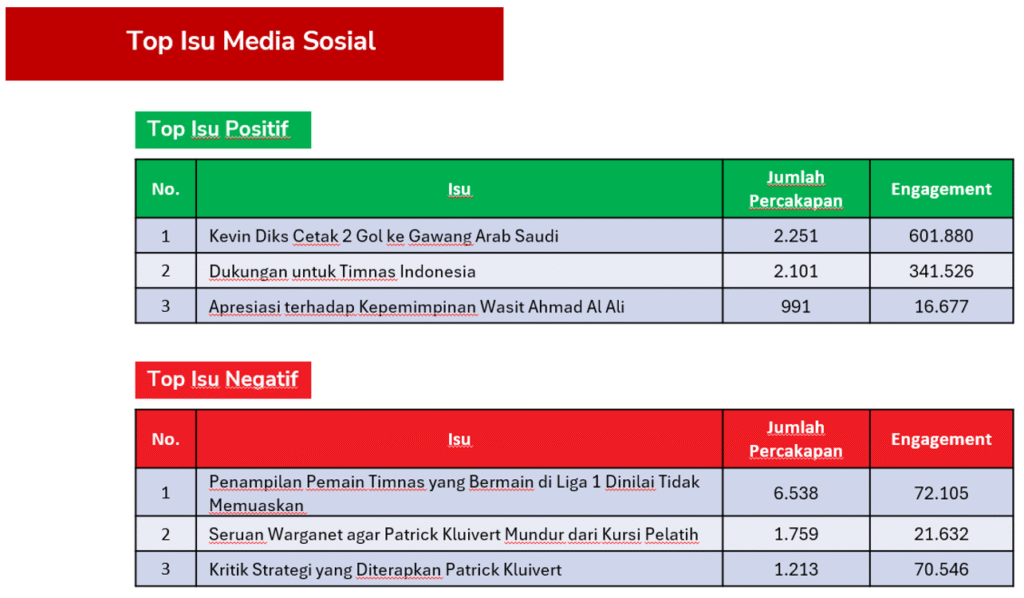
Conversely, social‑media sentiment was mostly neutral (42 %) with real‑time discussions about the match. 32 % was negative: netizens criticised League 1 players Marc Klok, Yakob Sayuri and Beckham Putra for unconvincing displays and costly blunders, with some demanding Klok’s removal from the squad. Another wave pushed the hashtag #KluivertOut, comparing coach Patrick Kluivert unfavourably to predecessor Shin Tae‑yong, who once led Indonesia to a 2‑0 victory over Saudi Arabia at Gelora Bung Karno Stadium. Strategic decisions were also questioned, from his starting line‑up to late substitutions.
Positive sentiment (26 %) represented unconditional support for Garuda. Danu Setio Wihananto, Binokular’s Social Media Big Data Analytics Manager, noted that social‑media criticism stemmed from comparisons with past triumphs over Saudi Arabia. He emphasised that “hope still remains for the remaining match against Iraq. Indonesians can again channel prayers, support and hope that the World Cup door stays open for us”.
Common Positive Narratives
Despite harsh criticism, both mass media and social platforms recorded similar positive themes:
Praise for Kevin Diks as the hero of the defeat (31 news items, 2 251 discussions).
Recognition of the team’s never‑say‑die spirit (189 news articles, 2 101 discussions).
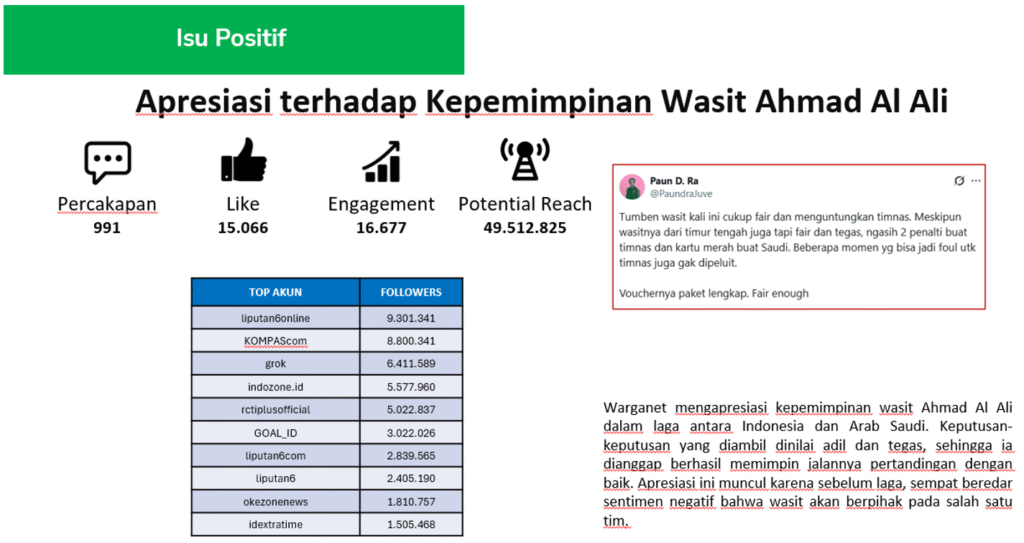
Appreciation for the referee, Kuwaiti official Ahmad Al Ali (104 news articles, 991 discussions).
Key opinion leaders amplified these messages. Coach Patrick Kluivert expressed pride despite disappointment. Balancing firmness and empathy, he lauded his players for fighting “like lions,” acknowledged weaknesses, promised evaluation, and motivated the squad with development plans. Defender Jay Idzes provided a player’s perspective on the team’s transformation, highlighting improved cohesion and thanking supporters for their extraordinary backing even in defeat.
Support also came from President Prabowo Subianto and PSSI chairman Erick Thohir, both urging the team to recover quickly. Thohir demonstrated solution‑oriented leadership, focusing on swift recovery and setting targets for the next match.
Positive sentiment grew thanks to praise for referee Ahmad Al Ali. Before the game, many Indonesians and PSSI doubted the AFC’s decision to appoint a Kuwaiti official, fearing bias. Al Ali’s performance erased those fears: he issued six yellow cards, one red and three penalties in 60 minutes, with Indonesia’s goals coming from penalties. News Big Data Analytics Manager Nicko Mardiansyah said his firm, decisive officiating silenced accusations of partiality.
Rising to Face the Desert Lions, Iraq
The loss to Saudi Arabia does not end Indonesia’s dream of reaching the 2026 World Cup. To reverse fortunes, Indonesia must beat Iraq in the second Group B match at the same stadium on Sunday (12 October 2025 early WIB) by at least two goals (e.g., 2–0). If that happens and Iraq defeats Saudi Arabia by a single goal, all three teams would finish with three points, and Indonesia would top the group on goal difference.
If Indonesia cannot win by two goals, then Jay Idzes and friends must at least beat Iraq by any score. In that scenario Indonesia’s fate depends on the Saudi Arabia vs Iraq result. If Saudi wins, Iraq would falter and Indonesia would advance to the fifth round as runners‑up.
That night Indonesia lost only one point but gained recognition that the warrior spirit is alive. Now eyes turn to Saturday, to Iraq, to a new battlefield where the Garuda must prove that the “like a lion” spirit is not just a slogan but a new identity. Whereas Saudi Arabia relied on individual brilliance, Iraq is known for discipline and physical toughness.
Commenting on these findings, Ridho Marpaung, Vice President of Operations at Binokular Big Data Analytics, noted that mass media interpret the defeat as part of team development, while social media focus on the result—win or lose. Despite different expressions, both narratives reflect deep love for the national team. “The biggest challenge now is bridging the gap between rational analysis in mass media and the emotional energy of social media. Against Iraq, Indonesia needs both: intelligent tactics and burning support. Come on, Indonesia, focus on rising to face Iraq. We still have hope,” Ridho concluded.