Michael Kusuma Head Of Investor Relations Sampoerna Agro
“Binokular makes it easier for us to obtain up-to-date information and news. Its monitoring reports are comprehensive and customizable, and features like news archive searching are very useful. The range of services allows personnel with high mobility to access the website, newsletters, and SMS alerts.”
Arif Haryanto Corporate Communication Department, PT Angkasa Pura I (Persero)
“Binokular is a smart solution! Monitoring media spread across 13 regions in central to eastern Indonesia, where Angkasa Pura I airports are located, becomes easy and fast with Binokular. The accuracy and relevance of the captured news are commendable. Binokular’s comprehensive and user-friendly web service makes news documentation searches easier. Binokular also helps us respond quickly to any negative news with its SMS alert service. Kudos to all these innovations, Binokular!”
Miranti Hadisusilo Corporate Secretary & Legal Director, PT Matahari Department Store Tbk
“Binokular has been incredibly helpful for our media monitoring, covering news related to our company, industry, and competitors. Up-to-date information is essential for market analysis, allowing us to respond quickly when necessary.”
Eko Harmonsyah Director of Strategic Planning and Public Relations, Bank Indonesia
“Media monitoring has become easier with Binokular. The necessary information can be searched quickly and accurately using its search engine. The interface is also quite user-friendly. But most importantly, the responsive and proactive service from the Binokular team is extremely helpful.”)
August 17, Indonesia’s Independence Day, is a joyful occasion for all Indonesians—including prisoners. On this day, the government grants sentence reductions or general remissions to well-behaved inmates. In 2025, a total of 372,025 prisoners received remission from the Ministry of Immigration and Corrections (Kemenimipas). Among them was Setya Novanto, chairman of the Golkar Party (2016–2019), convicted in the e-KTP corruption case.
On Saturday, August 16, 2025, Novanto—often called Setnov—was granted conditional release from Sukamiskin Prison, Bandung, West Java, after the Supreme Court approved his judicial review (PK). His sentence was reduced from 15 years to 12.5 years. Since he had served two-thirds of his sentence, Setnov qualified for parole.
However, he must report monthly to the Bandung Correctional Center (Bapas Bandung) until April 1, 2029. His conditional release can be revoked if he fails to comply with the rules, including mandatory reporting.
Novanto is no ordinary figure. A senior politician, former Golkar Party chairman, and Speaker of the House of Representatives, his career has long been shadowed by scandals until his downfall in the Rp 5.9 trillion e-KTP project corruption case, which cost the state over Rp 2.3 trillion.
On April 24, 2018, the Jakarta Corruption Court sentenced him to 15 years in prison, a Rp 500 million fine, and ordered him to repay USD 7.3 million.
Why Was He Released?
Novanto earned his release through multiple remissions granted on national and religious holidays, reducing his sentence. His judicial review further cut it from 15 to 12.5 years.
Director General of Corrections, Mashudi, stated that Novanto had accumulated 28 months and 15 days of remission. Combined with his repayment of Rp 43.73 billion in restitution (plus a subsidiary 2 months 15 days completed before release), he fulfilled the requirements under Law No. 22/2022 on Corrections: good behavior, active participation in rehabilitation programs, reduced risk, and serving at least two-thirds of his sentence.
Yet his prison record was controversial. In 2019, he was caught in a hardware store despite only being permitted to leave prison for hospital treatment. The Ombudsman also found his luxurious prison cell—double-sized, with mattress, sheets, fan, bookshelves, work desk, and private bathroom. He was also photographed using a mobile phone. These incidents suggested preferential treatment.
This raises doubts: what definition of “good behavior” is applied by the government in parole decisions?
Remissions for Corruptors
Novanto is just one of many high-profile corruptors granted early release:
Suryadharma Ali, former Religious Affairs Minister, sentenced to 6 years in 2016, freed on parole in 2022.
Patrialis Akbar, former Constitutional Court judge, sentenced to 8 years in 2017, freed in 2022 after remission and judicial review.
Ratu Atut Chosiyah, former Banten Governor, sentenced to 7 years for bribery and medical equipment graft, freed on parole in 2022.
Anti-corruption expert Zaenur Rohman (UGM’s Pukat) said Novanto’s release undermines anti-corruption efforts. While technically legal, he argued regulations should be re-examined.
Previously, Government Regulation (PP) No. 99/2012 imposed stricter conditions for parole/remission in extraordinary crimes (narcotics, corruption, terrorism), requiring justice collaborator status. However, in October 2021, the Supreme Court annulled these stricter requirements, making all convicts eligible for remission.
Former KPK investigator and now head of IM57+ Institute, Lakso Anindito, called Novanto’s release a serious setback under President Prabowo Subianto’s administration—especially after the recent amnesty for PDIP’s Hasto Kristiyanto. He warned this erodes deterrence and risks normalizing leniency for corruption.
Media Monitoring
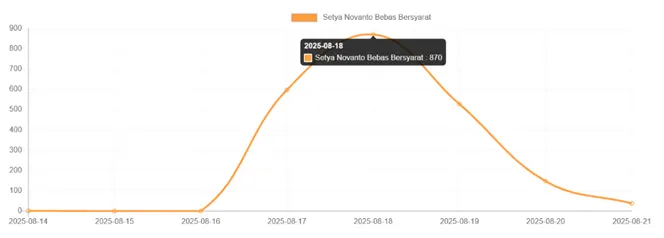
Figure 1. Daily news volume on Setya Novanto’s parole (Aug 14–20, 2025, source: Newstensity)
Between August 16–20, 2025, Newstensity, a big data–powered media monitoring tool, recorded 2,142 news items mentioning “Setya Novanto” and “bebas.” Coverage peaked on August 18 with 870 articles, then quickly declined, showing a short media cycle.
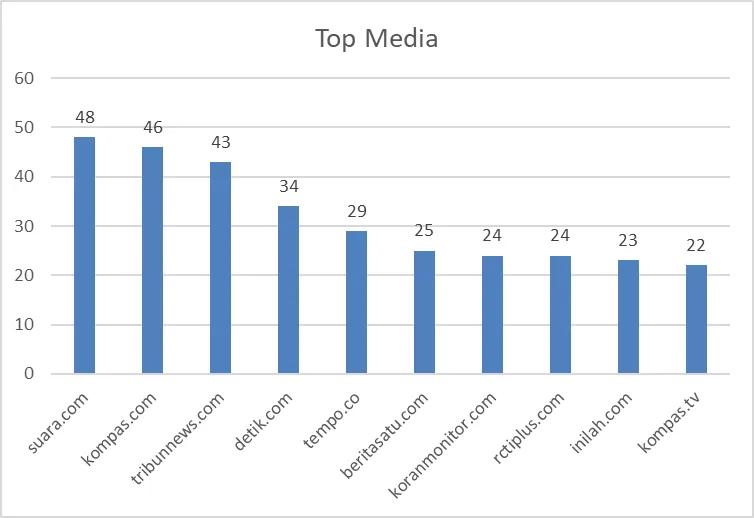
Figure 2. Top media outlets covering Novanto’s parole (Aug 14–20, 2025, source: Newstensity)
Suara.com: 48 articles
Kompas.com: 46
Tribunnews.com: 43
Online portals dominated coverage due to speed and reach.
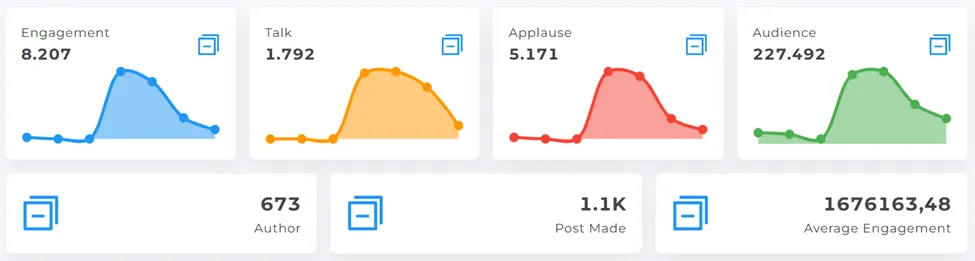
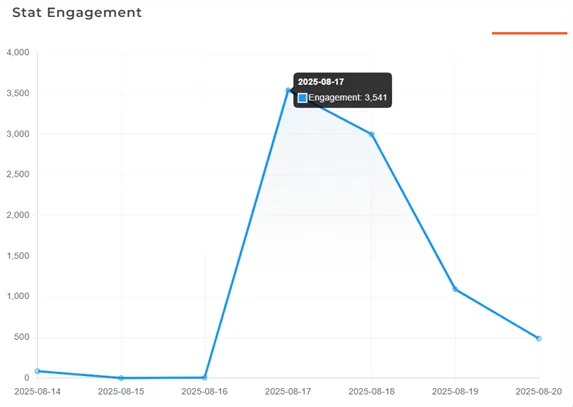
Figure 3. Keyword statistics (“Setya Novanto” / “Setnov”) on X (Aug 14–20, 2025, source: Socindex)
Engagement spiked on August 17 with 3,541 interactions, then quickly declined.
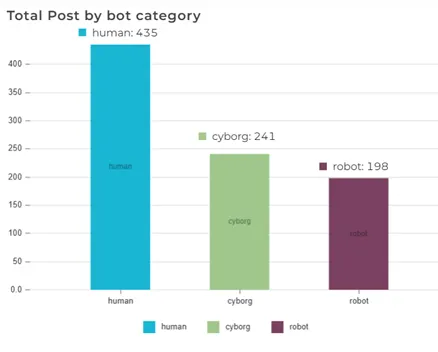
Figure 5. Bot activity (source: Socindex)
While most posts came from humans (435), cyborg (241) and bot (198) accounts contributed nearly half, showing strong automated amplification.
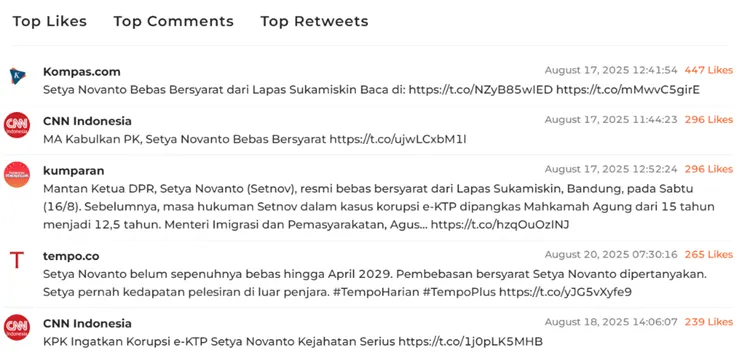
Figure 6. Top posts (source: Socindex)
Top tweets came from Kompas.com (447 likes), CNN Indonesia and Kumparan(296 likes each), and Tempo(265 likes). This shows discourse was driven by media accounts, not influencers.
Conclusion
Setya Novanto’s parole reveals the dilemma of anti-corruption enforcement in Indonesia. Legally valid, but morally questionable, it risks weakening public trust and reducing deterrence. Unless regulations are tightened, leniency for corruptors will be seen as compromising justice—deepening skepticism about the government’s true commitment to eradicating corruption.
Writer: Indra Buwana (Jangkara), Ilustrator: Aan K. Riyadi
When geopolitical tensions surge—such as in a scenario of US–Iran escalation—business risks often appear long before operational disruptions become visible….
The government’s decision to appoint personnel from the Nutrition Fulfillment Service Unit (SPPG) as Government Employees with Work Agreements (PPPK),…