The dream of building machines that think like humans began with Alan Turing’s famous Turing Test in 1950. The term artificial intelligence (AI) was formally coined at the 1956 Dartmouth Conference. Early AI systems relied on simple, rule-based structures—classic if–else logic exemplified by chess programs—yet their capabilities were limited by the computing power of the day.
Hardware advances and, later, deep-learning algorithms transformed the field in the 2010s. AI can now “learn” from massive datasets instead of following hard-coded rules.
The Rise of Large Language Models
Large Language Models (LLMs) such as Google’s BERT (2018) and OpenAI’s GPT series marked a giant leap forward. Powered by transformer architectures, LLMs can understand and generate natural language at a scale never seen before. A single model can now perform a wide array of tasks—creative writing, customer support, even data analysis—where earlier generations needed one model per task.
Fine-tuning on high-quality, task-specific data remains critical: poor datasets introduce bias and make results unreliable.
Jobs Already Affected
LLMs have automated repetitive or formulaic work: data entry, basic customer service, routine content writing, and parts of manufacturing and logistics. Even software development sees increasing automation. That shift fuels fears of technology-driven unemployment, especially in vulnerable sectors.
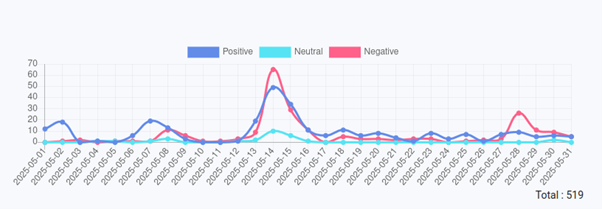
Picture 1 – Line graph showing daily volume of Microsoft‐layoff news in May 2025. Peak coverage occurs on 14 May, the day Microsoft announced more than 6,000 layoffs to “align strategically” while boosting AI investment (source: Newstensity).
Many social-media users link such layoffs directly to AI adoption. One viral post by tech entrepreneur Greg Isenberg warned that AI could replace “many jobs in a very short time.”
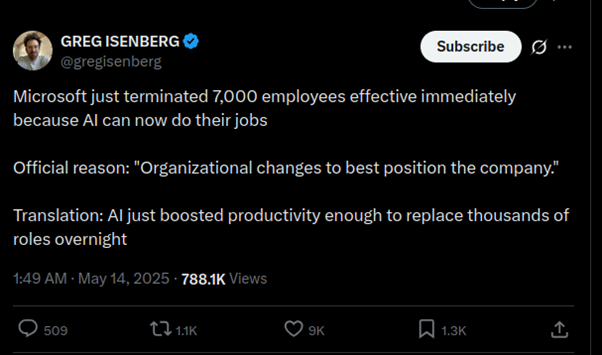
Picture 2 – Screenshot of @gregisenberg’s post on X (Twitter) expressing concern that AI will soon displace large numbers of workers.
Lessons from Past Industrial Revolutions
Technological upheaval is nothing new. The first Industrial Revolution introduced steam engines that displaced hand weavers; the second brought electricity and assembly lines that shifted farm laborers into factories; the third added computers and automation, shrinking production-line workforces. Every wave reshaped the labor market—and every wave eventually created new types of jobs.
What Still Requires Humans
Original creativity, empathetic counselling, and ethical decision-making remain hard for AI to replicate. Interpersonal skills—leadership, negotiation, cultural nuance—are inherently human. Indeed, AI’s rise is spawning entirely new roles: data scientists, AI ethicists, machine-learning engineers, and more. Human teachers, physicians, and artists still excel where intuition and emotional resonance matter. Raw Rev AI_ Tidak Seked…
Reject or Adapt?
Some people reject AI, fearing job losses and ethical pitfalls such as algorithmic bias. Others choose to adapt—raising digital literacy, experimenting with new tools, and integrating AI judiciously. Education and forward-looking policy are essential to help workers transition and to ensure AI enhances rather than erodes human value. Critical thinking will be vital: individuals must be able to evaluate AI output, spot bias, and make ethical choices.
Writer: Abadi Gilang, Ilustrator: Aan K Riyadi