Michael Kusuma Head Of Investor Relations Sampoerna Agro
“Binokular makes it easier for us to obtain up-to-date information and news. Its monitoring reports are comprehensive and customizable, and features like news archive searching are very useful. The range of services allows personnel with high mobility to access the website, newsletters, and SMS alerts.”
Arif Haryanto Corporate Communication Department, PT Angkasa Pura I (Persero)
“Binokular is a smart solution! Monitoring media spread across 13 regions in central to eastern Indonesia, where Angkasa Pura I airports are located, becomes easy and fast with Binokular. The accuracy and relevance of the captured news are commendable. Binokular’s comprehensive and user-friendly web service makes news documentation searches easier. Binokular also helps us respond quickly to any negative news with its SMS alert service. Kudos to all these innovations, Binokular!”
Miranti Hadisusilo Corporate Secretary & Legal Director, PT Matahari Department Store Tbk
“Binokular has been incredibly helpful for our media monitoring, covering news related to our company, industry, and competitors. Up-to-date information is essential for market analysis, allowing us to respond quickly when necessary.”
Eko Harmonsyah Director of Strategic Planning and Public Relations, Bank Indonesia
“Media monitoring has become easier with Binokular. The necessary information can be searched quickly and accurately using its search engine. The interface is also quite user-friendly. But most importantly, the responsive and proactive service from the Binokular team is extremely helpful.”)
Indonesia’s Asset Forfeiture Law and the Trust Gap Online
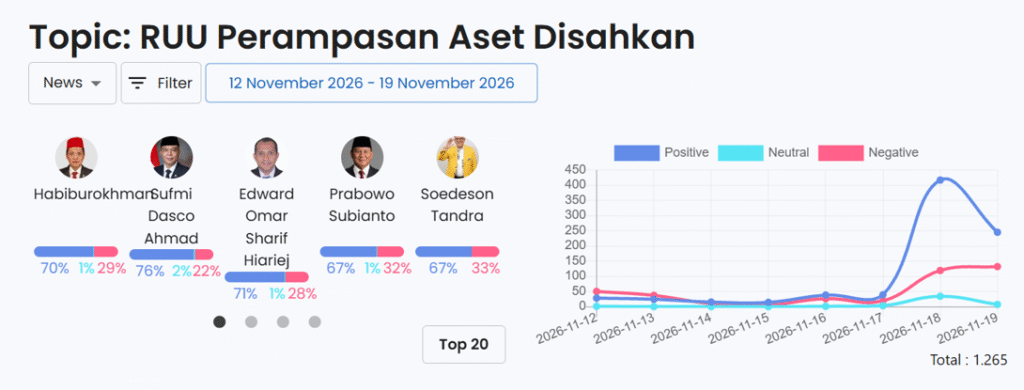
Indonesia’s House of Representatives passed the Asset Forfeiture Law on 19 November 2026, and the public did not respond with one voice. Of 1,265 news articles Newstensity tracked from 12 to 19 November, 65% were positive. Of 12,767 social media conversations, 44% were negative. Social media users read the clauses and asked who would enforce them.
On Thursday, 19 November 2026, House Speaker Puan Maharani brought down the gavel on the Asset Forfeiture Bill at the 13th plenary meeting of Sitting Period II, 2026/2027. The day before, all factions agreed to send the text to the plenary without reservations. The idea has been discussed since 2008, so the wait is described as 18 years. This article does not go through the law clause by clause. It looks at what happened among the public watching it.
What social phenomenon appeared when Indonesia passed its Asset Forfeiture Law?
The data from the week of passage shows three linked patterns. First, people tested the clauses instead of just receiving news of the vote. Second, their questions moved from what the law says to who will enforce it. Third, readers of news and readers of comments lived in different moods: 65% of news was positive, against 9% of social media conversation.
These three patterns are Binokular’s reading of conversation data. They do not measure how the law affects people’s lives. The law is new, so the effects of enforcement cannot be measured yet. What can be seen now is how the public reacted in the first days.
What was the public mood before the vote?
Public skepticism did not emerge overnight during the week of the bill’s ratification. Public pressure had already taken to the streets: the Aliansi Masyarakat Pati Bersatu (Pati United Community Alliance) visited the House of Representatives (DPR) in late August to demand its passage. The promise to pass the bill no later than December 15 was met with widespread enthusiasm. However, an opinion writer at Katadata cautioned that the euphoria should not end with a mere promise. Binokular’s observation suggests that the initial excitement over the bill’s swift passage quickly gave way to questions about its actual contents, a pattern reflected in this week’s comment sections.
The narratives circulating online were not always accurate, either. In July, Commission III Chair Habiburokhman denied claims circulating through anonymous social media accounts that the DPR had rejected the bill’s passage, stating instead that deliberations were actively underway. Some members of the public had already been following the issue through information circulating on social media for quite some time.
How did social media users test the clauses?
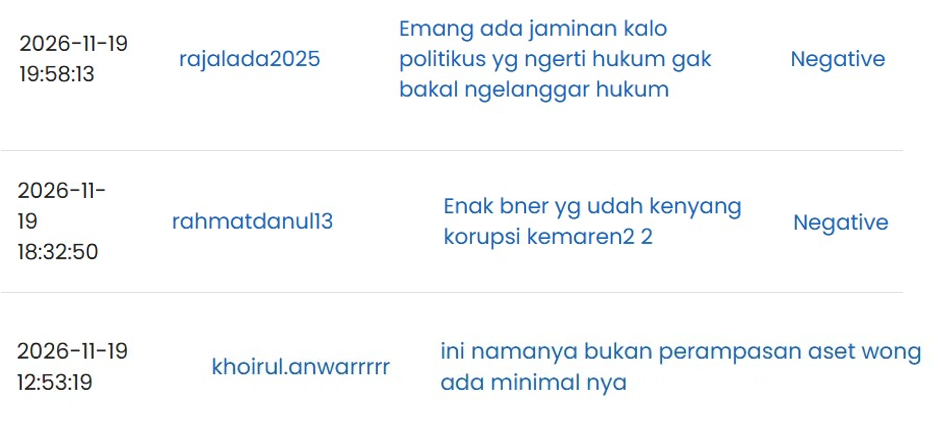
One negative comment, chosen from the Newstensity data, reads: “This isn’t asset forfeiture at all, there’s a minimum” (translated from Indonesian). Binokular picked this example by hand, not by random sample, so it does not represent all 5,569 negative conversations. The comment points to the asset value threshold. According to reporting on Article 6, forfeiture without a criminal conviction requires assets worth at least IDR 1 billion. That mechanism, known as non-conviction-based forfeiture, lets the state seize assets without a court ruling in a criminal case, under limited circumstances.
The figure used to be different. In early deliberations in 2023, a minimum of IDR 100 million was recorded. Indonesia Corruption Watch (ICW) asked in 2025 that the limit be reviewed to account for inflation. For the new figure, the reason given is proportionality. ICW says the increase weakens the instrument.
The commenter is half right. The IDR 1 billion threshold exists, but according to reporting it applies to the mechanism without a criminal conviction, not to all asset forfeiture. Binokular’s hunch: this pattern shows legal literacy growing on its own in comment sections, along with its risk. A half-correct reading can spread as shared understanding.
How wide is the trust gap toward the people who will enforce the law?
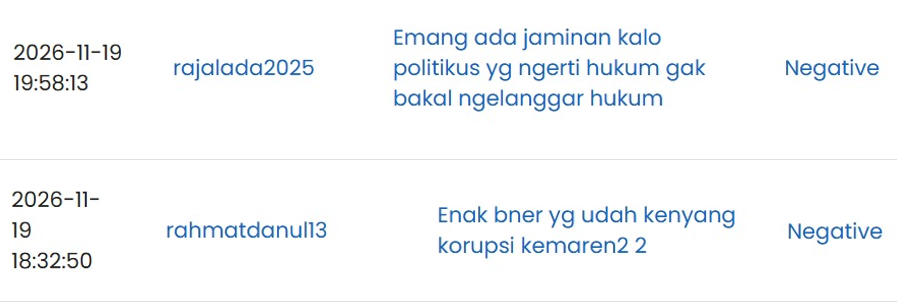
Some comments move into the territory of trust. One asks: “Is there any guarantee that politicians who know the law won’t break it?” Another jabs at people who already grew fat on corruption earlier. Both ask who will hold this new tool.
That question has measurable background outside the Newstensity data. The Muda Bicara ID survey for Q1 2026 asked young people which state institutions they trust. It put the House of Representatives lowest, at 38.6%. The Kawula17 survey for Q2 2026 found that 52% of young people cite official corruption as the main reason they lost trust in government.
The picture is not uniform. An Adidaya Institute survey found 68.8% of respondents optimistic about the government’s anticorruption agenda. Differences in population and method mean these surveys cannot be compared directly. Legal and development observer Hardjuno Wiwoho raises another concern: public anxiety that asset forfeiture could be applied to ordinary citizens. Those trust questions sit inside a wider split between how news and comments treated the vote.
Why did news readers and comment readers see two different realities?
Newstensity recorded 1,265 articles from 12 to 19 November 2026: 820 (65%) positive, 46 (4%) neutral, and 399 (32%) negative. Percentages are rounded, so the total does not equal exactly 100. Six social media platforms (X, Facebook, Instagram, YouTube, TikTok, and Threads) add up to 12,767 classified conversations. Of these, 1,192 were positive (9%), 6,006 neutral (47%), and 5,569 negative (44%).
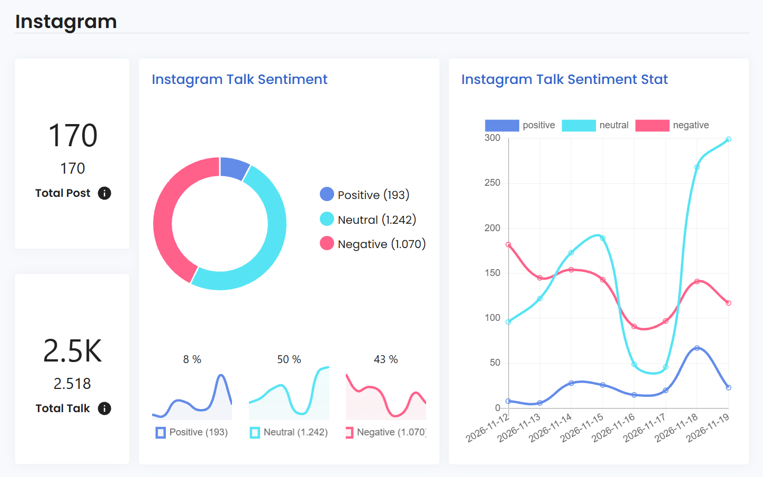
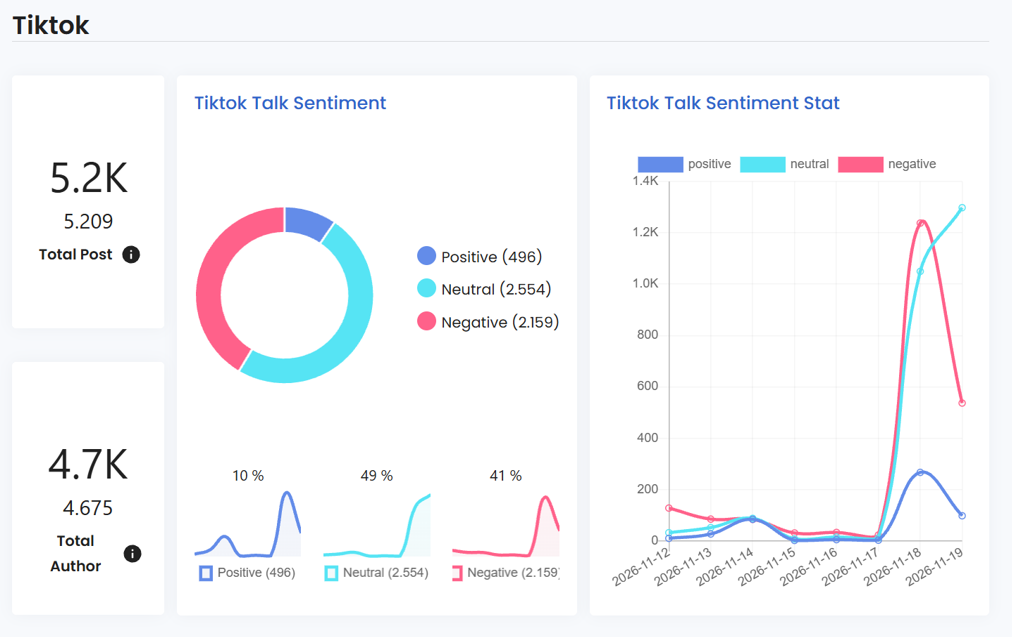
By platform, the highest negative share is on Facebook (52% of 903 conversations) and Threads (49% of 3,083). Instagram (43%), TikTok (41% of 5,209), and X (35% of 1,004) follow. YouTube is almost entirely neutral (92%) but holds only 63 conversations.
On TikTok, negative conversation peaked at around 1,200 on 18 November, the day House Commission III approved the bill at the committee stage. It then fell to around 500 on 19 November. The 19 November figure covers only part of the day, so the drop is not final.
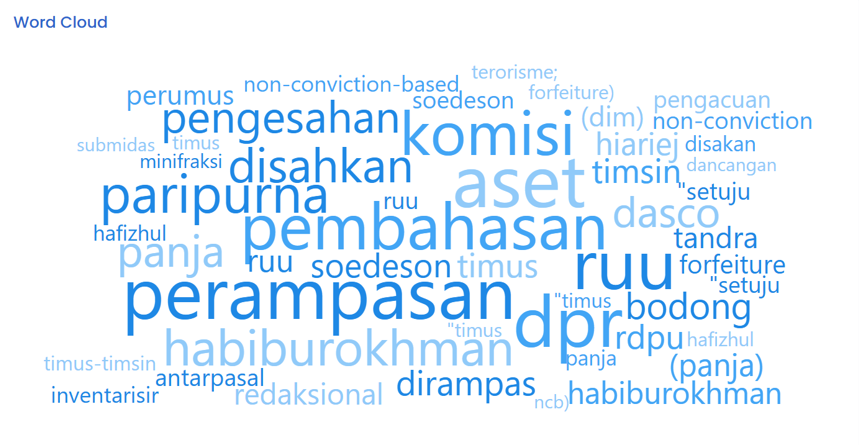
On the news side, the Newstensity word cloud is dominated by words for ratification, commission, forfeiture, and deliberation. The names Habiburokhman and Dasco also stand out. Habiburokhman chairs House Commission III, and Sufmi Dasco Ahmad is a House deputy speaker. Coverage centered on who brought down the gavel and how the process went. It also carried the House’s claim that oversight was strengthened to make the law hard to abuse.
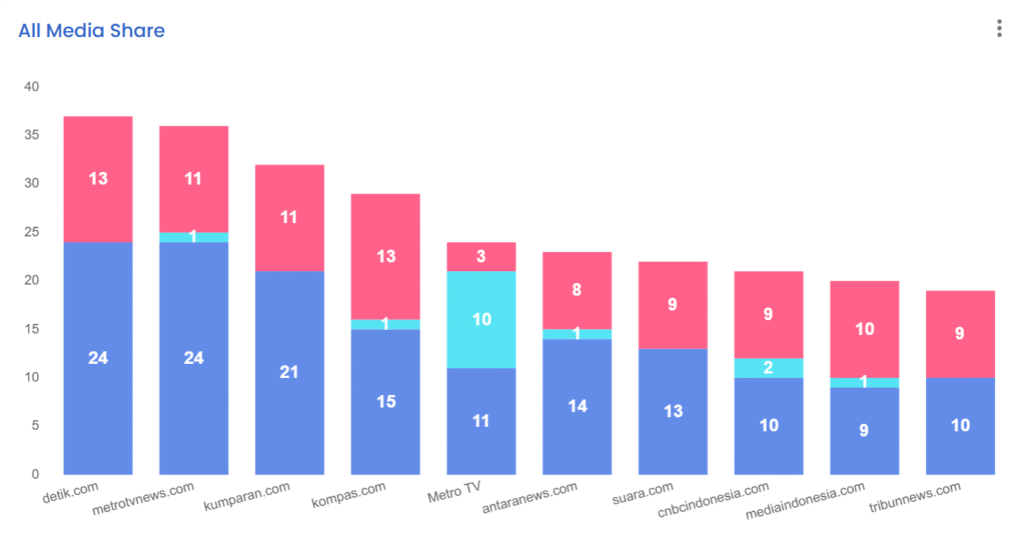
Newstensity recorded Detik.com as the source with the largest share of coverage. Binokular’s hunch: the committee meeting on 18 November and the plenary on 19 November gave news two key dates, so coverage followed the agenda. Social media users moved from the opposite direction. They did not wait for the gavel to start testing.
These numbers have limits. They describe the sentiment of news and posts tracked by Newstensity, not the stance of the whole public. A negative label does not always mean rejecting the law, because comments that jab at politicians can also be classified as negative. A gap between social media and public opinion is not unique to Indonesia. A 2013 Pew Research Center study found that Twitter reaction to major events often differs a great deal from public opinion measured in surveys.
What narratives did the main parties send to the public?
Citizens received competing messages from opposing sides. House Commission III chair Habiburokhman said the law has 74 articles and excludes tax crimes. On unexplained wealth (illicit enrichment), he said the provision was left out. His reason was that many members of the public rejected it.
Katadata reported that the House struck out the provision for impoverishing corruptors. Researcher Zaenur Rohman of Pukat UGM called the absence of unexplained wealth a fundamental weakness and the closed-door deliberations a procedural defect. Pukat is an anticorruption research center at Gadjah Mada University. ICW rejects the law as too blunt to catch big-time corruptors and says it is ready to file a judicial review at the Constitutional Court. Against messages this far apart, the large neutral share on social media deserves a closer look.
What does neutral conversation mean for an undecided public?
News outlets show almost no neutrality (4%), while 47% of social media conversation is neutral. A gap this large may partly reflect how the two dashboards classify content, on top of reader behavior. Binokular’s hunch: neutral conversation on social media often consists of shared news and questions, not settled positions.
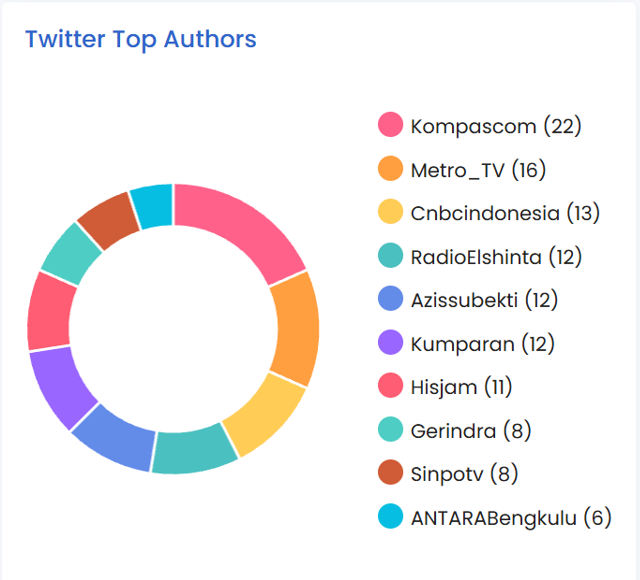
On X and Facebook, media accounts appear among the top authors. On X, Kompascom logged 22 conversations, Metro_TV 16, and Cnbcindonesia 13. On Facebook, Kumparancom logged 149 and Metrotv 81. Some of these conversations are probably replies to media posts, but the data does not yet separate the two.
If the hunch above holds, part of the public is still in a reading phase and may shift as the law’s content is better understood. This reading covers one week, so it is not enough to infer a general pattern.
What should communicators watch after the Asset Forfeiture Law passed?
Enforcement of the law still waits for the creation of an asset management and oversight body, and ICW says it is ready to challenge the law at the Constitutional Court. Three things are worth watching in the data. First, whether the conversation shifts after the official text is promulgated. Second, whether the word “minimum” stays the entry point for debate. Third, whether the question of who will enforce the law fades or grows.
For communications practitioners, tracking news sentiment alone will miss criticism that settles in social media comments. Reading only the comments has the opposite risk. It can exaggerate rejection of the Asset Forfeiture Law, because negative labels also capture jabs at politicians.
Indonesia Corruption Watch (ICW) findings regarding influencer service contracts have been widely discussed since November 9, 2026 night. ICW highlighted…