

How to Tell AI Astroturfing From Genuine Public Opinion
You can no longer tell AI astroturfing from genuine public opinion by reading the text. Generative AI writes as fluently…
-
binomedia
- October 2, 2026


Since early September 2026, the term “downgrade lifestyle” has spread across Indonesian Threads. Users openly admit they are cutting daily spending. They swap branded skincare for cheaper options. Artisan coffee gives way to instant sachets.
Parents share a quieter worry too: the rising cost of school fees. These posts show an economic reality that feels far from the growth story the government usually tells.
A clear pattern has formed. Some users reframe downgrade lifestyle as the more honest choice. It beats faking stability under economic strain, they say. That reflective tone keeps many posts neutral, even upbeat. But the root cause stays the same: a wallet under pressure.
This is not just a local story. Globally, the same habit has its own name: trading down, when shoppers switch to cheaper goods or delay a purchase as money gets tight. McKinsey’s ConsumerWise survey covered five European countries. By late 2024, it found 89 percent of Gen Z respondents said they were trading down. Only 59 percent of baby boomers said the same.
Downgrade lifestyle on Threads looks like a local version of that same global shift. It also echoes “loud budgeting,” the term that took over English-language social media in 2024 for admitting money limits out loud instead of hiding them.
This trend did not come out of nowhere. It runs alongside a string of economic headlines through 2026: a shrinking middle class, a wave of layoffs that has yet to ease. So is this just a loud minority on social media? Or does it match what official data shows? The next section lays out both sides: the voices on Threads, then the official numbers.
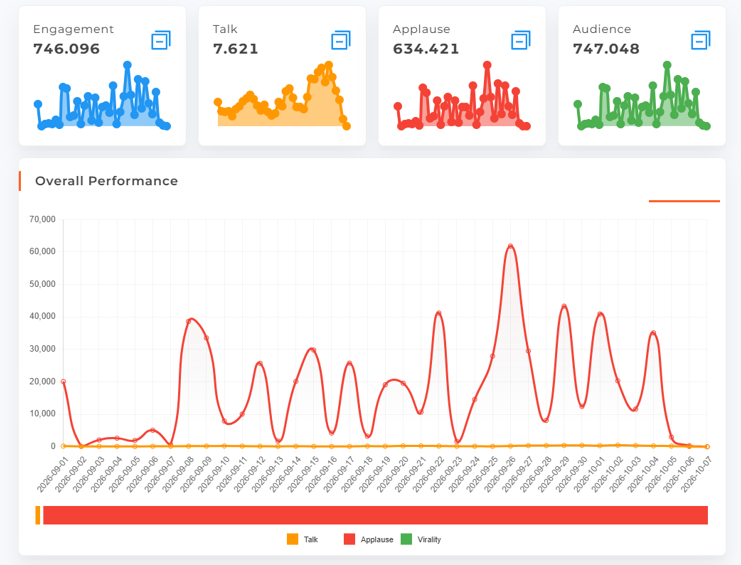
Socindex tracked downgrade-lifestyle talk on Threads from September 1 to October 7, 2026. Total engagement hit 746,096 across 952 posts, with 7,621 talk mentions and a reach of up to 747,048 people. Conversation peaked in late September 2026. That lines up with fresh inflation data and heavy coverage of the shrinking middle class.
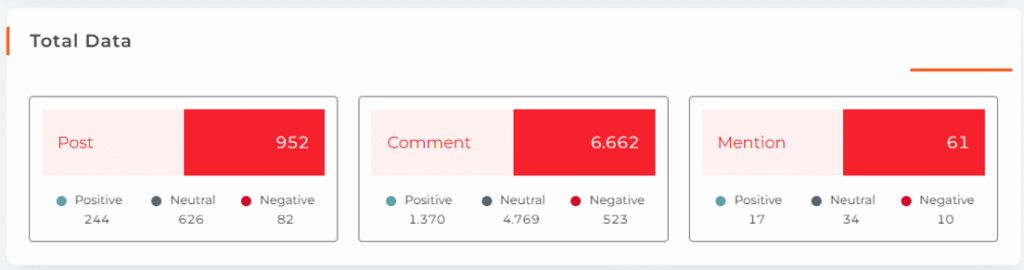
Of the 6,662 comments collected, most stayed neutral (4,769). The rest split into 1,370 positive and 523 negative, so positive comments beat negative ones by a wide margin.
Posts and mentions tell the same story. Of the 952 posts, 626 were neutral, 244 positive, and only 82 negative. The 61 mentions from larger accounts follow suit: 34 neutral, 17 positive, 10 negative.
One user wrote about switching from a branded moisturizer to a drugstore version that cost a tenth as much, just to keep the rest of the budget intact. That kind of post repeats across the dataset in different forms, from skincare to coffee. Others share more personal stories. Some worry about covering basic daily costs. Others fear they won’t be able to keep paying school fees partway through the term.
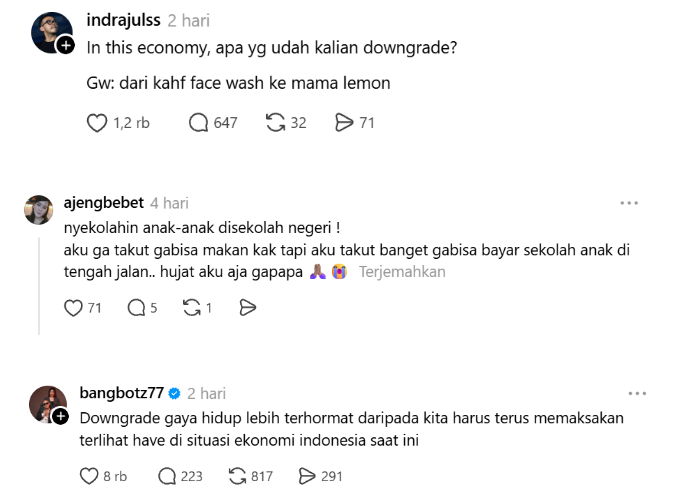
Some frame the downgrade as the more dignified choice, rather than forcing an image of stability under economic strain. That reflective tone from original posters seems to have spread into the comments too. Most comments stay neutral, but among those with a clear tone, positive beats negative by a wide margin. That pattern backs up the idea that downgrade lifestyle is becoming an accepted, normal response to money pressure, not something to hide. A similar shift is happening beyond spending too, in how people hunt for extra income.
The government and several economists often point to growth in gig work, side hustles, and small businesses (UMKM) as proof of Indonesia’s economic drive. They read it as evidence that people are getting more resourceful about earning money. But the same numbers can be read another way.
They may also show how many people are building extra income on their own because living costs are squeezing them. For some, it tops up a main income. For others, it is pure survival, because the main income no longer covers the basics.
Downgrade lifestyle going viral on Threads and the growth of informal work look like two sides of the same coin. Both are public responses to everyday economic pressure. On one side, people cut spending and hunt for cheaper options. On the other, people look for extra income to keep the kitchen running. This two-sided pattern points to a bigger question: how wide is the gap between the official economic story and what people actually live through?
That gap is real, not just a feeling. Three macro indicators through 2026 move in the same direction as what Threads users describe. The middle class keeps shrinking. Layoffs keep coming. Inflation keeps rising, even as official surveys stay upbeat.
Mandiri Institute, the research arm of Bank Mandiri, one of Indonesia’s largest banks, tracked the shift. Indonesia’s middle class fell from 47.9 million people in 2024 to 46.7 million in 2025. That is a drop of 1.2 million people in a single year. The figure now equals 16.6 percent of the national population.
Most people who dropped out of the middle class did not fall into poverty. They joined the “aspiring middle class” group, which now makes up more than half of Indonesia’s population.
The labor market tells a similar story. Indonesia’s Ministry of Manpower (Kemnaker) recorded 53,490 workers filing for layoffs through the Job Loss Insurance program (JKP) between January and August 2026. West Java stayed the province with the highest layoff count all year. Several labor unions argue the real number on the ground runs even higher than the official count.
Here is where the contrast sharpens. Statistics Indonesia (BPS) recorded annual inflation at 3.28 percent in September 2026, up from 2.65 percent in September 2025. Rising prices for staples like chilies and chicken drove the jump.
At the same time, Bank Indonesia’s Consumer Survey moved the other way. Its Consumer Confidence Index hit 118.5 in August 2026, up from 116.8 the month before, and still firmly upbeat. Two official data points, same period, opposite directions. That is the picture Threads complaints paint: prices rise, but official surveys say everything is fine.
Social media data has a value nothing else replaces. It captures the economic pulse people feel, a pulse that big-picture numbers like GDP growth or job-creation claims often miss. Those numbers matter, but they speak at a national scale over long stretches of time. Threads complaints speak at a personal scale, and they surface almost instantly, the moment someone feels the pinch in their own wallet.
A personal post about switching soap brands to save money can pull in hundreds of thousands of interactions within weeks. That is a signal, not noise. It stands in for worry far wider than one person’s story.
This pattern matters to any organization tracking how economic policy lands with the public. That is different from how the policy claims to perform. For PR, communications, and market research teams, watching social narratives closely is an essential complement to official macro data, not a replacement for it. Read both together, and you get a fuller economic picture: the numbers on paper, and the complaints on the timeline.

You can no longer tell AI astroturfing from genuine public opinion by reading the text. Generative AI writes as fluently…

binomedia

Who controls money in the blockchain era? When Bitcoin launched in 2008, the answer sounded simple: no single party, because…
binomedia

The debate over whether AI development should slow down is no longer theoretical. In September 2026, the CEOs of the…
binomedia

AI brand visibility is how often, how accurately, and in what context your brand appears in answers from AI-powered search…
binomedia

The DTSEN social assistance decile controversy in 2026 is not merely about inaccurate data. Media monitoring and digital conversation analysis…
binomedia
Indonesia’s gross domestic product (GDP) grew by 5.29 percent in the second quarter of 2026. This figure exceeded the median…
binomedia

Artificial intelligence (AI) is transforming education faster than most education systems can respond. Machines can now search for information, summarize…
binomedia
One Event, Two Market Moves On Monday, August 10, 2026, Indonesia’s rupiah closed 0.79% higher at IDR 17,755 per US…
binomedia

On Thursday, July 30, 2026, Indonesian President Prabowo Subianto announced a “cleanest city” competition. The top five cities would win…
binomedia

Before dawn on Friday, 24 July 2026, a mob in Bali beat a man to death. He is identified only…
binomedia