Michael Kusuma Head Of Investor Relations Sampoerna Agro
“Binokular makes it easier for us to obtain up-to-date information and news. Its monitoring reports are comprehensive and customizable, and features like news archive searching are very useful. The range of services allows personnel with high mobility to access the website, newsletters, and SMS alerts.”
Arif Haryanto Corporate Communication Department, PT Angkasa Pura I (Persero)
“Binokular is a smart solution! Monitoring media spread across 13 regions in central to eastern Indonesia, where Angkasa Pura I airports are located, becomes easy and fast with Binokular. The accuracy and relevance of the captured news are commendable. Binokular’s comprehensive and user-friendly web service makes news documentation searches easier. Binokular also helps us respond quickly to any negative news with its SMS alert service. Kudos to all these innovations, Binokular!”
Miranti Hadisusilo Corporate Secretary & Legal Director, PT Matahari Department Store Tbk
“Binokular has been incredibly helpful for our media monitoring, covering news related to our company, industry, and competitors. Up-to-date information is essential for market analysis, allowing us to respond quickly when necessary.”
Eko Harmonsyah Director of Strategic Planning and Public Relations, Bank Indonesia
“Media monitoring has become easier with Binokular. The necessary information can be searched quickly and accurately using its search engine. The interface is also quite user-friendly. But most importantly, the responsive and proactive service from the Binokular team is extremely helpful.”)
AI brand visibility is how often, how accurately, and in what context your brand appears in answers from AI-powered search engines. When someone asks about your brand, AI assembles its response from sources across the internet, not just your website. Brands that do not understand the information ecosystem around them risk losing control of the story being told about them.
What Is AI Brand Visibility?
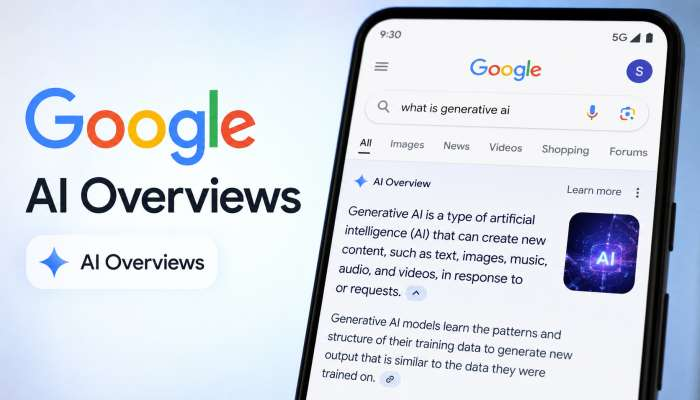
AI brand visibility measures how your brand shows up in answers generated by AI-powered search engines such as Google AI Overviews, AI Mode, ChatGPT, Perplexity, and Gemini. It differs from traditional SEO visibility, which tracks where your pages rank in a list of search results.
Image: Google AI Overviews view/source: lyfdose.com
In traditional search, visibility meant your website appeared near the top when users typed a relevant keyword. Users then chose which links to open, compared information from several sources, and formed their own conclusions. Brands had relatively clear control: SEO, published content, and media relations all contributed directly to how the brand was found.
AI brand visibility works differently. When someone asks AI about a brand or product category, the system does not present a list of links. It gathers information from multiple sources, synthesizes it into a single answer, and delivers that answer directly. The question is no longer whether your page appears on page one. The question is whether your brand is mentioned in the AI’s answer, and in what context.
The concept itself is still evolving. Tools like Adobe Brand Visibility, Similarweb, and Ahrefs already offer tracking features, but their metrics and methodologies vary. Adobe defines AI brand visibility as how brands are discovered, cited, and represented by AI systems such as ChatGPT, Perplexity, and Google AI Mode. AI brand visibility should not be understood simply as “does the brand appear?” The more important question is how it appears and what information shapes that appearance.
How Does AI Search Change the Way People Find Brands?
AI search changes discovery because users can get answers directly without opening multiple websites. This shift affects traffic to original sources and alters how brands are found by potential customers.
According to Google Search Central, AI Overviews and AI Mode use generative AI technology to help users understand complex questions. These features generate summary answers from multiple sources available across the internet before presenting them to users. For users, this change feels simple. For brands, the impact runs deeper: your website can still be one source of information, but it is no longer the only source shaping the answer.
Data from Pew Research Center puts concrete numbers to this shift. In an analysis of approximately 69,000 Google searches by 900 adult users in the United States in March 2025, users clicked traditional search results about 8% of the time when an AI summary appeared. That dropped from 15% when no AI summary was present. Links within the AI summary itself were clicked only about 1% of the time.
Those Pew findings come from the context of U.S. users and can’t be directly assumed to represent Indonesian users’ behavior. This study also shows association, not direct causation. Even so, the data gives a strong indication that when answers are already available on the search page, the relationship between information, sources, and website traffic starts to change.
This change is also catching the attention of the media industry worldwide. In the Journalism, Media and Technology Trends and Predictions 2026 report, the Reuters Institute noted that publishers expect traffic from search engines to drop in the coming years due to the rise of AI-generated answers. If publishers who produce news content are already anticipating a traffic decline, brands that rely on organic traffic need to think about the same thing.
Why Can Brands Lose Control of Their Own Story?
Brands can lose control of their narrative because AI assembles answers from sources the brand does not fully control. The official website is just one of many inputs. Media coverage, consumer reviews, industry reports, and third-party commentary all shape the answer AI delivers.
A company can control what it publishes through its official website, corporate reports, press releases, and social media. But it cannot control everything said about it online. Journalists, consumers, independent researchers, and communities also talk about the brand. In AI search, all of this information can become raw material the system uses to compose its answer.
Consider what happens when someone asks AI about a company’s reputation. The information used to form the answer does not always come from the company’s official statements. AI may draw from news articles, customer reviews, third-party reports, or other sources it considers relevant. The brand has the story it tells. The internet has the story that develops beyond the brand’s control. AI search brings both together in a single answer.
Recent research examines this more closely. In the study “From Citation Selection to Citation Absorption”, researchers distinguish between citation selection (when a system chooses a source as a reference) and citation absorption (the extent to which information from that source actually shapes the AI’s answer). These two concepts differ, and the difference matters for brands. Knowing a source was cited is not enough to understand how much it contributed to the final answer. A brand may appear in an AI response, but that appearance does not automatically mean the brand controls the context. Being mentioned and being heard are two different things.
What Is the Difference Between AEO and SEO for Brands?
AEO (Answer Engine Optimization) focuses on how brand information is found, understood, and used in AI-generated answers. SEO remains the foundation. AEO adds attention to whether your content can be extracted and presented as a relevant answer.
For years, brand digital strategy centered on SEO: making websites easy to find and securing strong positions in search result listings. AEO and GEO (Generative Engine Optimization) bring attention to a different dimension. The question is no longer just “is the brand’s page found?” It has shifted to something harder to measure: “is information from that page used when AI answers a user’s question?”
AEO should not be understood as a replacement for SEO or a special formula for making AI mention a brand. In its latest guide on AI search, Google confirms that existing SEO practices remain relevant for appearing in AI Overviews and AI Mode. Content that is useful, unique, and created for users remains the foundation.
The deeper AEO question is whether information about a brand is available clearly, relevantly, and credibly. Not whether the brand has managed to “game” AI. What matters is whether the available information is strong and structured enough that when AI tries to answer a user’s question, it can find and use that information accurately. If information about a brand is scattered, inconsistent, or unsupported by credible sources, AI will fill the gap with information from elsewhere.
What Can Brands Do to Protect Their Narrative?
Brands cannot directly determine which sources AI will use or how each answer is assembled. The realistic strategy is not trying to control AI, but building a strong information ecosystem around the brand.
The first step starts with what brands can control directly. Provide clear official information on your website, create content that answers real user questions, and maintain consistency across channels. Google emphasizes the importance of content that is unique, high-quality, and built to help users. Claims need credible backing because AI tends to prioritize information that can be confirmed from multiple angles.
Cross-channel consistency also plays a significant role. When your official website says one thing while your social media profiles or listings on other platforms say something different, AI receives mixed signals. Brands that maintain alignment across all channels give AI systems a clearer picture of who they are and what they offer.
Beyond owned channels, brands also need to pay attention to how they are discussed by media and third parties. If AI search draws from multiple sources, understanding what information circulates in public becomes increasingly important. Consumer reviews, media coverage, industry reports, and forum discussions all have the potential to shape the answers users receive when they ask AI about a brand.
How Does Media Monitoring Help With AI Brand Visibility?
Media monitoring helps brands understand the information ecosystem surrounding them: what issues are developing, who is discussing them, from what angle, and how coverage trends are moving. This understanding becomes a first step toward managing AI brand visibility.
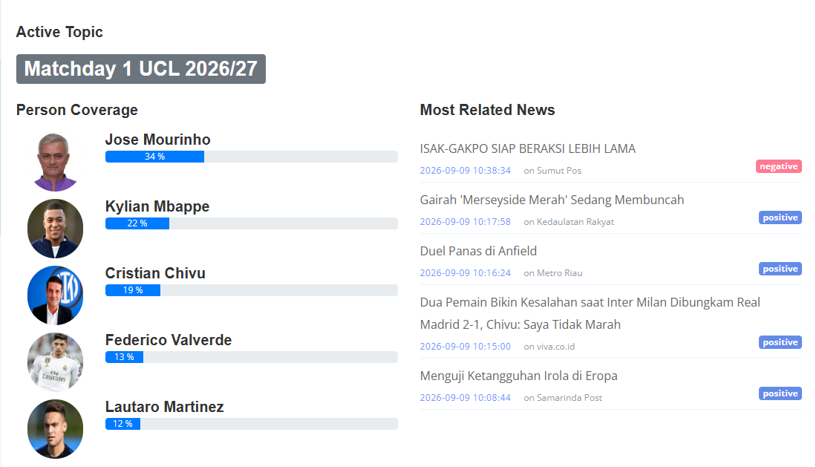
Image: Newstensity Dashboard View
Media monitoring has long been used to track how often a brand is covered and which issues appear most frequently. It also reveals who is talking about the brand and how coverage trends over time. In the AI search era, that information takes on new relevance. What is being monitored is no longer just material for PR evaluation. It is also potential material that AI may use when composing answers about the brand.
Media monitoring cannot guarantee how AI will answer questions about a company. But it can help brands understand the narratives, sources, and coverage patterns developing in public. When a brand knows what the media is saying about it, it has a stronger basis for evaluating whether online information reflects the position and values it wants to communicate.
This is where an approach like Newstensity becomes relevant. Newstensity is a news monitoring platform developed by Binokular, a media intelligence company based in Indonesia that serves PR agencies, brand managers, and communications teams. Its role is not to control what AI says. It helps brands understand what the media is saying about them and the issues connected to them.
Frequently Asked Questions
Is AI brand visibility the same as SEO?
AI brand visibility and SEO are related but distinct. SEO focuses on how web pages appear in traditional search result listings. AI brand visibility focuses on whether a brand is mentioned, cited, or recommended in AI-generated answers. Strong SEO practices remain foundational because high-quality, well-structured pages are easier for AI systems to find and use as sources.
Can brands control what AI says about them?
Brands cannot directly control AI-generated answers. But they can build a strong information ecosystem by providing clear official content, maintaining consistency across channels, and backing claims with credible sources. The stronger and more consistent the available information about a brand, the greater the chance AI will use it accurately.
What is the connection between media monitoring and AI brand visibility?
AI assembles answers from multiple sources across the internet, including media coverage. Media monitoring helps brands understand the issues, narratives, and coverage trends developing in public. This understanding is a first step toward evaluating the information ecosystem that could influence how AI tells a brand’s story.
Is AEO only relevant for large companies?
AEO is relevant for brands of all sizes. When users ask AI about a product category or service, AI composes answers based on available information, not company size. Smaller brands with clear, specific, and useful content still have the opportunity to appear in AI answers, provided information about them is adequately available and credible.
How can I check whether my brand appears in AI answers?
The simplest approach is to test directly. Ask questions relevant to your brand category across several AI platforms such as Google AI Overview, ChatGPT, Perplexity, and Gemini, and see whether your brand is mentioned. For more systematic tracking, tools like Ahrefs AI Visibility Checker, Similarweb AI Brand Visibility, and Adobe Brand Visibility offer dedicated AI visibility monitoring features.
Artificial intelligence (AI) is transforming education faster than most education systems can respond. Machines can now search for information, summarize…