Michael Kusuma Head Of Investor Relations Sampoerna Agro
“Binokular makes it easier for us to obtain up-to-date information and news. Its monitoring reports are comprehensive and customizable, and features like news archive searching are very useful. The range of services allows personnel with high mobility to access the website, newsletters, and SMS alerts.”
Arif Haryanto Corporate Communication Department, PT Angkasa Pura I (Persero)
“Binokular is a smart solution! Monitoring media spread across 13 regions in central to eastern Indonesia, where Angkasa Pura I airports are located, becomes easy and fast with Binokular. The accuracy and relevance of the captured news are commendable. Binokular’s comprehensive and user-friendly web service makes news documentation searches easier. Binokular also helps us respond quickly to any negative news with its SMS alert service. Kudos to all these innovations, Binokular!”
Miranti Hadisusilo Corporate Secretary & Legal Director, PT Matahari Department Store Tbk
“Binokular has been incredibly helpful for our media monitoring, covering news related to our company, industry, and competitors. Up-to-date information is essential for market analysis, allowing us to respond quickly when necessary.”
Eko Harmonsyah Director of Strategic Planning and Public Relations, Bank Indonesia
“Media monitoring has become easier with Binokular. The necessary information can be searched quickly and accurately using its search engine. The interface is also quite user-friendly. But most importantly, the responsive and proactive service from the Binokular team is extremely helpful.”)
Jakarta — Throughout June 2026, Jakarta became the center of a wave of student demonstrations held at several strategic locations, including the Hotel Indonesia Roundabout, Jalan MH Thamrin, the Horse Statue area, and in front of the DPR/MPR RI building.
The demonstrations involved students from various universities across Greater Jakarta. They voiced demands related to economic policy, opposition to fuel price increases, evaluation of the Free Nutritious Meals program, and criticism of militaristic practices.
Using Big Data Analytics tools, PT Binokular Media Utama, “Binokular,” conducted research on social media conversations to examine public attention, argument distribution, and social discourse related to student and civil society protests during the period of June 11–23, 2026.
This monitoring was conducted to understand how the protest issue developed in the public sphere, which actors were most frequently associated with it, which platforms were most active, and what narratives drove public attention.
Mass Media Coverage Was Dominated by Negative Sentiment
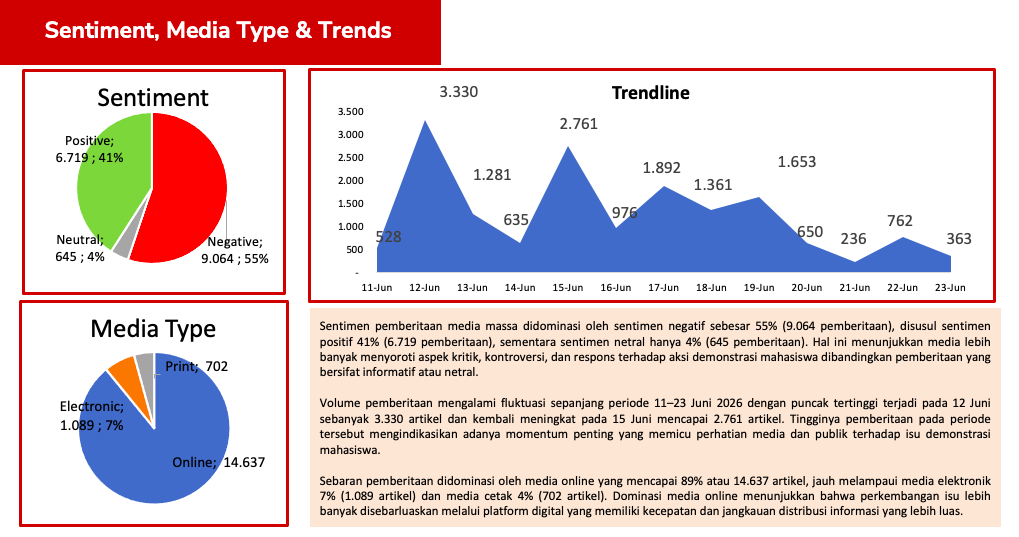
During the period of June 11–23, 2026, monitoring through Binokular’s Newstensity dashboard recorded 16,428 mass media articles related to student and civil society protests.
Of that total, news coverage with negative sentiment reached 9,064 articles, or 55 percent. Positive coverage was recorded at 6,719 articles, or 41 percent, while neutral coverage stood at 645 articles, or4 percent.
The dominance of negative sentiment shows that mass media gave more space to criticism, controversy, policy responses, and pressure directed at the government and state institutions. However, the relatively large share of positive sentiment also shows that some coverage framed the demonstrations as part of public aspiration and democratic dynamics.
In terms of media type, coverage was dominated by online media, with 14,637 articles, or 89 percent of total coverage. Electronic media recorded 1,089 reports, or 7 percent, while print media recorded 702 reports, or 4 percent.
This composition indicates that online channels became the main route for distributing protest-related issues because of their speed of production, information updates, and wider reach.
News volume fluctuated during the monitoring period. The peak of coverage occurred on June 12, 2026, with 3,330 articles. Another increase was recorded on June 15, 2026, with 2,761 articles.
This pattern indicates that media attention increased at certain moments, especially when there were developments on the ground, official responses, or an expansion of student demands.
Newstensity News Analytics Manager, Nicko Mardiansyah, said that the student demonstrations during this period became an important node connecting various actors and issues.
“Mass media coverage shows that student demonstrations did not stand as a single agenda. This issue was connected to government responses, official statements, demands directed at state institutions, and the way public institutions and security forces responded to emerging aspirations,” Nicko said.
Nicko explained that the high level of negative sentiment should not immediately be read as rejection of the student protests. According to him, negative sentiment in the context of mass media more often reflects criticism, issue pressure, and scrutiny of parties considered responsible for providing a response.
“Negative sentiment in news coverage must be read carefully. In protest-related issues, negative does not always mean that the media rejects the action. Often, negative sentiment appears because coverage contains student criticism, public concern, policy polemics, or notes on institutional responses,” Nicko said.
Instagram Became the Main Channel for Public Conversation
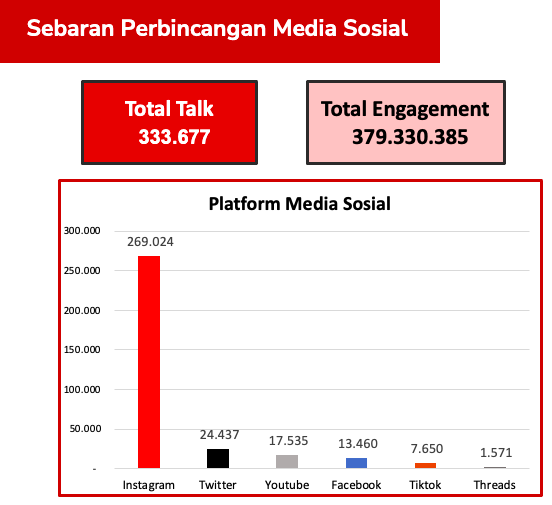
On social media, conversations related to student and civil society protests reached 333,677 posts, with total engagement of 379,330,385 interactions.
This figure shows that the protest issue gained broad attention in digital spaces, especially through platforms with strong visual characteristics and the ability to spread information quickly.
Instagram became the platform with the largest volume of conversation, reaching 269,024 posts, or around 80.6 percent of total talk. Twitter/X came next with 24,437 conversations, followed by YouTube with 17,535 conversations, Facebook with 13,460 conversations, TikTok with 7,650 conversations, and Threads with 1,571 conversations.
Instagram’s dominance shows that the spread of protest-related issues was heavily influenced by visual posts, video clips, field documentation, news carousels, and comments on media accounts and popular accounts.
Meanwhile, Twitter/X played a role as a space for quick responses and text-based discussions, while YouTube expanded the discussion through video formats and longer comments.
In terms of sentiment, social media conversations were dominated by neutral sentiment, with 209,193 posts, or 63 percent. Negative sentiment was recorded at 95,152 posts, or 28 percent, while positive sentiment reached 29,332 posts, or 9 percent.
This composition shows that most public conversations were still informative, responsive, or involved the resharing of information, even though criticism remained present in significant numbers.
Bot detection data showed that 267,654 conversations, or 80 percent, came from organic accounts. Meanwhile, 66,023 conversations, or 20 percent, were indicated as bot activity.
The dominance of organic accounts shows that the protest issue had a strong base of public involvement.
Vice President of Operation at Binokular Big Data Analytics, Ridho Marpaung, said social media conversations showed high public attention toward the issue.
“Social media data shows that conversations about student demonstrations were driven mainly by organic accounts. This indicates that public attention toward the issue was strong and was not merely shaped by artificial amplification patterns,” Ridho said.
Ridho said this finding is important for public institutions that need to read issue dynamics more precisely.
“When 80 percent of conversations come from organic accounts, it means this issue truly attracted user attention. The government, state institutions, and other stakeholders need to read conversations like this as public signals, not merely as traffic in social media comments,” Ridho said.
Student Demands, Official Responses, and Security Issues
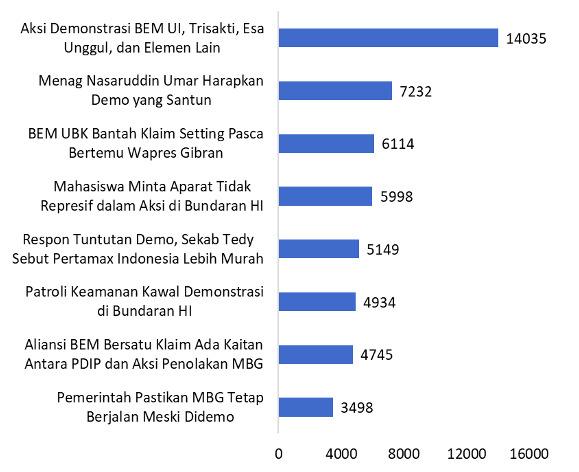
Monitoring results show that conversations did not only focus on demonstrations on the ground. The issue developed through several main narratives, ranging from student demands, responses from state officials, concerns about security forces, to debates over economic issues linked to protesters’ aspirations.
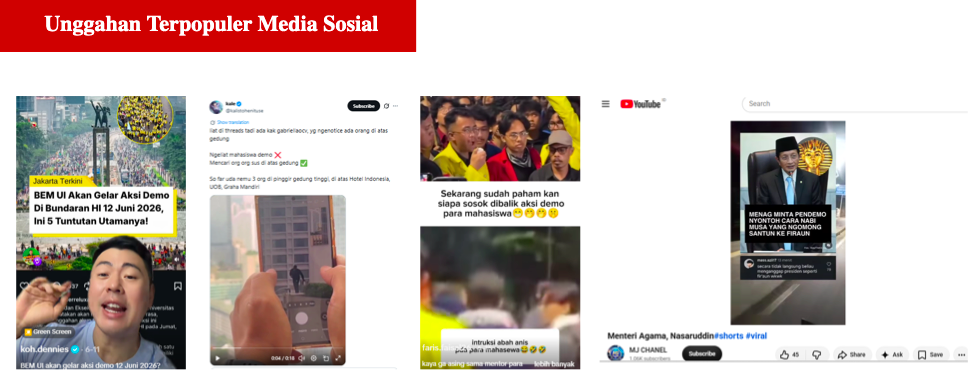
The largest issue on social media was the demonstration involving BEM UI, Trisakti, Esa Unggul, and various other student elements, with 14,035 conversations.
The next issue was the statement by Minister of Religious Affairs Nasaruddin Umar, who hoped that demonstrations would be carried out politely, with 7,232 conversations.
The polemic involving BEM UBK, which denied claims that its meeting with Vice President Gibran had been “staged,” also drew public attention, with 6,114 conversations.
Another major issue was students’ request for security forces not to act repressively during the protest at the Hotel Indonesia Roundabout, with 5,998 conversations.
In addition, the response from Cabinet Secretary Tedy regarding Pertamax prices in Indonesia, which were said to be cheaper than in other countries, triggered 5,149 conversations.
According to Nicko, this series of issues shows that the student demonstrations developed into a layered conversation.
“Top issue data shows that the public was not only discussing who took part in the protests. Conversations also moved toward how officials responded, how security forces handled the demonstrations, and how student demands were connected to economic issues and government policy,” Nicko said.
In the news ontology, student demonstrations became the main node connecting political actors, government institutions, student organizations, and mass media.
Several entities with strong links to the main issue included Minister of Religious Affairs Nasaruddin Umar, the Indonesian House of Representatives, the Ministry of Religious Affairs, BEM SI, and student groups.
This interconnectedness shows that the protest issue was not only positioned as an on-the-ground event, but also as a space of narrative contestation between student aspirations, government responses, the stance of state institutions, and public attention.
The statement by Minister of Religious Affairs Nasaruddin Umar regarding the need to express aspirations politely became one of the narratives frequently linked to discussions about the demonstrations.
On one side, this narrative emphasized the importance of order and deliberation. On the other side, public responses showed that some netizens continued to focus on the substance of the demands and how the government would follow up on those aspirations.
Conversation Networks Were Controlled by Major Hubs
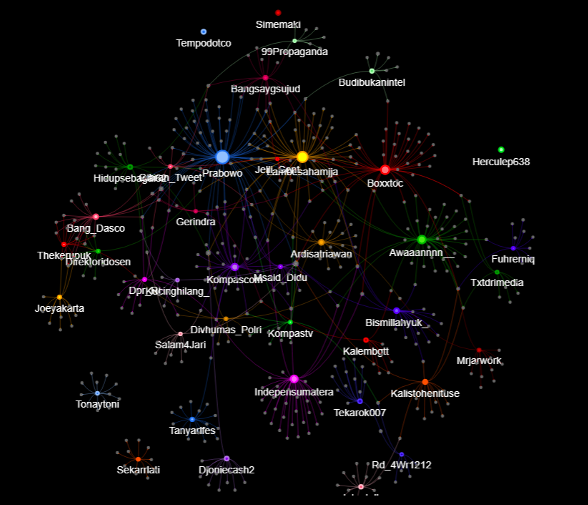
One of the most significant findings from the Social Network Analysis, or SNA, was the formation of a network pattern consisting of six community clusters, three main hubs, four bridge accounts, and more than 25 accounts identified within the conversation network.
Prabowo and Lambesahamija became the two largest hubs in this conversation. They represented two different poles: one connected to government figures, while the other belonged to the realm of popular or viral accounts.
This finding shows that the student protest issue did not only circulate within formal political spaces. It also entered popular content spaces capable of reaching a broader audience.
The DPR RI account appeared in the network, but it did not become the main center of conversation distribution.
The network pattern identified was scale-free, or hub-spoke. Most smaller accounts were connected to only one or two major nodes. In this type of pattern, information flows more from major accounts to peripheral accounts, rather than purely through horizontal conversations among users.
The SNA data also showed early indications of an echo chamber. Clusters carrying critical narratives and pro-government clusters appeared to have limited overlap in connections.
This condition needs attention because separated conversations can make each group receive only narratives that reinforce its own views.
Even so, several bridge accounts played a role in connecting conversation clusters. Kompascom served as a connector between the media cluster and the public discussion cluster. Ardisatriawan acted as an individual bridge connecting several communities. Meanwhile, jakartatalk connected the upper cluster and the middle cluster.
Ridho said mapping conversation networks is important in managing public issues.
“In a fast-moving issue, stakeholders cannot simply look at the number of conversations. What needs to be read is who becomes the hub, who becomes the connector between clusters, and what narratives begin to move from one community to another,” Ridho said.
How Should the Government Manage Its Response?
Based on media monitoring findings, Binokular believes that managing the student demonstration issue requires a more measured communication approach.
The government and state institutions need to ensure that public responses do not stop at appeals for order, but also answer the substance of the demands conveyed by students and civil society groups.
First, relevant institutions need to provide a clear explanation of how student aspirations are received, recorded, and followed up. The public needs to see that demonstrations are treated as a mechanism for citizen participation, not merely as a public order disturbance.
Second, the issue of protest security needs to be explained openly. Concerns over repressive actions by security forces emerged as one of the important conversations on social media. Therefore, information regarding security procedures, commitments to protect protest participants, and complaint channels needs to be delivered in simple language.
Third, public officials need to be careful, calm, and wise when responding to economic issues included in protest demands. Statements without sufficient context can trigger new debates and extend the issue cycle on social media.
Fourth, public institutions need to monitor hub accounts and bridge accounts regularly. In a conversation pattern that depends heavily on major accounts, narrative shifts can spread quickly when pushed by accounts with high reach.
Fifth, daily monitoring needs to include volume, sentiment, actors, dominant platforms, top issues, and conversation network patterns. This data can help institutions determine response priorities and avoid delayed communication.
“Public communication in protest-related issues needs to be based on data and substance. Speed is important, but the content of the response must be relevant to public questions. If the response is only normative, digital spaces will continue to search for their own answers through narratives that may not necessarily be accurate,” Nicko said.
Ridho encouraged the government to accommodate aspirations and criticism as valid input for improving non-ideal conditions that are truly felt by the public.
“The government still needs to be honest and open-hearted in listening to aspirations and criticism voiced by community groups, including students. Those aspirations and criticisms can become evaluation material and follow-up for improving government policies and programs. If student demonstrations are feared and what receives attention instead is the practice of dishonesty, then something is certainly wrong. After all, truth elevates the dignity of a nation,” Ridho said.
On the other hand, Ridho also encouraged community groups, including students, to express their aspirations and criticism peacefully and with civility, while maintaining the purity of protest actions from political group interests and efforts to divide the nation.
“History records that many changes in Indonesia have come from students as a group that voices truth, aspirations, and criticism for improving conditions in Indonesia. Therefore, students and elements of civil society need to maintain the purity of their actions and remain firm in voicing truth and input to the government through peaceful and civilized ways,” Ridho concluded.
Jakarta — Although Indonesia ultimately conceded to Saudi Arabia 2‑3 in the Group B fourth‑round Asian qualifiers at King Abdullah Sports City Stadium, Jeddah,…