

How to Tell AI Astroturfing From Genuine Public Opinion
You can no longer tell AI astroturfing from genuine public opinion by reading the text. Generative AI writes as fluently…
-
binomedia
- October 2, 2026


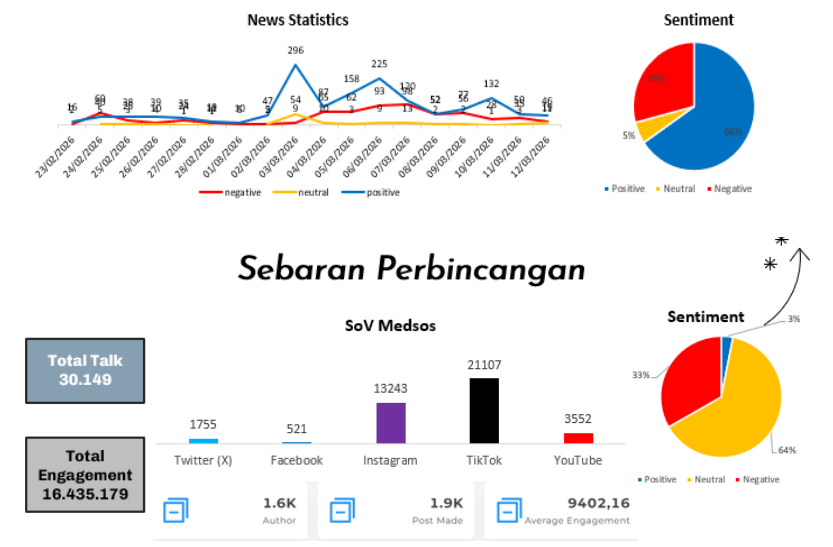
During the period from February 23 to March 12, 2026, Indonesia’s media landscape and public sphere were animated by one issue that drew major attention: the tax on the Holiday Allowance, or Tunjangan Hari Raya (THR). Based on media monitoring data using PT Binokular Media Utama’s Newstensity and Socindex tools, this issue was not merely a technical debate about the Monthly Effective Rate (TER) or Article 21 Income Tax. More than that, the discourse surrounding the THR tax evolved into a socio-political phenomenon touching on broader narratives of trust, justice, and the relationship between citizens and the state.
In the mass media, the issue generated 2,334 news reports, dominated by positive sentiment at 66 percent, followed by negative sentiment at 29 percent and neutral sentiment at 5 percent. Meanwhile, on social media, the conversation reached 30,149 mentions with 16,435,179 engagements. Social media sentiment was instead dominated by neutral sentiment at 64 percent, compared with 33 percent negative and only 3 percent positive.
This is where the real problem emerged. When the state explained that THR was “not a new tax,” the public did not automatically feel reassured. In everyday experience, people do not judge policy only by whether it is formally correct under regulations, but also by how it affects concrete moments in their lives. In The Wealth of Nations, Book V Chapter II, Adam Smith wrote, “The subjects of every state ought to contribute towards the support of the government, as nearly as possible, in proportion to their respective abilities; that is, in proportion to the revenue which they respectively enjoy under the protection of the state.”
This argument is often regarded as a modern foundation for the principle of fair taxation. Yet “ability” in the eyes of the state is not necessarily the same as “ability” in the eyes of the people.
From a fiscal perspective, deductions from THR may be justified as part of the normal distribution of the tax burden. But psychologically, citizens may understand THR as income with a social function different from an ordinary monthly salary. It is perceived as a reserve for family spending, homecoming travel costs, zakat, children’s needs, and socio-religious rituals, dimensions that often escape the bureaucratic register of the state. As a result, deductions from THR are automatically read by the public not as an ordinary fiscal procedure, but as state intervention into the household’s safe economic space.
Faced with this polemic, policymakers attempted to frame the issue and calm the public through technical and legal explanations. Yon Arsal, Special Staff to the Minister of Finance, stressed that there was actually no additional tax burden, only a change in the timing of payment, from one that had previously piled up in December to one that was now spread out. Coordinating Minister for Economic Affairs Airlangga Hartarto even underlined the fundamental difference between THR and the 13th-month salary. This was a classic government effort to redefine reality: what was happening, they argued, was administrative normalization, not a new burden.
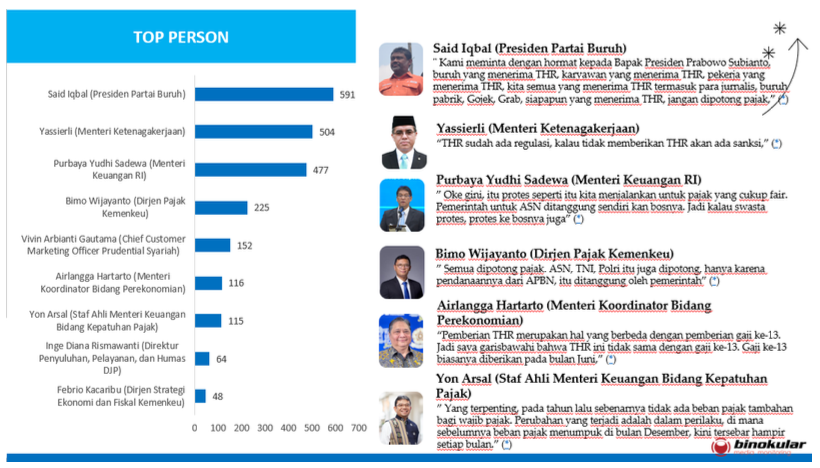
Yet on the other hand, statements by senior officials often triggered further controversy. Finance Minister Purbaya Yudhi Sadewa, in his distinctive communication style, stated that the policy was already fair and suggested that private-sector workers who objected should file their complaints with their own employers, because the government itself bears the tax burden for civil servants.
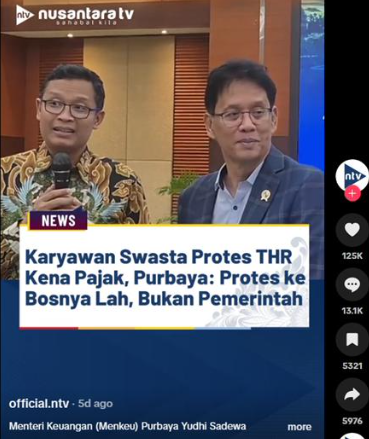
This explanation, even if intended to clarify differences in funding mechanisms, was understood by the public as a form of passing responsibility and, in fact, widened the perceived gap in treatment between state employees and private-sector workers.
This anger was voiced loudly by Said Iqbal, President of the Labor Party. He openly called on President Prabowo Subianto to ensure that the THR of all workers, from factory laborers to journalists, would not be cut by taxes. Labor protests were even staged at the Ministry of Manpower, demanding that THR not be deducted.
In a situation like this, fiscal communication is no longer sufficient if it relies only on the phrase “in accordance with the rules.” It must go further and answer more fundamental questions: fair for whom, fair by what standard, and why is the difference in treatment considered acceptable?
This is where the shift in discourse becomes essential. What began as a technical taxation issue, namely the TER calculation mechanism, shifted into an issue of justice for workers and its impact on purchasing power. In this regard, the thinking of the ancient Greek philosopher Aristotle in Politics remains relevant. He wrote in Part XIII, “those who are equal in one thing ought not to have an equal share in all.” In other words, justice is not identical with uniformity, because differences in treatment may be justified if they are based on relevant differences.
But at the same time, Aristotle’s logic also helps explain public anger over the THR tax: citizens will accept differences only if the basis for that distinction is seen as morally reasonable and openly argued. If the public sees private-sector workers bearing a direct burden while state apparatus are perceived as being treated differently because they are backed by the state budget, then suspicion emerges that the distinction is no longer ethically relevant, but merely political.
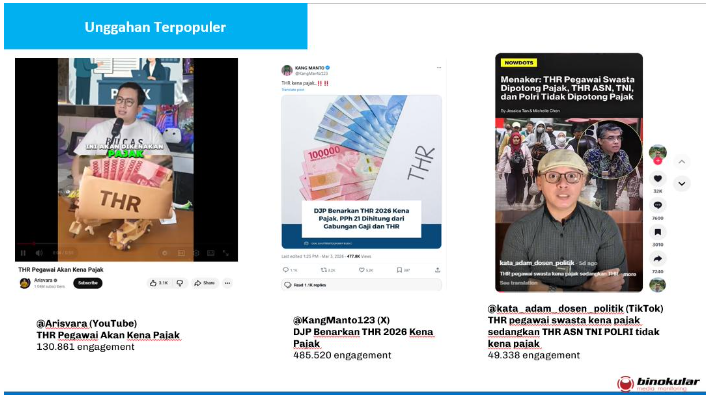
That is why the posts that gained the most public attention were not always the most technical ones, but those that most powerfully framed the issue as a comparison. One of the most popular posts explicitly emphasized the comparison between THR for private-sector employees and THR for civil servants, the military, and the police. Narratives like this are effective because they work on the most basic principle of human psychology: people judge fairness comparatively. They do not ask only, “how much did I receive,” but also, “why am I being treated this way while others are not?” Once it enters the logic of comparison, a fiscal debate becomes a debate over dignity. And when dignity is touched, public reaction usually becomes far more emotional than when the discussion concerns numbers alone.
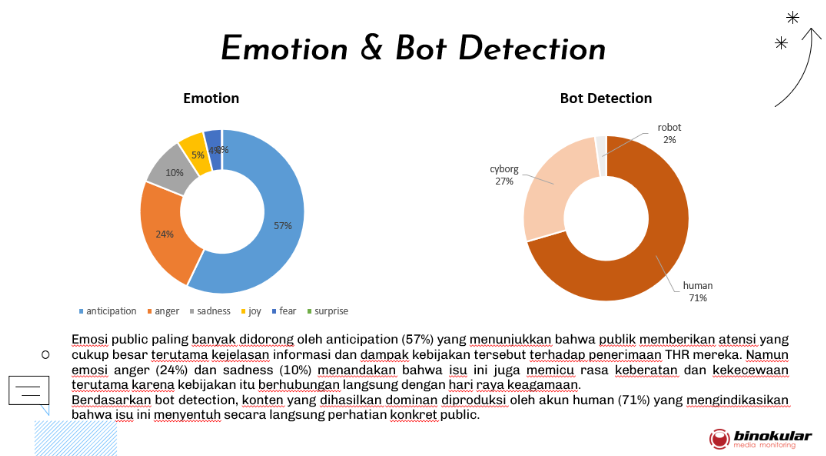
Similarly, public emotion data shows that the dominant emotion was anticipation at 57 percent, meaning the public was paying close attention to the clarity of information. But what is worrying is the high level of anger at 24 percent and sadness at 10 percent. Anticipation means netizens had not completely closed themselves off; they were still waiting for clarity and seeking explanations. But the presence of anger and sadness indicates that the space for explanation was already overshadowed by feelings of objection and disappointment. In short, the emotion detection data shows that citizens were still willing to listen, but they were listening with suspicion.
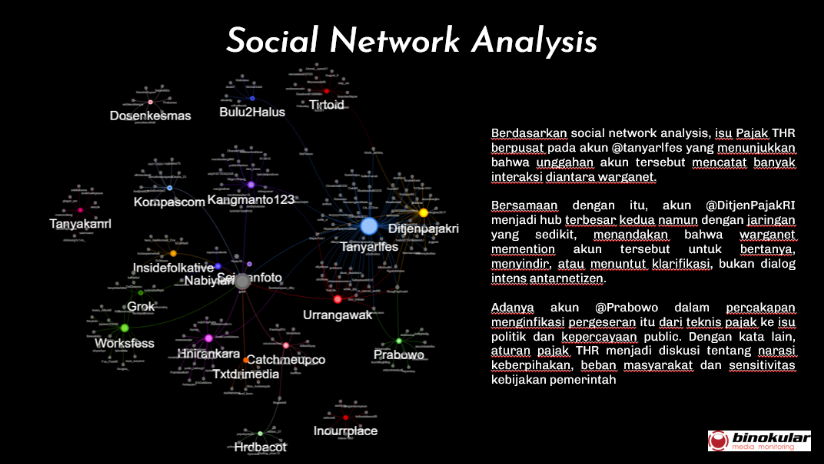
Based on Social Network Analysis, the account @tanyarlfes became the center of the conversation, followed by @DitjenPajakRI. Meanwhile, @Prabowo was also dragged into the discussion. These findings show three important things. First, the liveliest conversation did not happen on official channels, but in citizen-to-citizen spaces. Second, official state accounts were more often mentioned to be asked for explanations, mocked, or pressured, rather than serving as centers of organic dialogue. Third, this technical fiscal issue had transformed into an issue of political trust. Once the name of the national leader is dragged into it, the issue is no longer “how is the tax calculated,” but rather, “whose side is the government on?”
It is not uncommon for a polemic like this to be framed by the state from two perspectives. First, the legal-administrative and technocratic perspective, which emphasizes the set of rules behind a program and validates it through scientific foundations. Second, the issue is often framed as a matter of insufficient public outreach due to low literacy, in this case tax literacy.
Of course, technocratic language and the language of literacy rarely meet the language of citizens’ everyday lives. The state talks about deduction mechanisms, tax bases, and the normalization of annual burdens. But the public talks about Eid money, family expenses, and fairness of treatment. As long as those two languages are not brought together, clarification will always lose speed to public anger. Even when the mass media help explain the issue, social media can still turn that explanation into a symbol of the government’s lack of empathy.
Based on the findings above, several things need to be done by the government.
First, a policy that is technically correct can still fail socially if it is framed poorly, timed badly, or misreads public emotion. THR is not merely a taxable object. It is a symbol of recognition for work, hard effort, and the right to celebrate. Touching that symbol without adequate moral communication opens the door to politicization.
Second, defensive answers need to stop. During the monitoring period, the government tended to respond to public anxiety with technical logic. Administratively, it may be true that THR is a taxable object. But using that logic consistently only creates the impression that the government is avoiding the question of fairness.
Third, the government needs to issue a single official statement rather than allowing separate responses from the Directorate General of Taxes, the Ministry of Finance, and the Ministry of Manpower. These three institutions need to explain clearly who is subject to Article 21 Income Tax on THR, whose tax is borne by the government, who does not receive that facility, and what the legal basis is. This matters because even within the broader category of state apparatus, the treatment is not uniform, with government contract employees, for example, not receiving the facility of tax being borne by the state.
Fourth, the government needs to focus on taking action against companies that delay, pay in installments, or fail to pay THR at all. This is often far more material than the debate over the tariff itself.
Fifth, if the government does not take a firm position, this polemic will most likely reappear every time there is a major religious observance, such as Ramadan and Christmas. Therefore, if the government wants to maintain the current mechanism, it must be willing to explain it openly even at the risk of criticism. Or, if this distinction is considered too sensitive, the government can improve the policy so that the gap is not too wide, for example by providing incentives for companies to bear the THR tax for certain employees, or by setting a threshold so that smaller THR payments are not excessively eroded by deductions.

You can no longer tell AI astroturfing from genuine public opinion by reading the text. Generative AI writes as fluently…

binomedia

Who controls money in the blockchain era? When Bitcoin launched in 2008, the answer sounded simple: no single party, because…
binomedia

The debate over whether AI development should slow down is no longer theoretical. In September 2026, the CEOs of the…
binomedia

AI brand visibility is how often, how accurately, and in what context your brand appears in answers from AI-powered search…
binomedia

The DTSEN social assistance decile controversy in 2026 is not merely about inaccurate data. Media monitoring and digital conversation analysis…
binomedia
Indonesia’s gross domestic product (GDP) grew by 5.29 percent in the second quarter of 2026. This figure exceeded the median…
binomedia

Artificial intelligence (AI) is transforming education faster than most education systems can respond. Machines can now search for information, summarize…
binomedia
One Event, Two Market Moves On Monday, August 10, 2026, Indonesia’s rupiah closed 0.79% higher at IDR 17,755 per US…
binomedia

On Thursday, July 30, 2026, Indonesian President Prabowo Subianto announced a “cleanest city” competition. The top five cities would win…
binomedia

Before dawn on Friday, 24 July 2026, a mob in Bali beat a man to death. He is identified only…
binomedia