

AI Brand Visibility: Who’s Telling Your Brand’s Story?
AI brand visibility is how often, how accurately, and in what context your brand appears in answers from AI-powered search…
-
binomedia
- September 11, 2026

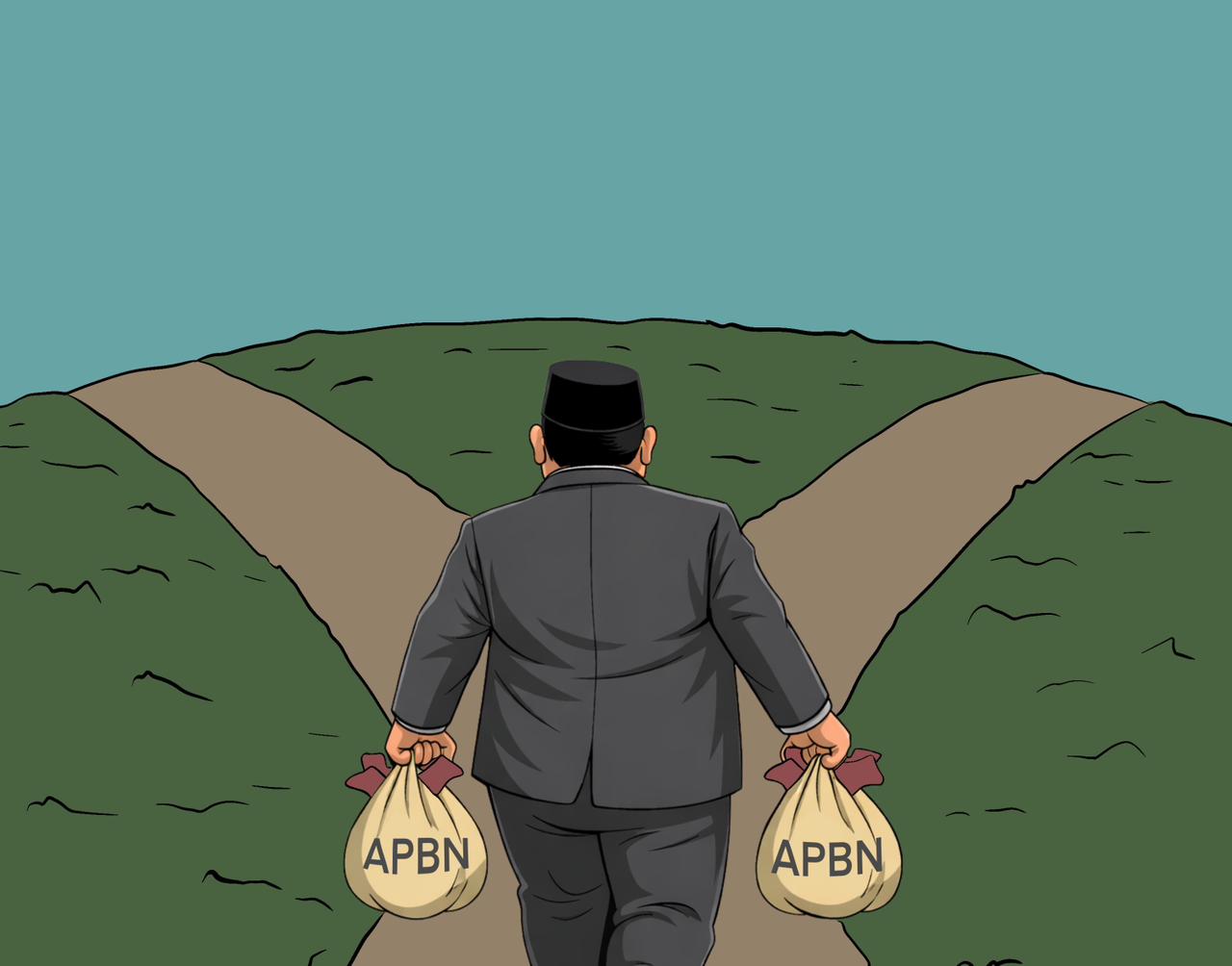
The government has begun outlining the direction of the 2026 State Budget (APBN 2026) amid ongoing global economic uncertainty. Finance Minister Purbaya Yudhi Sadewa stated that the government is relying on policy synergy between fiscal instruments, the financial sector, and investment as the main engines to sustain economic growth momentum while strengthening Indonesia’s fiscal foundations.
At this point, APBN 2026 becomes highly relevant for deeper examination. It does not emerge in a vacuum, but is formulated amid global pressures, continuing development agendas, and strong public expectations regarding the state’s role. APBN 2026 is positioned as an instrument to maintain economic stability while ensuring the sustainability of national development.
So far, APBN 2026 has often been perceived as a highly technical document filled with numbers, tables, and fiscal terminology. In practice, however, the state budget goes far beyond an administrative function. It serves as a marker of development direction and a space where interests between the state, the market, and society intersect—reflected in the national financial policy framework and reports from international institutions such as the World Bank.
As discussions on the APBN 2026 Bill begin, public attention has intensified once again. Amid global economic uncertainty, geopolitical dynamics, and ongoing development priorities, APBN 2026 is widely seen as a crucial instrument for safeguarding stability while driving growth. It is therefore unsurprising that the issue quickly became a focal point in media coverage and public discourse.
At this stage, the state budget no longer exists solely as government policy, but also as a narrative—framed, debated, and interpreted through media reporting.
From a policy perspective, APBN 2026 occupies a strategic position. The government views this period as a phase of fiscal consolidation following major development programs and economic recovery efforts. Finance Minister Purbaya Yudhi Sadewa emphasized that the government is banking on synergy between fiscal policy, the financial sector, and investment to drive economic growth, while maintaining fiscal discipline and sustainability.
The government faces the challenge of balancing budget discipline with public spending needs, ranging from social protection and infrastructure development to strengthening productive sectors.
External pressures such as global economic slowdown and commodity price fluctuations also affect fiscal space. At the same time, public expectations of the state’s role remain high. APBN 2026 is thus formulated amid limited fiscal room, while still being required to respond to public needs.
For the public, the state budget is not merely a national financial plan. It directly affects the prices of basic goods, energy subsidies, job creation, and the quality of public services. As a result, discussions around the APBN almost always generate widespread responses.
Public attention to APBN 2026 is inseparable from its tangible impact. Issues such as subsidy levels, budget deficits, and the effectiveness of state spending are among the most frequently highlighted topics. At this stage, the role of the media becomes crucial.
The media not only delivers information, but also shapes how the public understands policy. The choice of perspective, emphasis on certain issues, and the language used in reporting all contribute to the formation of public perception. The same APBN can appear either as a symbol of development optimism or, conversely, as a source of fiscal concern.
As the bridge between state policy and public understanding, the media plays a major role in framing APBN 2026. Complex fiscal policies are translated into narratives that are more accessible to the public, though simplification is sometimes unavoidable.
To objectively identify these patterns, data-driven analysis is needed so that public understanding does not rely solely on impressions or momentary opinions.
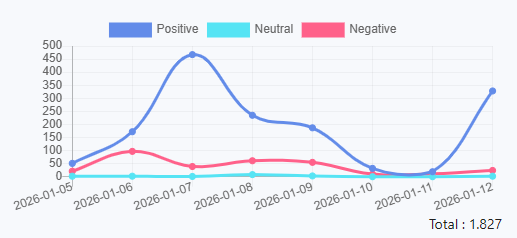
Newstensity analysis shows that media coverage of APBN 2026 is dominated by positive sentiment, particularly in the early stages of discussion. This optimism is generally linked to narratives about development continuity, economic stability, and the role of the state budget in maintaining purchasing power.
Nevertheless, negative sentiment also appears periodically. Issues such as potential budget deficits, spending effectiveness, and long-term fiscal burdens are the main drivers of critical coverage. This pattern indicates that media narratives are not uniform, but instead present a diverse spectrum of perspectives.
Beyond sentiment, word choices in media reporting also reflect how APBN 2026 is framed.
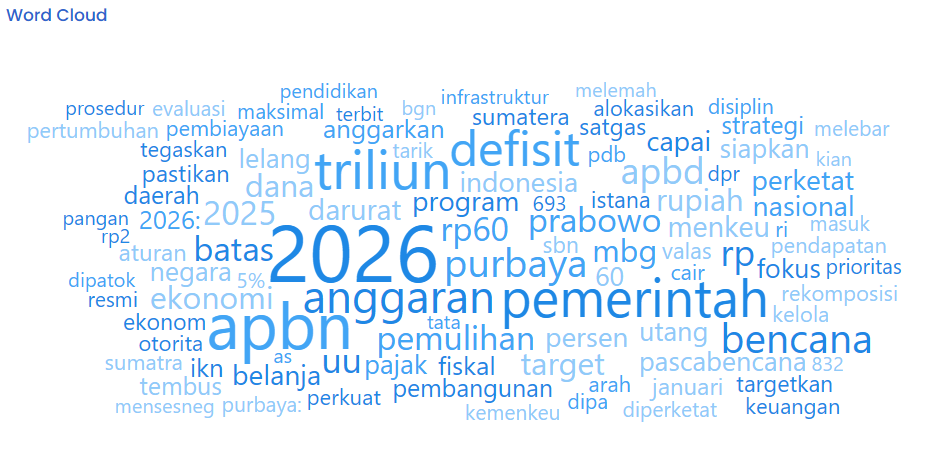
Picture 2. Word cloud of APBN 2026 media coverage based on word frequency. (Source: Newstensity)
The word cloud shows that terms such as APBN, government budget, deficit, spending, and economic recovery dominate coverage. This suggests that the media tends to highlight APBN from the perspective of fiscal stability and the state’s capacity to finance development.
Meanwhile, more technical discussions on budget structure or long-term fiscal risks receive relatively less attention. This pattern illustrates how media outlets select aspects most relevant to public interest, while potentially simplifying the complexity of fiscal policy.
Amid the rapid flow of information, data-driven approaches are becoming increasingly important. Media intelligence allows public issues to be examined more comprehensively—not just through one or two articles, but across the entire media landscape.
Through analyses such as those conducted by Newstensity, the dynamics of the APBN 2026 issue can be mapped systematically: when media attention peaks, which topics dominate, and how sentiment shifts over time. This approach helps both the public and policymakers understand the broader context behind circulating narratives.
Ultimately, APBN 2026 is not only about numbers in a state document. It lives in the public sphere, shaped by policy decisions, competing interests, and the way the media frames it.
Understanding the APBN as a narrative does not mean ignoring policy substance. On the contrary, it opens space to read policy more holistically—between what is planned, what is reported, and how it is interpreted by the public. In this complexity, data and analysis become essential to ensure that public discourse remains grounded in clear understanding.

AI brand visibility is how often, how accurately, and in what context your brand appears in answers from AI-powered search…

binomedia

The DTSEN social assistance decile controversy in 2026 is not merely about inaccurate data. Media monitoring and digital conversation analysis…
binomedia
Indonesia’s gross domestic product (GDP) grew by 5.29 percent in the second quarter of 2026. This figure exceeded the median…
binomedia

Artificial intelligence (AI) is transforming education faster than most education systems can respond. Machines can now search for information, summarize…
binomedia

One Event, Two Market Moves On Monday, August 10, 2026, Indonesia’s rupiah closed 0.79% higher at IDR 17,755 per US…
binomedia

On Thursday, July 30, 2026, Indonesian President Prabowo Subianto announced a “cleanest city” competition. The top five cities would win…
binomedia

Before dawn on Friday, 24 July 2026, a mob in Bali beat a man to death. He is identified only…
binomedia

Gen Z is increasingly tuning out advertisements that look overly polished and perfect. Instead, they tend to trust recommendations from…
binomedia

On June 10, 2026, Indomie brought back its Goreng Cabe Ijo flavor after the product had been difficult to find…
binomedia

Companies today use AI to read customer data, monitor public conversations, measure reputation, map issues, and support strategic decision-making. In…
binomedia