

AI Brand Visibility: Who’s Telling Your Brand’s Story?
AI brand visibility is how often, how accurately, and in what context your brand appears in answers from AI-powered search…
-
binomedia
- September 11, 2026

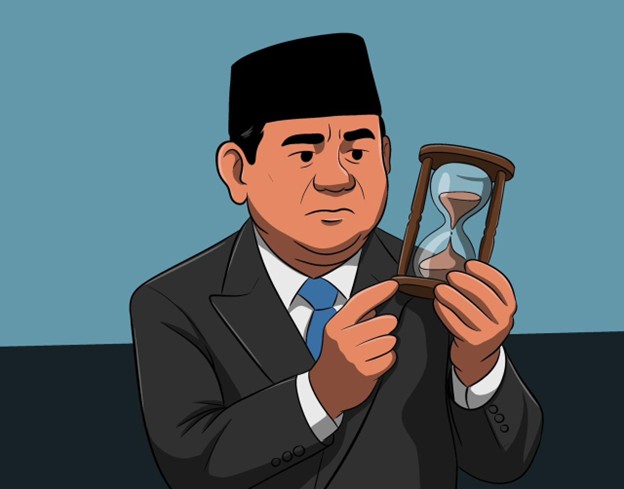
October 20, 2025 marks one full year since President Prabowo Subianto and Vice President Gibran Rakabuming Raka began their administration under the Red-and-White Cabinet. Coinciding with this anniversary, several survey institutions released their findings on public perceptions of the government’s first-year performance.
These survey results serve not only as a reflection of popularity but also as an evaluation of how effectively President Prabowo’s programs have reached the broader population.
However, survey outcomes depend heavily on each institution’s methodology — including sample size, randomization technique, margin of error, and confidence level — all of which play crucial roles in determining accuracy. Consequently, the results vary widely across different pollsters.
Poltracking Indonesia released its national survey results in early October 2025 to measure public perceptions of the government’s first-year performance.
Conducted on 3–10 October 2025 using stratified multistage random sampling, the poll surveyed 1,220 respondents across 38 provinces, with a margin of error of ± 2.9% and a confidence level of 95%.
Poltracking found public trust at 81.5% and satisfaction at 78.1%. The main factor driving satisfaction was President Prabowo’s firm and authoritative leadership style (18.8%), followed by accurate government assistance (12.3%) and approval of the Free Nutritious Meal (MBG) program (10.4%).
By sector, satisfaction was highest in education (79%), followed by health (76.6%), defense (75.5%), and social-cultural affairs (74.9%). The lowest satisfaction levels appeared in law and anti-corruption (68.2%), political stability (65.7%), and economy (57.4%).
Cabinet evaluation also formed part of the survey: Religious Affairs Minister Nasaruddin Umar ranked highest in satisfaction (65.7%) — followed by Youth and Sports Minister Erick Thohir, Finance Minister Purbaya Yudhi Sadewa, Infrastructure Coordinating Minister Agus Harimurti Yudhoyono, and TNI Commander Agus Subianto. A majority (58.4%) of respondents supported a cabinet reshuffle.
As for flagship programs, the MBG Program was known to 89.7% of respondents, and 53.5% rated it as the most beneficial policy. Strong support also emerged for the 3 Million Subsidized Houses program (54.7%) and Red-and-White Cooperatives (58.6%).
IPO’s “National Survey on One Year of President Prabowo’s Government” was conducted 9–17 October 2025, using the same stratified multistage random-sampling approach.
The survey gathered 1,200 respondents nationwide, maintaining gender parity and a margin of error of ± 2.9%.
IPO recorded 81% public trust and 67% satisfaction with President Prabowo’s leadership. Again, firmness and authority (19.8%) were cited as the biggest strengths, followed by pro-people policies (15.5%) and commitment to anti-corruption (14.2%).
By sector, rural economy (85%) scored highest, followed by law enforcement (80%), national security (77%), and politics (74%).
Conversely, national economy (73%), anti-corruption (61%), and especially democracy (42%) showed weaker performance.
In cabinet rankings, Finance Minister Purbaya Yudhi Sadewa led (17.5%), followed by Cabinet Secretary Teddy Indra Wijaya (15.1%) and Foreign Minister Sugiono (11.8%).
Public approval for Prabowo’s priority programs remained strong: MBG Program awareness (94%) with 62% positive ratings; 3 Million Houses Program (74% awareness; 56% positive); and Village Fund and Red-and-White Cooperatives Programs (74% awareness; 69% and 53% positive respectively).
Unlike Poltracking and IPO, which surveyed general public perception, the Center for Economic and Law Studies (Celios) adopted a more critical and mixed-method approach.
Its study, “Performance Report on the First Year of the Prabowo–Gibran Administration,” combined:
Celios’s results were strikingly different:
Further findings:
Celios’s survey also found 34% of Prabowo–Gibran’s 2024 voters would not vote for them again, reflecting serious concerns about governance and delivery.
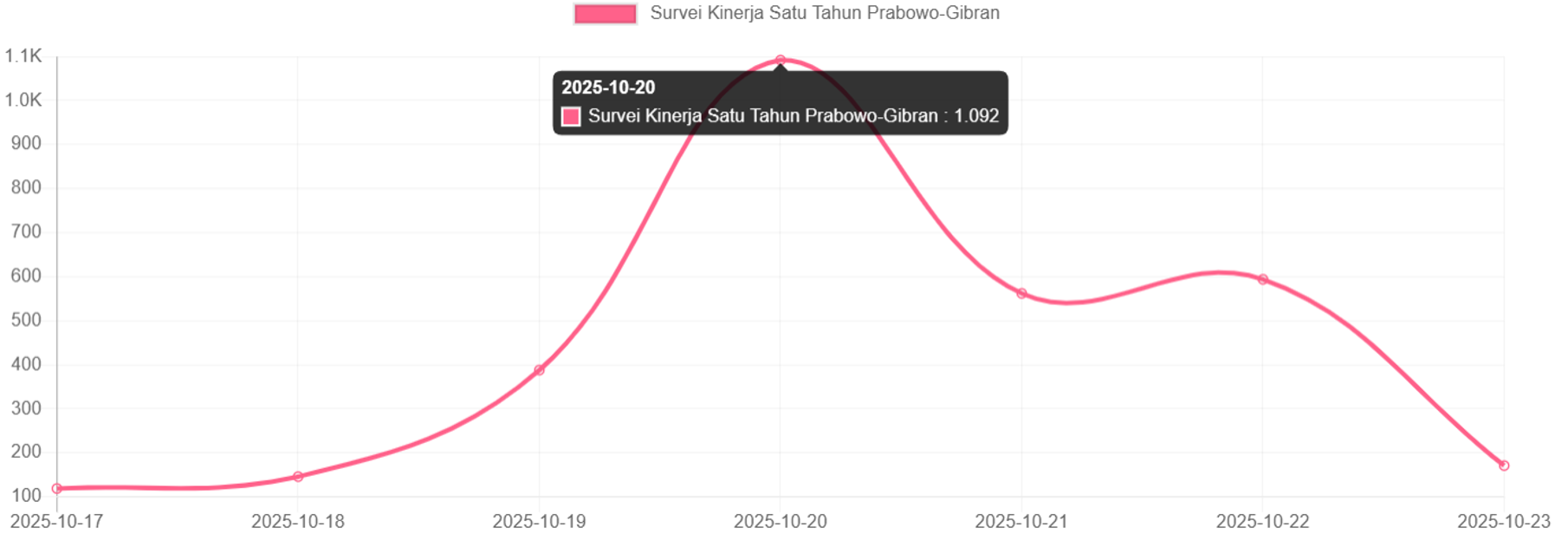
Big-data media monitoring by Newstensity recorded 3,109 news articles on “First-Year Performance Survey of Prabowo–Gibran” during 17–23 October 2025, peaking on 20 October — the exact anniversary of their inauguration.
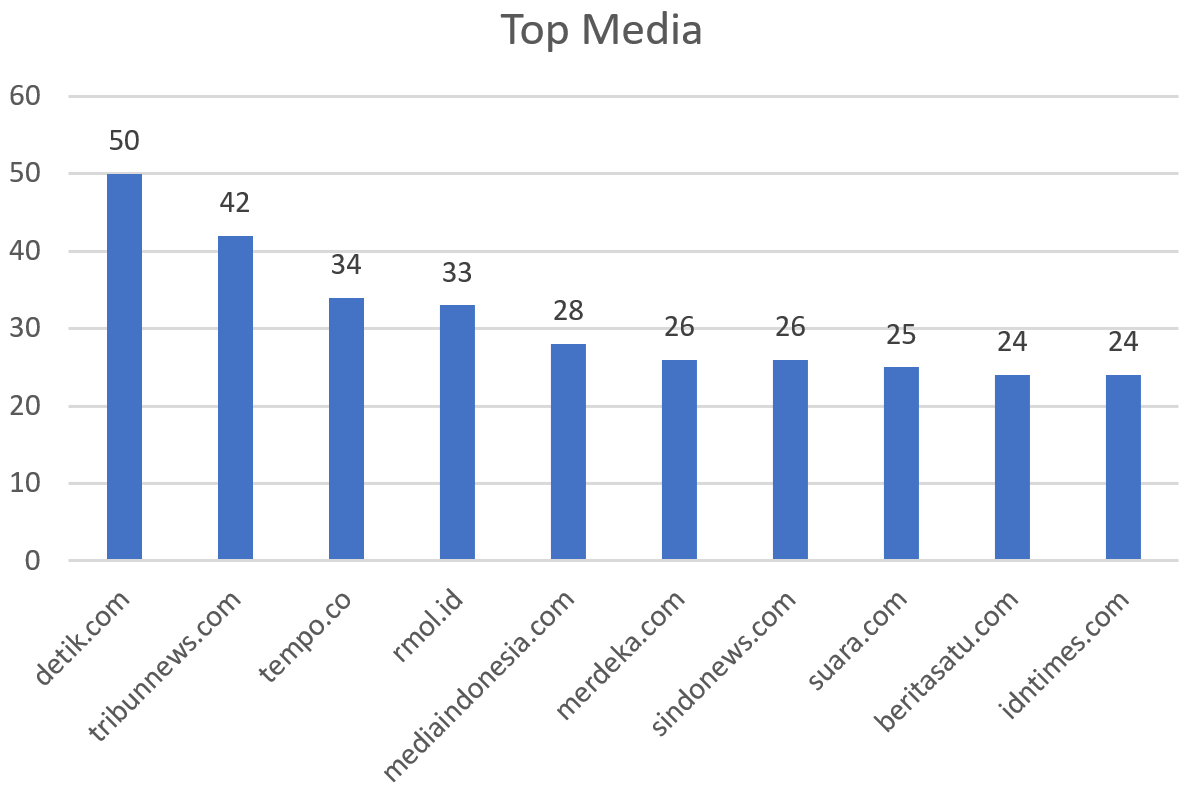
Detik.com led coverage with 50 articles, followed by Tribunnews.com (42), Tempo.co (34), Rmol.id (33), and Media Indonesia (28) — showing that online media dominated the conversation due to faster publishing cycles.
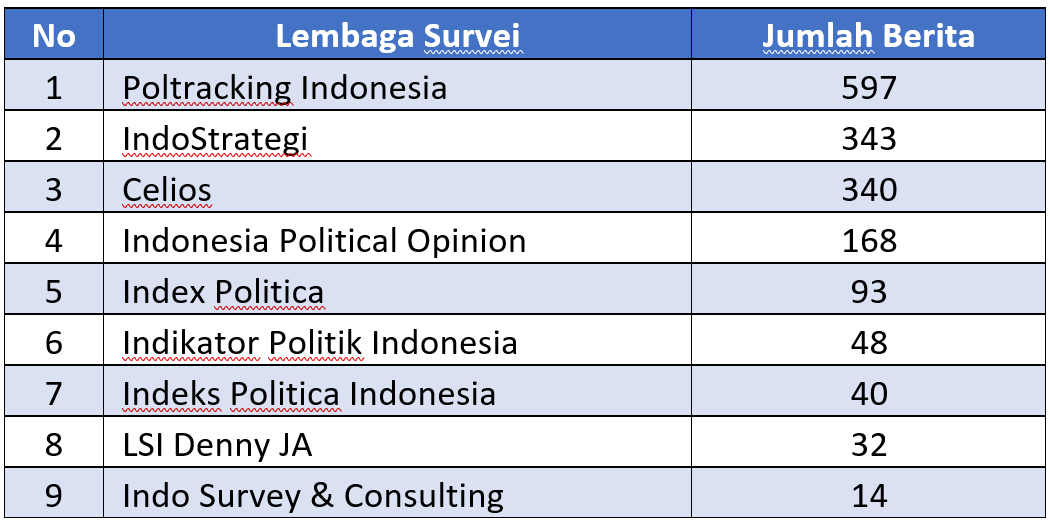
Among survey institutions:
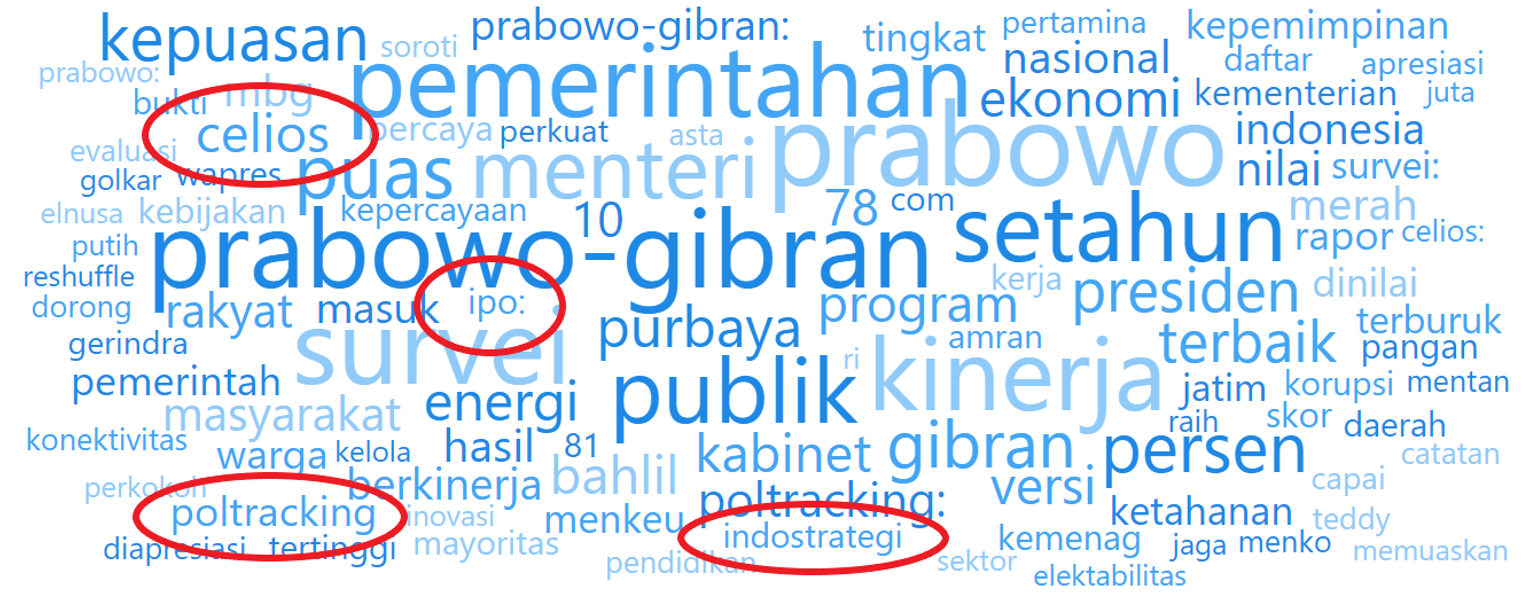
Media word-cloud analysis highlighted four dominant names — Poltracking, Celios, IndoStrategi, and IPO — as the primary references shaping public perception of Prabowo–Gibran’s first-year evaluation.
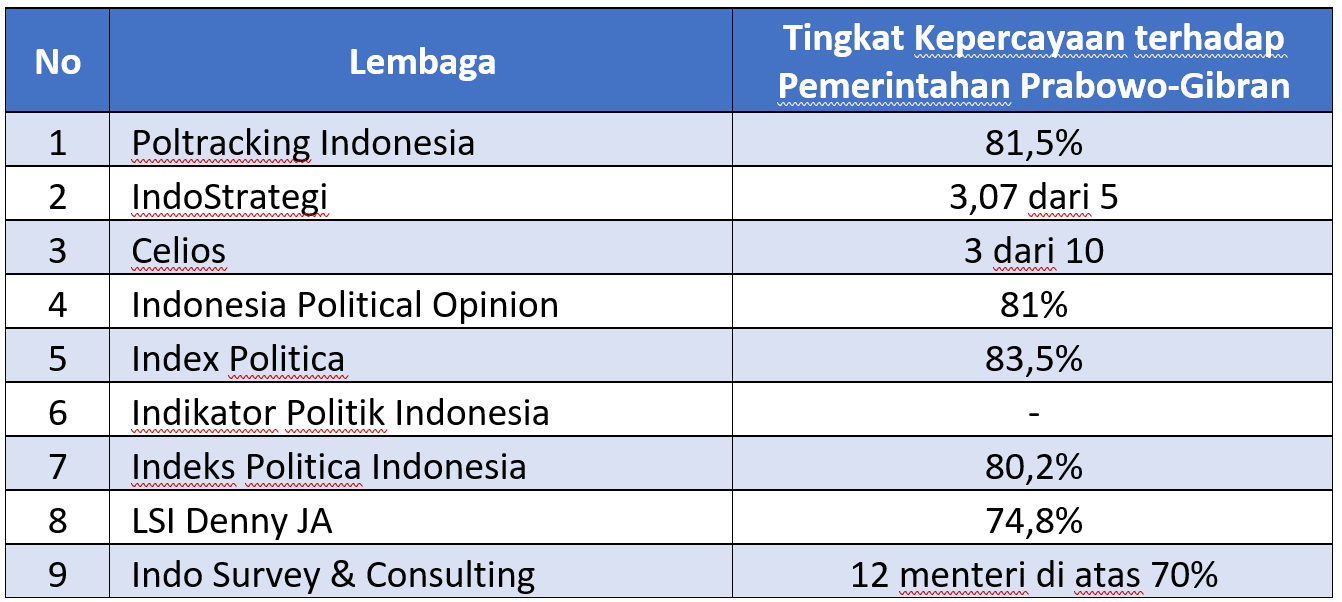
Overall, most survey institutions showed relatively high trust levels, led by Poltracking (81.5%) and Index Politica (83.5%). Celios remained the outlier with its harsh 3 / 10 score, explained partly by its journalist-based expert sampling method, which naturally produced more critical evaluations.
While the Poltracking–IPO–IndoStrategi bloc framed the government’s first year as strong and stable, Celios’s findings sparked public debate — reminding readers that optimism should still coexist with accountability.
Both supportive and critical survey findings deserve their space.
The dominance of positive ratings does not invalidate Celios’s dissenting perspective — it enriches public discourse by showing how different methodologies produce different pictures.
For the public, the key takeaway is this: surveys are only as accurate as their methods. Whether using stratified random sampling (Poltracking & IPO) or expert judgment (Celios), variations in design explain the conflicting results.
Ultimately, a critical reader must not accept numbers at face value but always question how the data was collected and who interprets it — because even in statistics, truth is rarely singular.

AI brand visibility is how often, how accurately, and in what context your brand appears in answers from AI-powered search…

binomedia

The DTSEN social assistance decile controversy in 2026 is not merely about inaccurate data. Media monitoring and digital conversation analysis…
binomedia

Indonesia’s gross domestic product (GDP) grew by 5.29 percent in the second quarter of 2026. This figure exceeded the median…
binomedia

Artificial intelligence (AI) is transforming education faster than most education systems can respond. Machines can now search for information, summarize…
binomedia

One Event, Two Market Moves On Monday, August 10, 2026, Indonesia’s rupiah closed 0.79% higher at IDR 17,755 per US…
binomedia

On Thursday, July 30, 2026, Indonesian President Prabowo Subianto announced a “cleanest city” competition. The top five cities would win…
binomedia

Before dawn on Friday, 24 July 2026, a mob in Bali beat a man to death. He is identified only…
binomedia

Gen Z is increasingly tuning out advertisements that look overly polished and perfect. Instead, they tend to trust recommendations from…
binomedia

On June 10, 2026, Indomie brought back its Goreng Cabe Ijo flavor after the product had been difficult to find…
binomedia

Companies today use AI to read customer data, monitor public conversations, measure reputation, map issues, and support strategic decision-making. In…
binomedia