

Downgrade Lifestyle: Indonesia’s Real Economic Signal
What Is “Downgrade Lifestyle” and Why Is It Trending on Threads? Since early September 2026, the term “downgrade lifestyle” has…
-
binomedia
- October 9, 2026

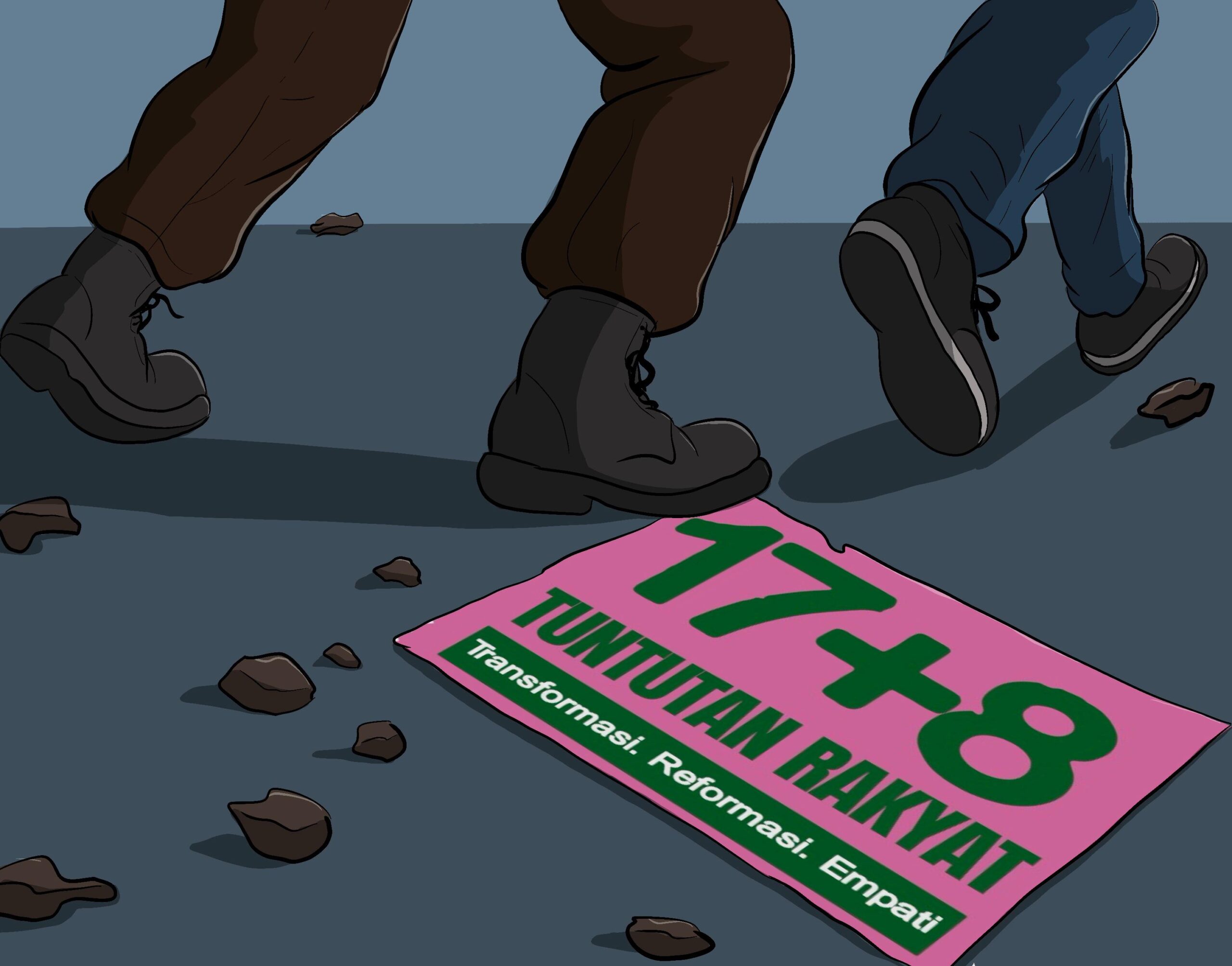
A wave of mass demonstrations has swept across Indonesia. The protests, which began on 25 August 2025, spread like flames. In the midst of an economy in turmoil, members of parliament proudly raised their allowances. This policy, conceived during a crisis, was seen as lacking empathy for the public’s plight. Unsurprisingly, since 25 August, thousands have taken to the streets, lighting a collective fire of anger that has reached every corner of the city.
According to Home Affairs Minister Tito Karnavian, by 2 September 2025 there had been 107 demonstrations in 32 provinces, demonstrating the scale of protests across the country. The impact is clear: traffic jams are no longer caused by rush hour but by thousands of people voicing their aspirations.
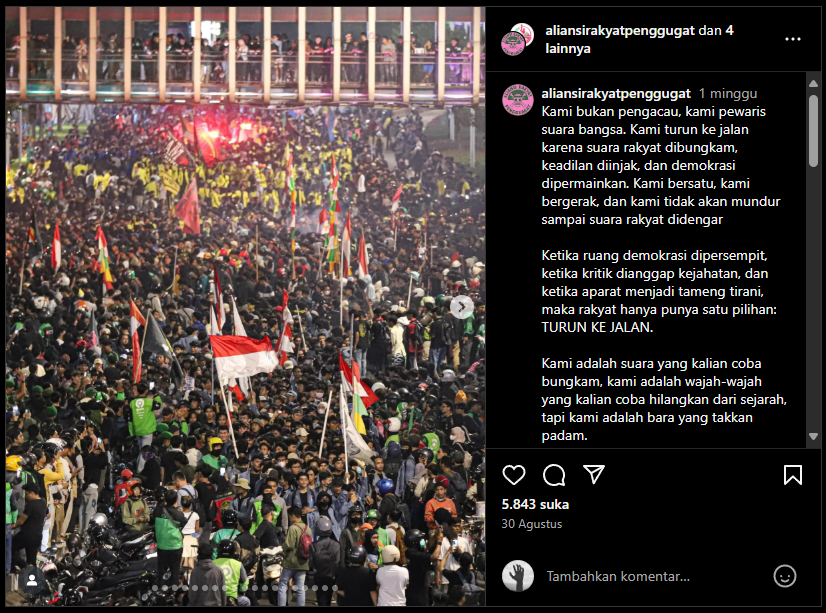
These demonstrations are not just about shouting in the streets; they are the culmination of frustrations that have finally erupted. Citizens are asked to pay taxes and fees and endure austerity, yet the government seems indifferent. Ministries multiply, state‑owned enterprises remain bloated, and the salaries and allowances of officials and MPs are increased. All of this hardens into one: a collective cry, a movement, a mass in the streets.
This protest differs from previous ones – it is larger, more intense, and resonates more widely. Its echo is heard not only in the city centre but also in the digital realm. Twitter/X is filled with protest hashtags, TikTok with videos of actions, and Instagram has become a gallery of infographics. Street protests and digital activism support each other, creating a socio‑political pressure that is hard to ignore.

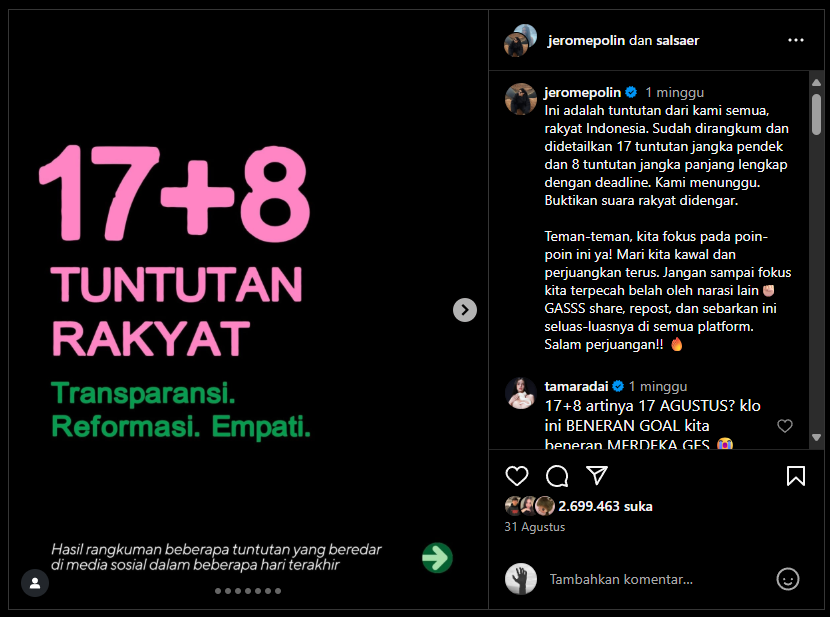
From the continuous stream of demonstrations since late August emerged a list of demands summarised as “17+8 People’s Demands: Transparency, Reform, Empathy.” The numbers 17 and 8 symbolise Independence Day on 17 August. These demands arose from disappointment, cries about injustice, food, policy and a country rife with chaos.
The demands were compiled through online discussions led by influencers Jerome Polin, Salsa Erwina Hutagalung, Andovi Dalopez, Abigail Limuria, Fathia Izzati and Andhyta Firselly Utami. They summarised demands from civil society organisations and popular voices.
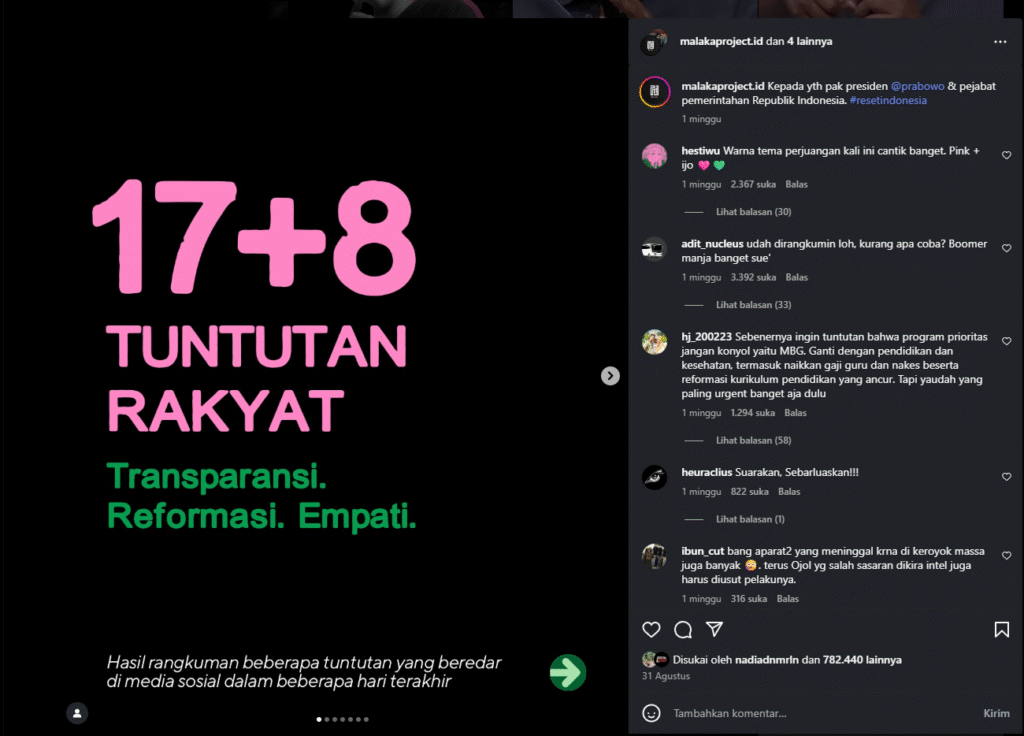
These demands originate from various organisations: YLBHI collected input from 211 civil society groups, while the Pusat Studi Hukum dan Kebijakan Indonesia (PSHK), the Master of Notary Students Association at UI, and Center for Environmental Law & Climate Justice at the University of Indonesia issued press releases. The organisers also included labour demonstrations on 28 August 2025 and 12 demands for transparency and justice by Reformasi Indonesia on Change.org.
People began to associate the movement with the colours Brave Pink and Hero Green, representing Ibu Ana, a pink‑veiled protester standing before police lines, and Affan Kurniawan, an ojek driver killed by an armoured vehicle.

There are 17 short‑term demands with a deadline of 5 September 2025 and 8 long‑term demands with a deadline of 31 August 2026. The 17 short‑term demands target four key institutions: President Prabowo, the DPR (parliament), the police, and the TNI (military). The deadlines show that the public isn’t just yelling; they want concrete action quickly.
The 8 long‑term demands focus on fundamental reforms:
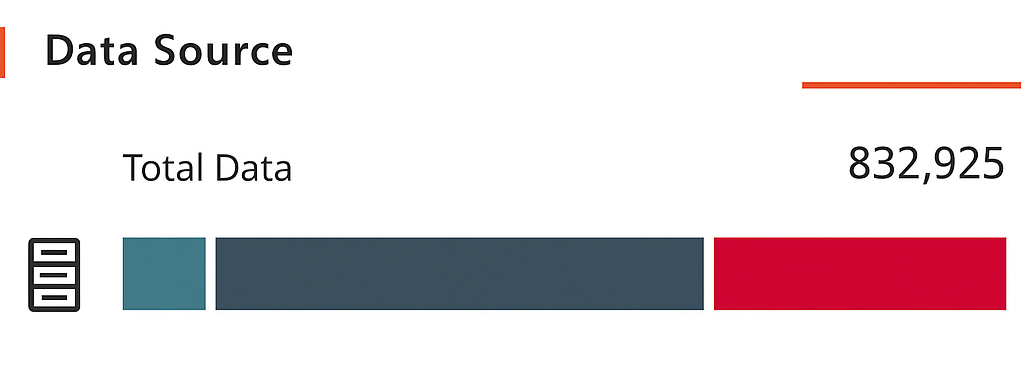
Protests aren’t just loud on the streets; they’re loud online. Using Socindex Binokular, analysts monitored conversations from 28 August to 8 September 2025. They recorded 832,925 conversations across X, Instagram, Facebook, YouTube and TikTok using keywords “17+8” and “Tuntutan Rakyat”.
Data show the highest engagement comes from big influencers on Instagram. Figures like Jerome Polin and Jovial da Lopez drove the movement with posts garnering over one million engagements (likes, comments and shares).
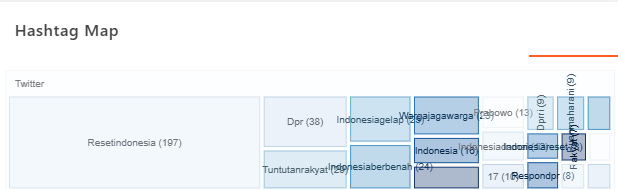
On X/Twitter, the demand’s echo grows through popular keywords and hashtags. “DPR” and “17+8” top the charts. Other hashtags like #ResetIndonesia and #WargaJagaWarga accompany the conversation.
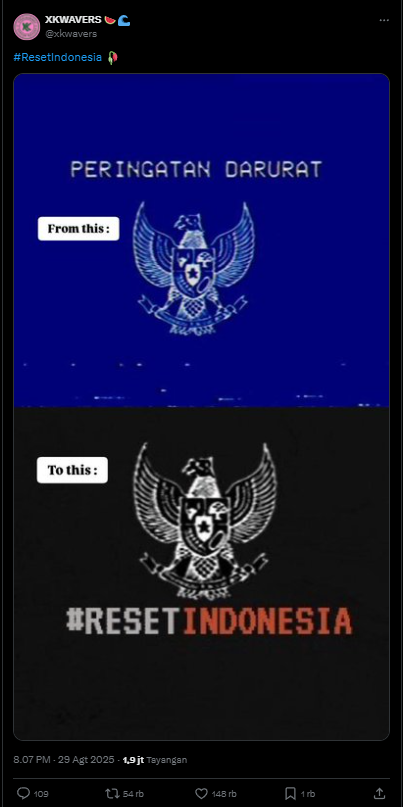
#ResetIndonesia became a platform for calls to overhaul national governance. Posts under this tag discussed not only the 25 demands but also big ideas on political, economic and legal reform.
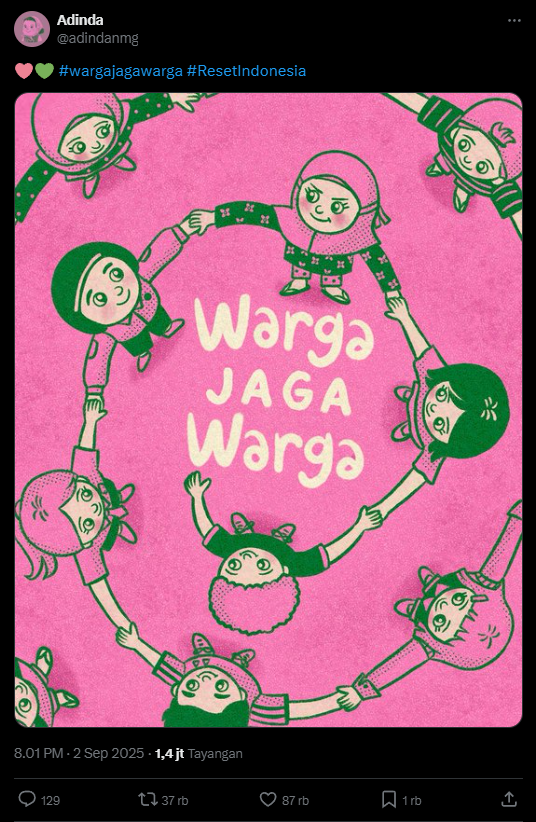
The #WargaJagaWarga hashtag symbolises horizontal solidarity among citizens: sharing field information, organising logistics for protesters and circulating legal aid hotlines.
The demonstrations finally elicited responses from the government and political elites. The people’s “17+8 demands” could no longer be dismissed as street noise. The socio‑political pressure – both on the ground and online – forced the government to move quickly, although not all demands could be met.
On Thursday, 4 September 2025, the DPR announced six decisions: (1) housing allowances for MPs were terminated as of 31 August 2025; (2) overseas working trips were put on hold, except for official invitations, starting 1 September; (3) allowances for electricity, phone and transport would be evaluated and cut; (4) financial rights of MPs suspended by their party were frozen; (5) the House Honor Council (MKD) would act against problematic members; and (6) a commitment to greater transparency and public participation in every legislative and policy process.
On Sunday, 8 September 2025, President Prabowo made a surprise cabinet reshuffle, replacing Finance Minister Sri Mulyani with Purbaya Yudhi Sadewa. On his first day, Purbaya commented on the 17+8 demands:
“That’s just the voice of a small segment of our people… once the economy grows 6–7 percent, they’ll be busy working and eating well rather than protesting”.
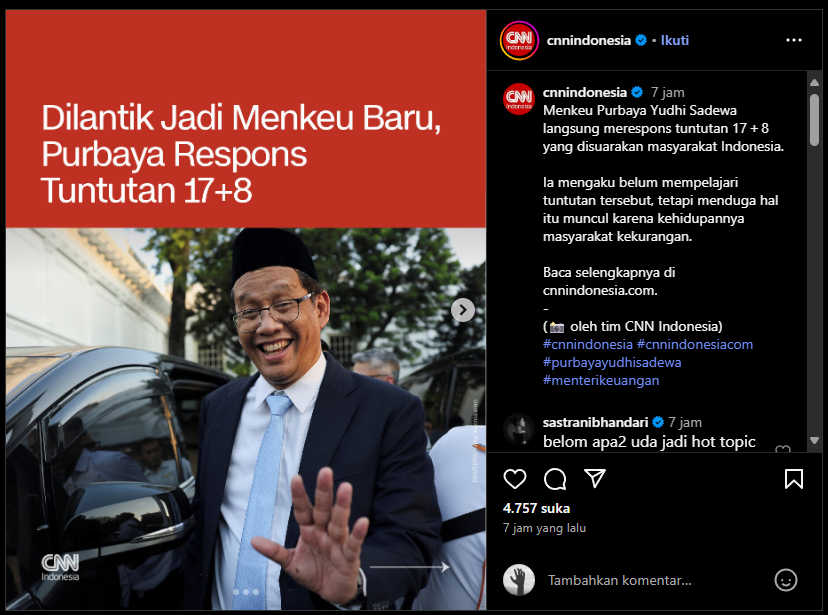
What might have been intended to calm the situation backfired. His words about a “small segment” sounded unempathetic and even provocative. Instead of easing tensions, they sparked new anger; many netizens interpreted them as a call for bigger demonstrations.
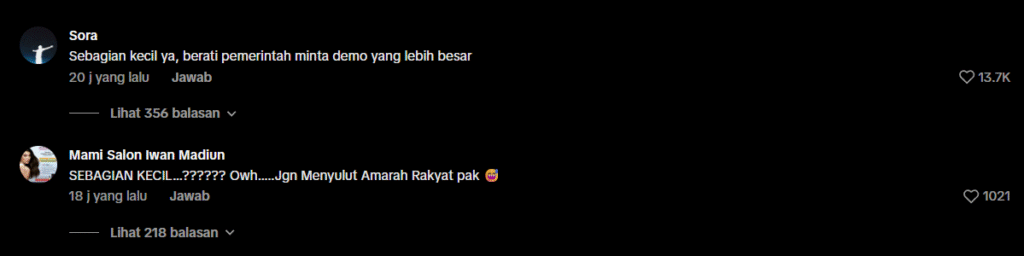
Reactions exploded. People refused to be labelled “small,” belittled or dismissed. They pointed out that those protesting included students, workers, farmers, ride‑hailing drivers and urban poor. To call their grievances “small” was to close one’s eyes to the injustices they endure.

As with a double‑edged sword, there are always opposing views. Amid criticism of the minister’s remarks, some netizens defended him. They believed his words expressed optimism that conditions would soon improve, aiming to reassure the public rather than dismiss their concerns.

Realising his mistake, Finance Minister Purbaya later issued a clarification and apology, stressing that he meant no disrespect to the people’s aspirations. He emphasised that the government would restore the economy and create jobs as concrete steps to address public anxiety.
Despite some parliamentary concessions, the public remains unsatisfied. Criticism continues, and demands are still monitored. People await concrete actions on more substantial issues: stopping the criminalisation of demonstrators, ensuring budget transparency and seriously reforming civil‑military relations. Outside Senayan, netizens keep pressing; hashtags #ResetIndonesia and #WargaJagaWarga still trend on X, signalling that unrest persists despite small concessions.
Amid all this, Finance Minister Purbaya’s “small segment of the people” blunder became an added catalyst. Instead of calming tensions, his remark sparked new waves of criticism. Netizens insisted that protesters represent layers of society hardest hit by inequality and economic pressure. His apology did not immediately pacify them; people and netizens still await real actions, not just words.
If the people’s voice is truly the voice of God, then the 17+8 People’s Demands are a long prayer echoing on the streets and in the digital world. The question remains: will the prayer be answered with real change, or will it fade into routine power plays?
Writer: Afandi (Socindex), Ilustrator: Aan K. Riyadi
What Is “Downgrade Lifestyle” and Why Is It Trending on Threads? Since early September 2026, the term “downgrade lifestyle” has…

binomedia

You can no longer tell AI astroturfing from genuine public opinion by reading the text. Generative AI writes as fluently…
binomedia

Who controls money in the blockchain era? When Bitcoin launched in 2008, the answer sounded simple: no single party, because…
binomedia

The debate over whether AI development should slow down is no longer theoretical. In September 2026, the CEOs of the…
binomedia

AI brand visibility is how often, how accurately, and in what context your brand appears in answers from AI-powered search…
binomedia
The DTSEN social assistance decile controversy in 2026 is not merely about inaccurate data. Media monitoring and digital conversation analysis…
binomedia
Indonesia’s gross domestic product (GDP) grew by 5.29 percent in the second quarter of 2026. This figure exceeded the median…
binomedia

Artificial intelligence (AI) is transforming education faster than most education systems can respond. Machines can now search for information, summarize…
binomedia
One Event, Two Market Moves On Monday, August 10, 2026, Indonesia’s rupiah closed 0.79% higher at IDR 17,755 per US…
binomedia

On Thursday, July 30, 2026, Indonesian President Prabowo Subianto announced a “cleanest city” competition. The top five cities would win…
binomedia