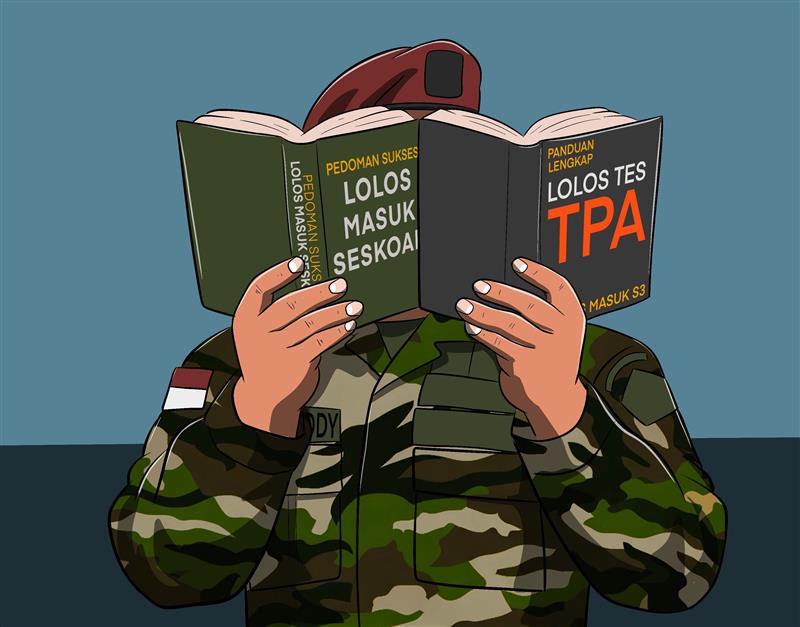
Lieutenant Colonel Teddy Indra Wijaya, the Cabinet Secretary of the Republic of Indonesia, is currently carrying three major roles at once: a high-level government official, an active Indonesian Army officer, and a doctoral student. He is undergoing advanced military education at the Army Staff and Command School (Seskoad) while also pursuing a doctoral degree (PhD/S3) at the Bandung Institute of Technology (ITB), alongside his duties as a state official.
Teddy’s decision to take Seskoad and pursue a PhD at ITB simultaneously is driven by the goal of strengthening professional competence in the military domain and building academic capacity in strategic management. This combination is intended to provide a stronger foundation for handling the dynamics of government responsibilities and leading large organizations—while also meeting the career development requirements within the Indonesian Army.
On the academic side, his choice to pursue a doctoral program at ITB is not merely a continuation of formal education. It is also seen as an effort to strengthen academic competence and methodological capability beyond the experience he has accumulated so far. The doctoral program he chose—Management Science—represents the highest level of education in strategic management and is relevant for expanding understanding of governance in large organizations and leadership.
Seskoad (the Army Staff and Command School) is the highest-level military education institution within the Indonesian Army, located in Bandung, West Java. It is designed to educate and develop mid-level officers in strategic leadership, defense management, command tactics, and geopolitical insight, preparing them to occupy key positions within the Army’s staff and command structure. This education is part of a professional career development pathway conducted according to established provisions. Participants are not only from the Army, but also from other services, the National Police, and officers from friendly nations. The curriculum emphasizes strategic analytical capability and readiness to face complex security and defense challenges.
Meanwhile, the doctoral program Teddy is taking at ITB is in the Management Science Study Program under ITB’s School of Business and Management. This doctoral program focuses on in-depth topics in strategic management, how large organizations operate, and decision-making processes in complex situations. Management Science PhD students do not only learn theory in class; they also conduct research to understand how large organizations function—whether in government, the military, or the private sector.
The combination of being an active military officer, holding a state position, and pursuing a doctoral degree at a leading university has triggered broad discussion and varied public opinion, since it is rare for a public figure to carry all these responsibilities simultaneously—or within nearly the same time frame.
In recent days, news about Cabinet Secretary Lt. Col. (Infantry) Teddy Indra Wijaya has become widely discussed on social media. The issue surfaced after a number of posts reported that, in addition to performing state duties, he is also attending Seskoad and pursuing a PhD at ITB. These posts quickly spread and prompted diverse reactions. Many netizens expressed curiosity about the multitasking ability of a state official, while others questioned whether it is feasible to maintain adequate time allocation and focus for such activities concurrently.
One of the posts drawing the most attention came from the TikTok account @officialinews, which featured a video about the Cabinet Secretary undergoing education at Seskoad while also studying for a PhD at ITB. The content recorded the highest engagement, totaling 381,997 interactions, consisting of 371,375 likes and 3,005 comments—an indication that the topic has strong traction on social media.
Based on monitoring using Socindex (across Twitter/X, Facebook, Instagram, YouTube, Threads, and TikTok), the issue of the Cabinet Secretary attending Seskoad and pursuing an ITB PhD generated a substantial volume of conversation: 7,244 total conversations. Monitoring was conducted during 6–11 February 2026, using keywords and hashtags such as Teddy Seskoad, Teddy S3, Teddy ITB, Seskab Seskoad, and Seskab S3.
Public Reaction on Social Media
Netizen reactions regarding the Cabinet Secretary’s activities—particularly his participation in Seskoad and an ITB doctoral program—show mixed sentiment, drawing public attention in several different ways.
Some netizens responded negatively, questioning the effectiveness of job performance if intensive education is pursued simultaneously with state duties. They raised issues related to work priorities, transparency in education permissions, and the workload carried by high-ranking officials. Negative reactions were not limited to the education topic; they also extended to past criticisms focusing on issues such as rank promotion and the granting of positions associated with the Cabinet Secretary.
On the other hand, some netizens responded positively to Teddy’s decision to pursue a PhD at ITB and participate in Seskoad. They viewed him as a public official who continues to learn despite holding a high position. Posts about his academic activities were also seen as showing a more human side of an official—appearing to manage time between work and education. Some praised his learning spirit and considered it an example that anyone can continue education even while busy with work.
Overall, social media monitoring indicates sentiment is divided between support for his dedication to learning and criticism regarding how his role in civilian government is perceived by some groups. These perceptions are influenced by social background and political views among social media users.
Conclusion
In closing, Teddy Indra Wijaya’s path—undertaking Seskoad while pursuing a PhD at ITB—illustrates how a public figure can stand at the intersection of official responsibility, military career demands, and the desire for continuous learning. On one side, this step is viewed as an effort to increase personal capacity and strengthen leadership readiness in both government and military spheres. On the other side, public discussion reflects a high expectation that state officials maintain focus, performance, and clear priorities in executing their primary duties. Ultimately, this debate reflects public attention to leadership quality and governance—while also showing that a public figure’s activities outside official duties can quickly become a spotlight issue on social media.
Contributor