Michael Kusuma Head Of Investor Relations Sampoerna Agro
“Binokular makes it easier for us to obtain up-to-date information and news. Its monitoring reports are comprehensive and customizable, and features like news archive searching are very useful. The range of services allows personnel with high mobility to access the website, newsletters, and SMS alerts.”
Arif Haryanto Corporate Communication Department, PT Angkasa Pura I (Persero)
“Binokular is a smart solution! Monitoring media spread across 13 regions in central to eastern Indonesia, where Angkasa Pura I airports are located, becomes easy and fast with Binokular. The accuracy and relevance of the captured news are commendable. Binokular’s comprehensive and user-friendly web service makes news documentation searches easier. Binokular also helps us respond quickly to any negative news with its SMS alert service. Kudos to all these innovations, Binokular!”
Miranti Hadisusilo Corporate Secretary & Legal Director, PT Matahari Department Store Tbk
“Binokular has been incredibly helpful for our media monitoring, covering news related to our company, industry, and competitors. Up-to-date information is essential for market analysis, allowing us to respond quickly when necessary.”
Eko Harmonsyah Director of Strategic Planning and Public Relations, Bank Indonesia
“Media monitoring has become easier with Binokular. The necessary information can be searched quickly and accurately using its search engine. The interface is also quite user-friendly. But most importantly, the responsive and proactive service from the Binokular team is extremely helpful.”)
A public debate has emerged around the presence of sound horeg (also called carnival sound), especially after the East Java MUI (Indonesian Ulema Council) briefly issued a haram (forbidden) fatwa on sound horeg, which drew varied reactions in news and on social media. The public has urged the government, via the East Java Provincial Government (Pemprov Jatim), to regulate sound horeg activities.
In formulating policy, various studies are needed so regulations can be implemented effectively. One research approach is media monitoring, which can serve as a strategic tool to design policies based on real events and public responses.
Binokular Media Utama, through Newstensity (a media-monitoring platform), can be used to formulate targeted policy on sound horeg. Several actions that can be taken through Newstensity include:
Public-Perception Analysis
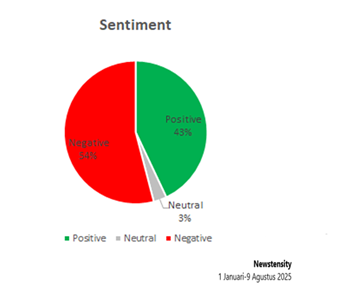
Policy makers can use sentiment analysis to gauge how necessary a regulation is. This summarizes pro–con views expressed in mass media and social media. Through Newstensity, policy makers can view prevailing sentiment regarding the sound horeg issue.
The majority of sentiment about sound horeg is negative. This should alert policy makers to pay closer attention to the issue. From the displayed sentiments, policy makers can identify both positive and negative sub-issues around sound horeg and use them to formulate policy.
Issue Identification
Newstensity can analyze both events and public responses related to sound horeg.
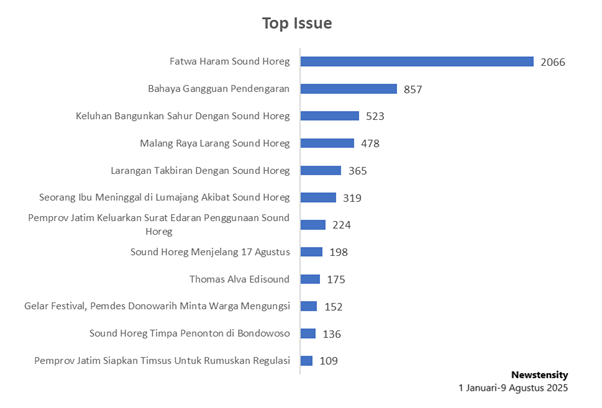
From the issue grouping produced through media monitoring, policy makers can determine which issues need regulation. Based on the Top 10 issues, Newstensity groups topics that require regulation or official response by policy makers, including:
Synchronizing communication among stakeholders Synchronized communication among stakeholders helps ensure regulation preparation and implementation speak with one voice, avoiding new polemics. The Provincial Government can take the lead as the principal spokesperson on sound horeg regulation.
Use of sound horeg based on health standards Sound horeg events have drawn attention from the public, including health experts. The decibel levels exceed the safe threshold and are seen as risky for elderly people and children; concerns also include long-term health effects. Policy makers can consider potential incidents like in Donowarih Village, where sick residents were asked to evacuate because a sound horeg event would be held.
Time and place of sound horeg events Even before the East Java MUI’s haram statement, sound horeg had already become a public concern—people were disturbed by events held during pre-dawn meals in Ramadan (sahur) and Eid-eve celebrations (takbiran). Circulating videos also showed damage to houses and public facilities as sound horeg convoys passed through neighborhoods.
Safety of event implementation Sound horeg is not without risk; safety is an aspect policy makers must consider. There have been incidents injuring spectators. The over-capacity of vehicles carrying sound horeg equipment is a safety problem and has also led to vandalism/damage to public facilities.
Stakeholder and Area Mapping
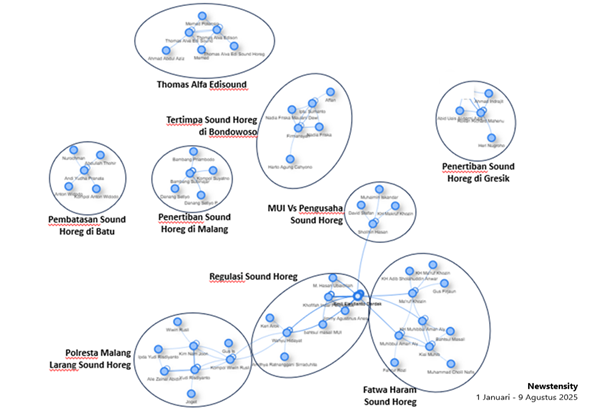
Communication is crucial for managing issues. Stakeholder cooperation is key to preventing an issue from escalating into a crisis. Through Newstensity, policy makers can map stakeholders that require attention.
Grouping stakeholders by issue helps policy makers identify relevant parties, enabling outreach or mitigation planning so the issue does not become a crisis later.
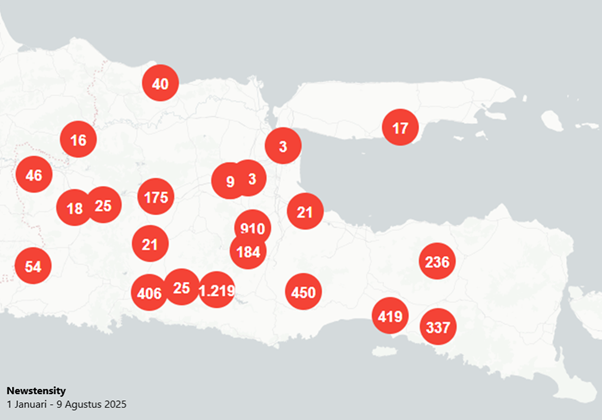
Newstensity as a media-monitoring platform can also conduct geographical mapping. Decision makers can identify which areas need attention. Regarding sound horeg, stakeholders can focus on:
Malang Raya
Pasuruan
Lumajang
Jember
Blitar
Banyuwangi
Bondowoso
Jombang
Policy Evaluation
East Java Governor Khofifah Indar Parawansa issued a circular letter to regulate sound horeg events on 9 August 2025. Through media monitoring, the Provincial Government can track feedback and implementation of the decision—whether it has impact or not—and determine any follow-up adjustments needed to refine the policy.
Sound Horeg at a Glance in the Media
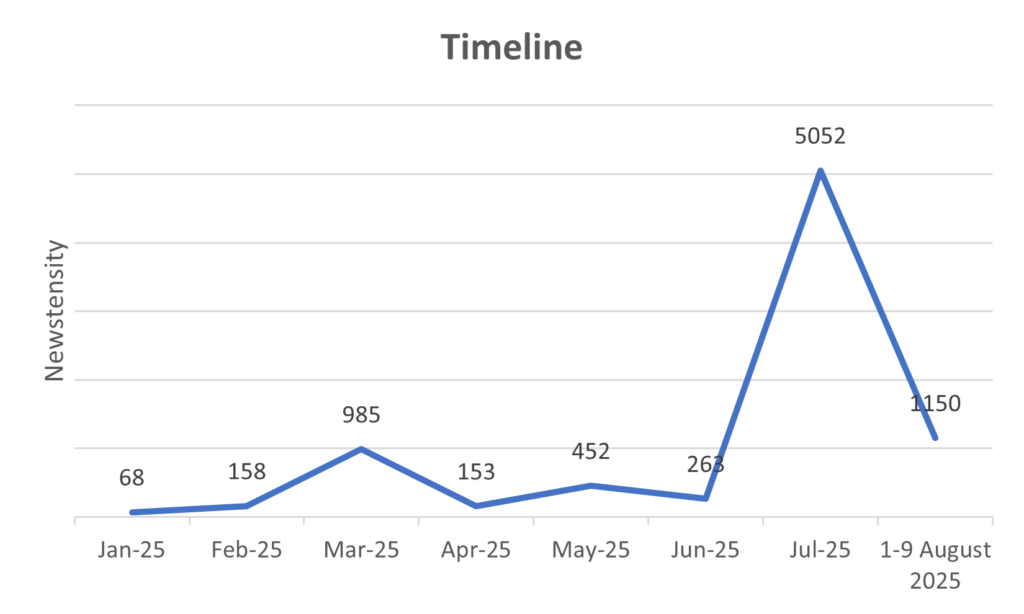
Timeline
Newstensity recorded that sound horeg drew heightened attention in July 2025, due to the temporary haram fatwa issued by East Java MUI. Previously, there was increased attention in March 2025 (Ramadan), influenced by sound horeg usage during sahur and takbiran.
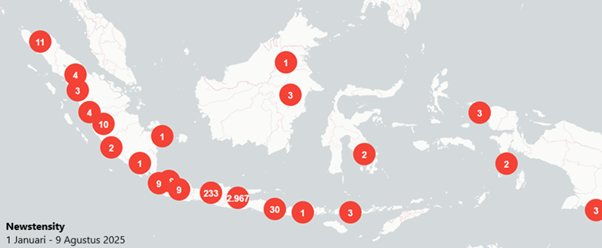
Which provinces drew public attention regarding sound horeg?
Among Indonesian provinces, attention to sound horeg is concentrated in East Java.
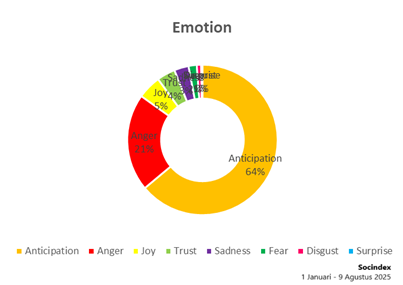
Netizen reactions
Netizen reactions are dominated by an anticipatory attitude toward incidents related to sound horeg. There is also a substantial anger emotion around sound horeg.
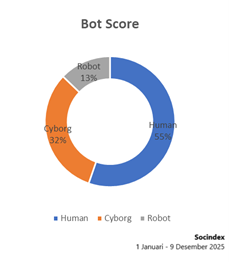
Is the sound horeg conversation organic?
Yes. The conversation is dominated by human (organic) accounts.
Is the conversation stamped as coming from “high-HDI” (high human-capital) users?
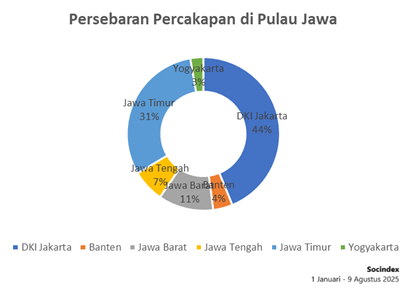
Yes. A significant share of conversation comes from DKI Jakarta netizens. According to BPS (Statistics Indonesia) 2025 Human Development Index (HDI) data, DKI Jakarta is the highest-HDI province in Indonesia.
Writer: Randy Davrian Imansyah(Newstensity), Ilustrator: Aan K. Riyadi
The government’s decision to appoint personnel from the Nutrition Fulfillment Service Unit (SPPG) as Government Employees with Work Agreements (PPPK),…
The Indonesian government, through the Ministry of Communication, Information, and Digital Affairs (Komdigi), has officially temporarily blocked the use of…