

Downgrade Lifestyle: Indonesia’s Real Economic Signal
What Is “Downgrade Lifestyle” and Why Is It Trending on Threads? Since early September 2026, the term “downgrade lifestyle” has…
-
binomedia
- October 9, 2026


When we consider people’s decisions today—what to buy, what issues to trust, and which trends to follow—one thing often triggers their choices: content from creators who feel “close” and relevant to them. This is where influencer impact in Indonesia works: changing behaviors, shaping opinions, and driving actions—sometimes for good, and sometimes otherwise.
This phenomenon gained momentum since the mid-2010s, as social media platforms rapidly expanded—from Facebook, YouTube, Twitter, and Instagram to TikTok—and people began seeking figures who aligned with their identity and lifestyle. This has influenced marketing, public opinion, and even the lifestyle standards of their followers.
At this point, influencer impact in Indonesia is no longer merely “entertainment” but a tangible social factor.
In the world of branding, the impact of influencers in Indonesia is most evident: driving people from “knowing” to “wanting,” and then to “buying.” This happens because influencer content often feels more personal than regular advertisements.
Influencers can also become a reference for public views because they build credibility, provide information, entertainment, and create a “friendship” feeling that makes followers easily follow their opinions or decisions.
Because of this, influencer impact in Indonesia can be a double-edged sword: educational or manipulative.
What is often overlooked: The greater the trust of the audience, the bigger the risk when misleading information spreads.
Influencer content sets an “ideal standard” to be mimicked: clothing styles, hangout spots, eating habits, and even career choices. On the positive side, this can inspire people. On the negative side, it can create social pressure, FOMO (fear of missing out), and impulsive consumption. Again, influencer impact in Indonesia is not just about ads—it’s about shaping popular culture.
Influencers are generally categorized by their follower count. The bigger the followers, the broader the reach, but the closeness may differ. Understanding these categories is crucial for targeting the right influencer in Indonesia for your goals.
If you ask what the biggest key is to influencer impact in Indonesia, the answer is simple: trust. When an audience trusts an influencer, they’re more willing to listen, spread the word, and take action. That’s why brands that choose influencers based solely on follower size often fail. Their audience’s trust might not align with the product.
A real example of influencer impact in Indonesia is Ferry Irwandi’s crowdfunding efforts. In response to disasters in Aceh, North Sumatra, and West Sumatra, he launched a donation campaign that raised Rp10.374 billion from 87,605 donors in just 24 hours (Tuesday, December 2, 2025).
From Socindex analysis, between November 28–December 10, 2025, there were 51,002 conversations on Instagram related to the issue. The account @irwandiferry made 69 posts, generating 22,579,875 engagements.
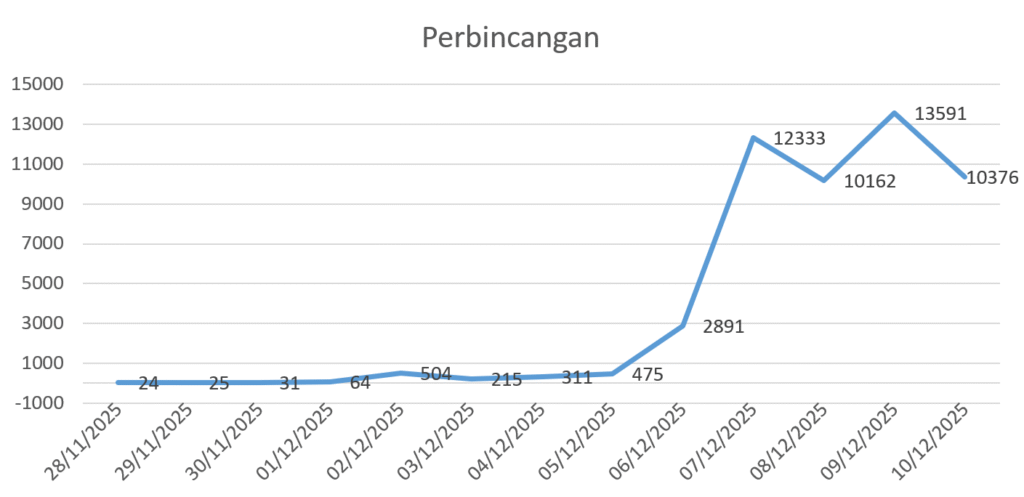
The lesson is clear: influencer impact in Indonesia can drive social action quickly due to a combination of large audiences, emotionally resonant narratives, and real-time updates that maintain trust.
If your goal is marketing, use this approach:
As influencer roles grow, Indonesia is expected to have over 863,000 active influencers by 2024. This makes manual selection time-consuming and prone to bias.
This is where data-driven approaches help. Socindex’s influencer feature can categorize influencers based on followers, niche, and past collaborations. This is ideal for digital marketing needs that connect brands with content creators. Using this method, influencer impact in Indonesia can be mapped more quickly and objectively.
Influencers can have both positive (donations, inspiration) and negative (fraud, mental pressure, manipulation) effects. Therefore, when you use an influencer for marketing, you’re also “borrowing” their reputation and assuming the associated risks.
In conclusion, influencer impact in Indonesia is real and wide-reaching: from daily shopping habits to social movements. If your goal is both information and marketing, the key is not “who is the most famous,” but “who is trusted by the right audience.” Ideally, select based on data, not intuition.
What Is “Downgrade Lifestyle” and Why Is It Trending on Threads? Since early September 2026, the term “downgrade lifestyle” has…

binomedia

You can no longer tell AI astroturfing from genuine public opinion by reading the text. Generative AI writes as fluently…
binomedia

Who controls money in the blockchain era? When Bitcoin launched in 2008, the answer sounded simple: no single party, because…
binomedia

The debate over whether AI development should slow down is no longer theoretical. In September 2026, the CEOs of the…
binomedia
AI brand visibility is how often, how accurately, and in what context your brand appears in answers from AI-powered search…
binomedia

The DTSEN social assistance decile controversy in 2026 is not merely about inaccurate data. Media monitoring and digital conversation analysis…
binomedia
Indonesia’s gross domestic product (GDP) grew by 5.29 percent in the second quarter of 2026. This figure exceeded the median…
binomedia

Artificial intelligence (AI) is transforming education faster than most education systems can respond. Machines can now search for information, summarize…
binomedia
One Event, Two Market Moves On Monday, August 10, 2026, Indonesia’s rupiah closed 0.79% higher at IDR 17,755 per US…
binomedia

On Thursday, July 30, 2026, Indonesian President Prabowo Subianto announced a “cleanest city” competition. The top five cities would win…
binomedia