

Two Years of the Prabowo-Gibran Government
Most positive news coverage: Kemenag, Kemenkeu and Kemendagri in the news media, and Kemensos, BGN and Kemenkeu on social media….
-
binomedia
- October 20, 2026

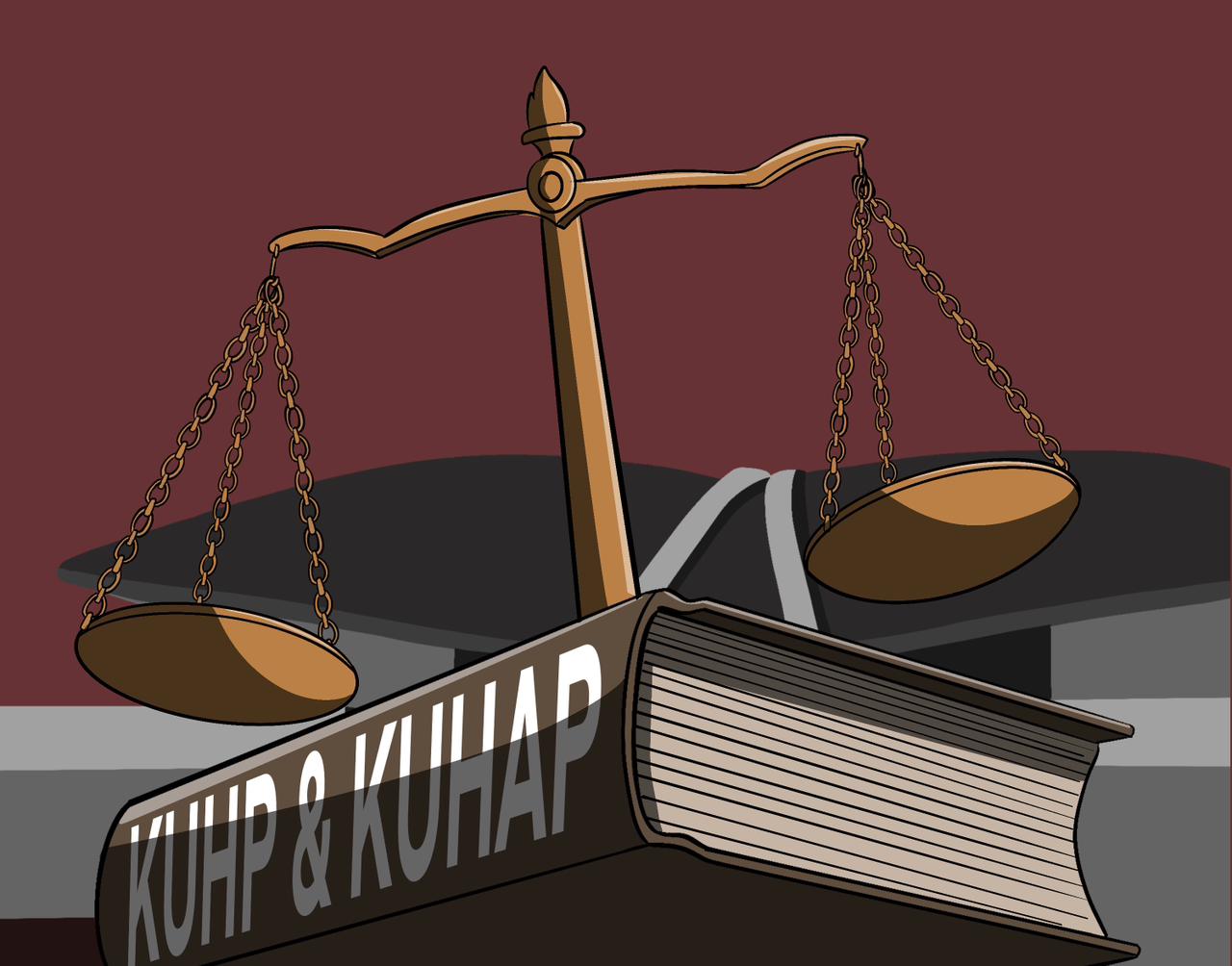
Jakarta — The enforcement of three new criminal-law instruments—Indonesia’s National Criminal Code (KUHP) under Law No. 1/2023, the new Criminal Procedure Code (KUHAP) under Law No. 20/2025, and Law No. 1/2026 on Penal Adjustments—effective 2 January 2026, marks a major moment of legal transformation in Indonesia.
Legal philosopher Lon L. Fuller, in The Morality of Law, argues that good law must meet eight “inner morality” principles, including clarity, non-contradiction, the possibility of compliance, and stability of meaning. The reason is simple: as a normative system, law can function effectively only if it has social legitimacy—recognition and acceptance by the public it governs. That is why the initial implementation period becomes a critical window to observe how key stakeholders (the state, the media, and the public) understand, frame, and respond to the changes.
Using big data analytics tools, PT Binokular Media Utama (“Binokular”) traced information flows produced by mainstream media (press) and public conversations on social media. During 2–15 January 2026, this research mapped news attention, the actor-network structure in media coverage, and the social-media buzz surrounding public responses to the new rules.
This study is exploratory-descriptive and aims to provide an early baseline map of public discourse in the first 14 days of implementation. Methods include quantitative analysis (share of voice and sentiment), framing analysis, and Social Network Analysis (SNA) to map relationships among actors in the coverage.
Within the monitoring window (2–15 January 2026), Binokular identified 10,972 articles from online, print, and broadcast media discussing the new KUHP and KUHAP. News volume peaked on 6 January 2026, with coverage focusing on the risk of the President/Vice President insult provisions. This issue touches the core of state–citizen relations in a democracy. Mainstream media tended to frame the provisions as carrying potential abuse of power to silence criticism.
Other prominent themes included multiple controversial articles, reinforcing a narrative that the new KUHP’s problem is not limited to one or two clauses, but rather reflects systemic shortcomings across many provisions. A third major theme—the Constitutional Court (MK) receiving dozens of judicial review petitions—became a crucial turning point, reflecting the principle of checks and balances.
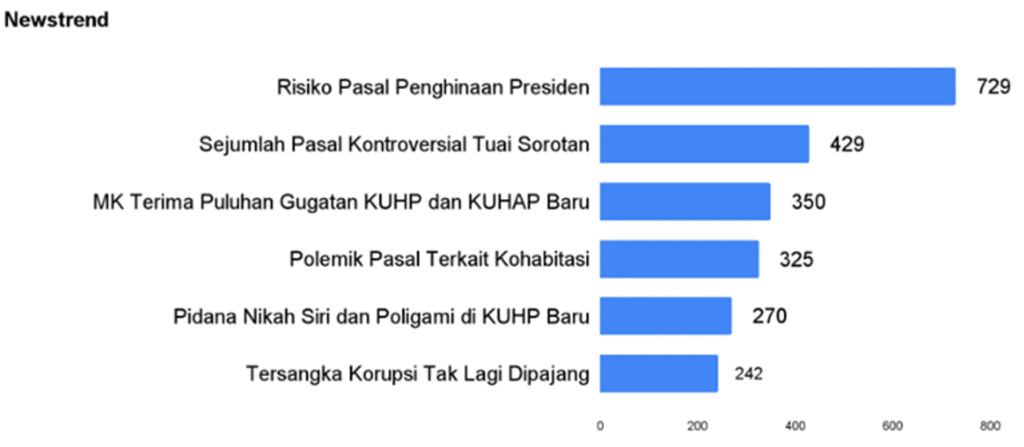
“This reflects the principle of balance in journalism. When the executive and legislature are seen as producing a problematic legal product, public hope shifts to the judiciary (the Constitutional Court). Especially since Deputy Minister of Law Edwar Omar Sharif said we should just follow the process at the Constitutional Court—this is how the government responds to media framing,” said Nicko Mardiansyah, Manager of Binokular News Big Data Analytics.
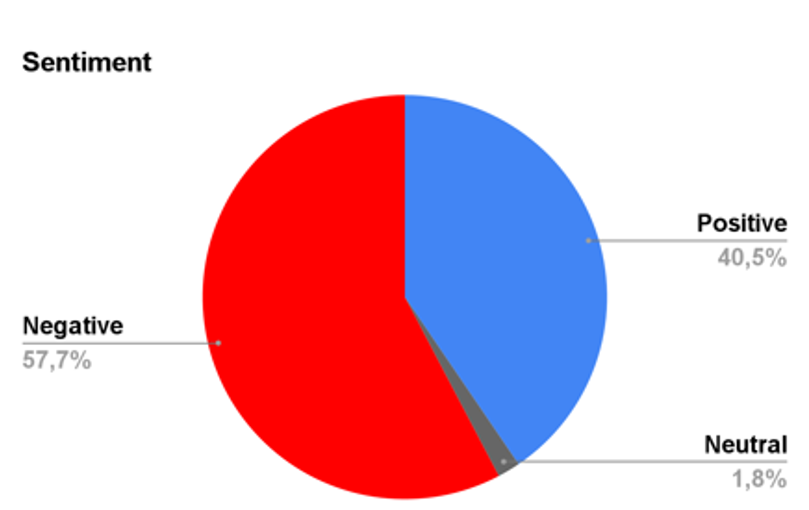
Based on sentiment analysis, Nicko said mainstream-media exposure was dominated by negative sentiment (57.7%), followed by positive sentiment (40.5%) and neutral (1.8%). Negative sentiment mainly reflected three concerns: (1) uncertainty and multi-interpretation of sensitive articles, (2) fear of restrictions on civil liberties, and (3) questions about the readiness of infrastructure and law enforcement to implement the new legal codes.
Nicko added that the dominance of negative framing aligns with negativity bias in journalism. “Media naturally pay more attention to conflict, problems, and things that do not go according to plan because they are seen as more attention-grabbing,” Nicko said.
More importantly, he continued, the findings indicate a real information gap between the government and the public: “Meaning, official government explanations are still considered insufficient to answer substantive public anxieties,” Nicko emphasized.
Amid the wave of concerns, a parallel narrative of legitimization and rationalization emerged from the government regarding the new policies. Recorded quotations show different government communication strategies.
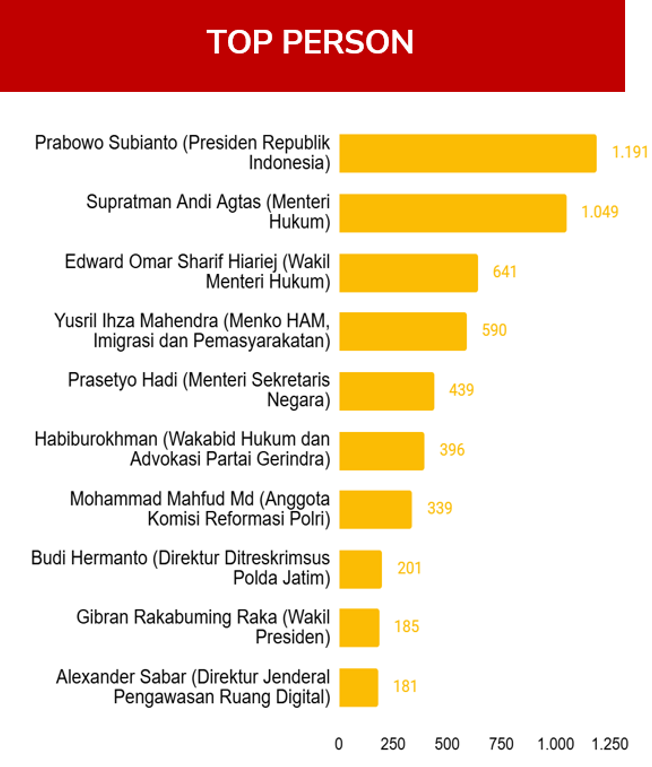
The government dominated public communication on the new KUHP and KUHAP. Socialization and intensive explanations were delivered to address public scrutiny. On the President/Vice President insult provisions, the government sought to calm fears of authoritarian drift by emphasizing procedural safeguards.
A more philosophical narrative also appeared: that the new KUHP aims to balance protection of freedom of expression with public interest, ensuring punishment is applied proportionally. In this framing, law is presented as a scale that must remain balanced—an attempt to weave harmony between individual rights and collective demands.
Yet beyond the measured official narrative, there remains room for doubt and an unfinished process. The constitutional space for judicial review underscores that the new KUHP–KUHAP should not be treated as dead dogma, but as something living—open to reinterpretation by the Constitutional Court (MK).
A deeper network analysis of the coverage shows a discourse ecosystem that is centralized and hierarchical. The Government of Indonesia—particularly the Ministry of Law and Human Rights—became the central node connecting multiple actors: the executive, the legislature, law enforcement, and the judiciary. The structure resembles a large tree with deep roots and intertwined branches, suggesting the KUHP issue is not merely technical legal debate.
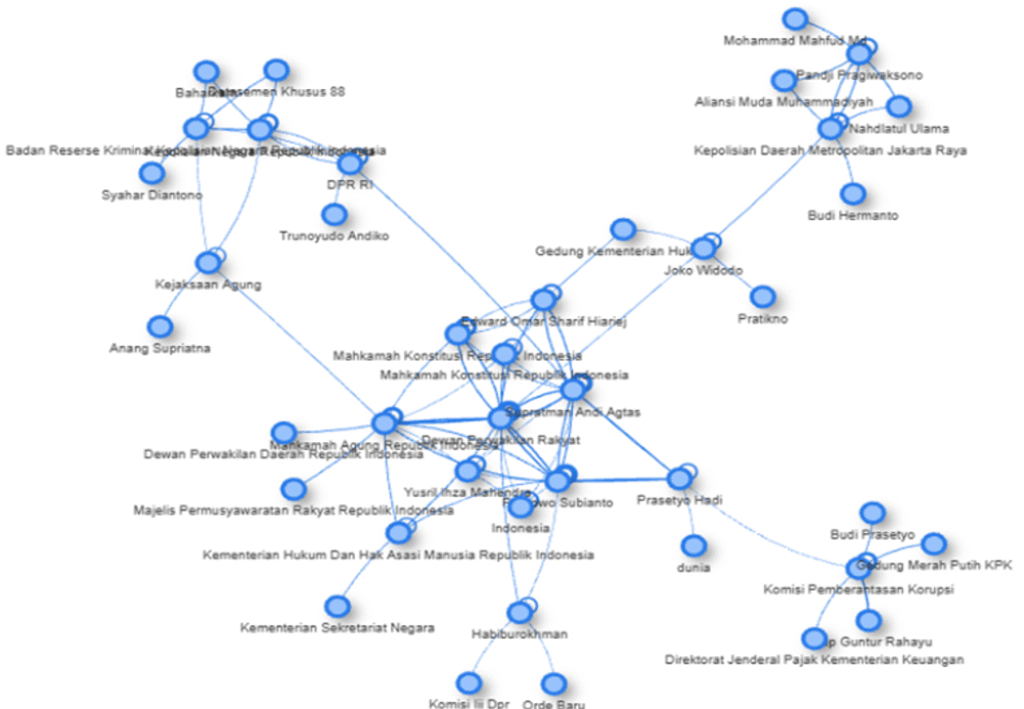
The dominant pattern is top-down: a narrative flow from high-level legitimation, down to legislative oversight, and then into implementation by law enforcement. It is a strong framing environment where the government acts as the primary source defining legal reality.
Interestingly, within this complex network, no truly separate and independent opposition cluster appears. Most conversation—despite criticisms and anxieties—remains within the same discourse universe, still connected to power nodes. This echoes philosopher Jürgen Habermas’ concept of the “public sphere,” where the ideal is free and equal debate among rational citizens. In this analysis, the state’s dominant narrative remains strong, while critical voices—though present—still orbit within the discourse boundaries already set.
Moving from mainstream media to the digital sphere reveals a more fluid, personal, and emotional landscape. Criminal-law reform is complex—legal in nature, but also socio-political. As a result, social-media discussion grows less like an orderly tree and more like dense brush that is difficult to map neatly. During the same period, 95,684 conversations were recorded, with total buzz reaching 6,147,205 engagements.
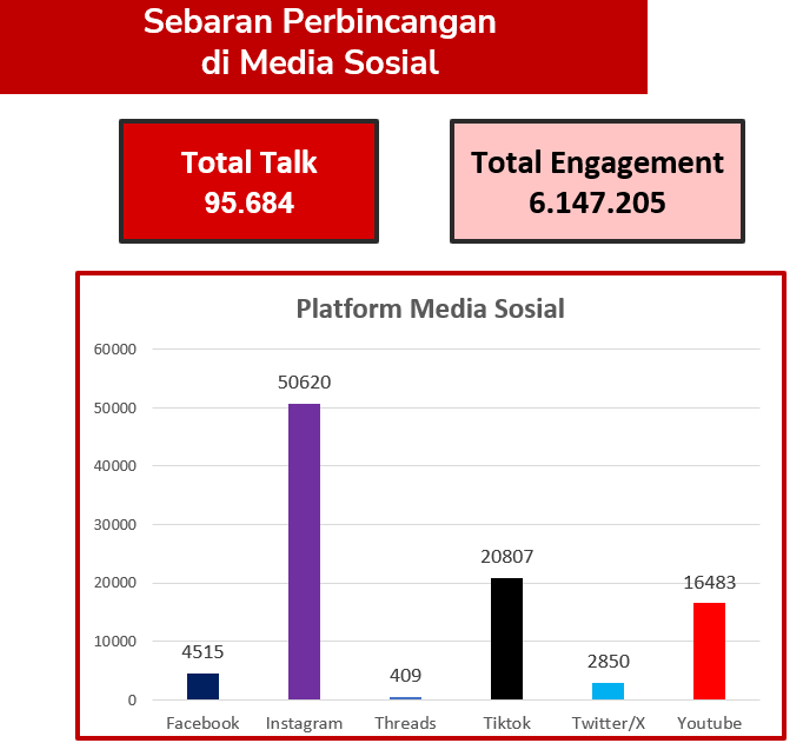
Binokular’s Social Media Big Data Analytics (Socindex) Manager, Danu Setio Wihananto, said these figures show how law has become an everyday issue—touched, discussed, and debated by netizens.
“Instagram, TikTok, and YouTube have become new digital channels where people speak not through long written posts, but via short comments, short videos, and memes—often loaded with irony and sarcasm,” Danu said.
Based on conversation context, Danu explained that discussion was dominated by comments responding to posts from media outlets or public figures—indicating a “trigger content” pattern rather than long, self-initiated debates.
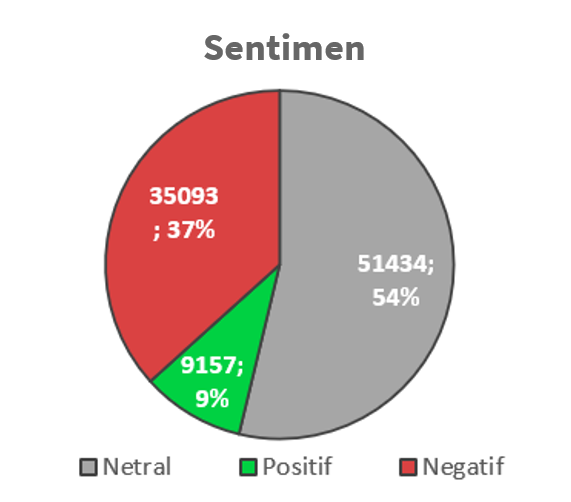
Danu noted that sentiment on social media was more diverse and fluid: 54% neutral, 37% negative, and only 9% positive. The “neutral” category is particularly notable because it can include factual questions and content-sharing without commentary.
“This is interesting because it can range from simply sharing factual information to skeptical comments that have not yet become open rejection. In other words, high neutrality may reflect public confusion about the complexity of the new KUHP, while only 9% positive indicates that the official optimism narrative has not been widely adopted by everyday netizens,” Danu said.
This space was filled with netizens’ interpretations of articles seen as open to multiple meanings—especially those related to insulting the President, the Vice President, and state institutions. Concerns about limiting freedom of expression and potential misuse of power echoed strongly, creating an undercurrent of fear that is subtle but real. Netizens appeared to be “playing with fire,” trying to understand new boundaries of what can and cannot be said.
One name emerged as a symbol of this collective anxiety: Pandji Pragiwaksono. The possibility that he could be processed under the new KUHP triggered the largest volume of discussion—turning him into a concrete narrative symbol of public fear that criticism, satire, and creative expression could be criminalized. As a vocal and critical public figure, Pandji became a personification of the risks faced by ordinary citizens. This is an example of how abstract legal issues become personal and emotional on social media.
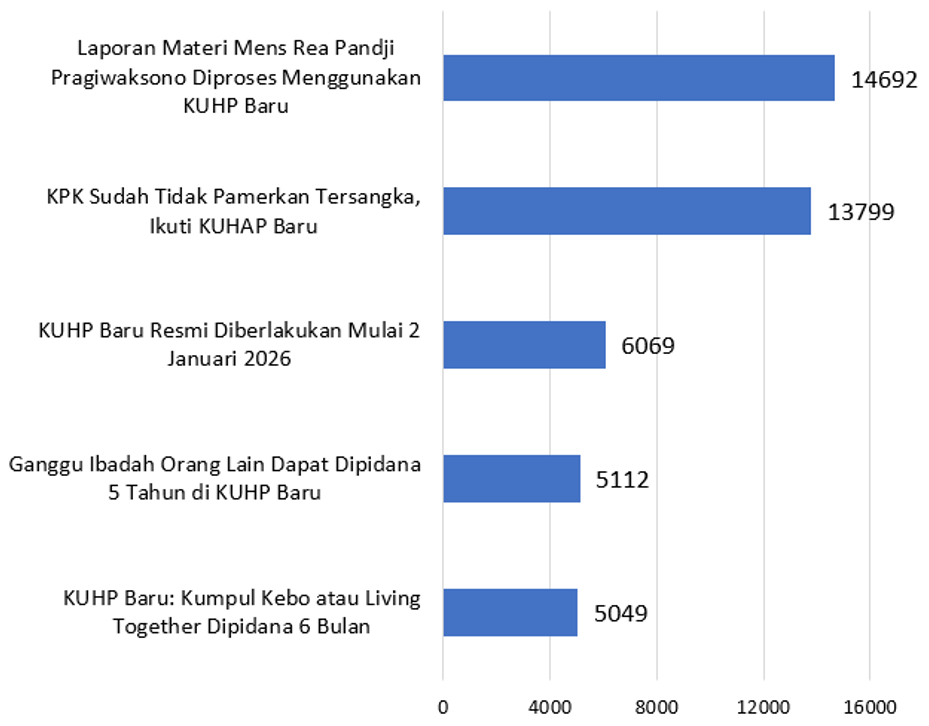
On the other side of the spectrum, the KPK’s decision to stop publicly displaying suspects—framed as an adjustment to the new KUHAP—revived a classic debate: protecting human rights and the presumption of innocence versus transparency and deterrence in anti-corruption enforcement. The debate reflects a core dilemma in legal systems: balancing the rights of accused individuals with the public’s right to know and a collective sense of justice.
Articles touching the most intimate private and social spheres—such as criminalization of disrupting worship and rules on cohabitation outside marriage—also drew heavy debate. These issues directly touch daily life, religious belief, social norms, and boundaries of personal space. Discussions carried moral, cultural, and religious weight, showing that the new KUHP does not merely regulate crimes, but also intersects with living social norms.
Looking deeper, popular positive-neutral posts tended to highlight the implementation of the new KUHP–KUHAP by emphasizing articles perceived to have direct impact on people’s lives. Circulating content often focused on restrictions on non-marital relationships, threats of criminal penalties for private behavior, and potential imprisonment linked to morality provisions and disruption of worship.
The first two weeks of the new KUHP–KUHAP created a complex and dynamic public-discourse landscape. Mainstream media acted as a critical watchdog, while social media became a deliberative arena where the public actively explored, debated, and articulated concerns about the implications of the new legal regime.
Commenting on the findings, Ridho Marpaung, Vice President of Operations at Binokular Big Data Analytics, said that although critical conversation on social media was high, it had not yet formed a solid opposition cluster. “This shows that legal awareness and willingness to participate in legal discourse are quite high. People are still searching for and digging into information about the new KUHP–KUHAP compared to the previous regime,” Ridho said.
Ridho added that the government’s frequently stated commitment to accept public input is an important marker: successful integration of the new KUHP–KUHAP into national life depends not only on firm enforcement, but also on the state’s willingness to absorb, respond to, and accommodate public aspirations—both in mainstream media and digital space.
The next challenge, Ridho continued, is narrowing the gap between the legal text, the drafters’ intent, and public understanding and acceptance. Media should not only report controversies but also explain the complexity. Civil society, academics, and practitioners can help translate complex legal language into information digestible for the general public. “The enactment of the new KUHP and KUHAP is the beginning of a milestone for independence, reform, and enforcement of Indonesia’s legal system—adjusted to today’s developments—so that criminal-law provisions can function well in society,” Ridho concluded.

Most positive news coverage: Kemenag, Kemenkeu and Kemendagri in the news media, and Kemensos, BGN and Kemenkeu on social media….

binomedia

Jakarta — Throughout June 2026, Jakarta became the center of a wave of student demonstrations held at several strategic locations,…
binomedia

Jakarta — The Work from Home (WFH) policy for Indonesian civil servants (ASN) every Friday has triggered the strongest wave…
binomedia

Jakarta — The roar of supporters has not yet fully echoed through Gelora Bung Karno Main Stadium (SUGBK), but the…
binomedia

Jakarta — Although Indonesia ultimately conceded to Saudi Arabia 2‑3 in the Group B fourth‑round Asian qualifiers at King Abdullah Sports City Stadium, Jeddah,…
binomedia

Jakarta — In the two weeks from 24 September to 7 October 2025, the Indonesian National Football Team became the nation’s sole focus. Ahead…
binomedia

Jakarta — In the vibrant celebration of Indonesia’s 80th Independence Day, the nation stands at the crossroads of history and…
binomedia